Rethinking speech goals: Communication that truly supports autistic kids
Speech therapist and AuDHDer Adina Levy challenges us to rethink communication goals for neurodivergent kids. Why are we prioritising "normal-looking" speech over authentic connection? Learn how to spot compliance-focused goals, what questions to ask your child's team, and discover the beautiful story of a child who created her own communication tool when she didn't feel like talking.
In short
Speech is one way to communicate, not the best way. Goals that reward sitting still, eye contact or mouth words often chase compliance, not connection. Ask what each goal is really for. Ask whether the same learning could happen another way. Affirming support offers choice and values every form your child uses.
Your child's speech therapy report arrives with a list of goals. "Billy will sit at the table for 10 minutes." "Sophie will use verbal requests instead of pointing." As you read them, something feels off, but you cannot quite name it. What if these well-intentioned goals are actually working against your child's communication?
In Episode 14 of the Neurodivergent Pulse podcast, host Laetitia Andrac speaks with Adina Levy, a proud AuDHDer, speech therapist, professional educator, and founder of Play. Learn. Chat. Together, they unpack why traditional speech goals often miss the mark, and what truly affirming communication support looks like in practice.
Why "speech" goals miss the mark
The very term "speech therapist" or "speech pathologist" is part of the problem. Having "speech" in the professional title prioritises mouth words as the best or primary form of communication. But speech is just one way humans connect and express themselves.
The truth is speech is such a small narrow part of what we should be doing in our role but the fact that the word speech is in our title is actually part of the problem because it's saying it's prioritizing speech as in mouth words as in the words that my mouth is forming and speaking as maybe equal or the best version of communication which is wrong.
Adina advocates for a shift in how we think about the profession entirely, suggesting titles like "communication connection facilitator" would better reflect the role's true scope. When families come to professionals saying "we need speech," what they actually need is communication support in whatever form works best for that individual.
Even Adina, a self-described "very chatty speech therapist," experiences times when speaking is not possible. "I have many hours of the day and week where I shut down and like 95% of my being does not want to speak," she shares. "To push myself to speak at that point is pushing myself to my edge and therefore reducing my capability to live, exist, interact, be okay, have wellbeing."
This insight highlights a crucial truth: speech may not be the best form of communication for someone in a particular moment, or at any moment. Reasons can include physiological factors, sensory preferences, skill differences, or difficulties with motor planning where the body does not reliably do what the brain intends.
The problem with compliance-based goals
Too often, goals for neurodivergent children focus on changing how they communicate to meet neurotypical expectations. Adina describes these as being about "prioritizing how normal they look or how comfortable the communication partner is."
Compliance goals are particularly problematic. These are goals where the aim seems to be getting a child to simply do what an adult tells them, rather than supporting genuine communication and learning.
Consider this example Adina shares: "The goal is for Billy to sit at the table for 10 minutes at a time twice each session." What is the actual point of this goal? If Billy finds sitting at a table difficult, that is a clue, not a problem to fix through compliance.
"The point is not for Billy to sit at a table," Adina explains. "The point might be for Billy to learn different colour words, but there's a hundred ways to do that. You don't have to do it with a boring worksheet."
Here is how to spot the difference:
- Compliance-focused goals prioritise following instructions, sitting still, making eye contact, or using speech when other communication would work
- Communication-focused goals prioritise the child's ability to express themselves, be understood, and connect with others in whatever way works for them
This does not mean throwing out all expectations. Adina gives the example of working with her two-year-old to respond to "stop" near roads. That is a safety goal with clear purpose. The difference is questioning whether each goal truly serves the child's wellbeing and growth, or simply their conformity.
Questions to ask about your child's goals
How do you evaluate whether a goal is genuinely supportive? Adina encourages everyone to question any goal or intention, whether written on a formal plan or simply held in your mind.
"Is it coming from a place of trying to have that child feel most supported, most comfortable, most self-aware?" she asks. "Or is it coming from a place of I want you to fit in? Is it coming from a place of this is how it was always done?"
Key questions to consider when reviewing goals:
- Is this a reasonable expectation for this child in this moment?
- Does this goal account for fluctuating capacity? (What a child could do yesterday, they may not be able to do today)
- Is this about the child's comfort and communication needs, or about making them appear more "normal"?
- What is the actual learning objective behind this goal?
- Could this objective be achieved in a way that works with, rather than against, the child's preferences and needs?
Adina emphasises that neurodiversity-affirming practice "doesn't mean we're saying yes or being permissive to everything. It is coming back to a position of first trying to honor and understand what does an individual want and need and then questioning our expectations of them as well."
For parents wanting a structured framework, Adina offers a free resource called "How Neurodiversity Affirming Is Your Child's Team?" available at playlearnchat.com/freebies. This checklist uses a green, orange, and red light system to help you evaluate whether your child's support team is truly affirming.
Pip remembers the appointments, the notes and the small wins, so you don't have to.
7 days free.
What affirming communication support looks like in practice
Laetitia shares how she recognised an affirming therapist within seconds of their first meeting: "As soon as they arrived and they opened the door, straight away they asked, 'Zoe, how would you like where would you like the session to be?' And I was like, 'Tick.' Because sitting at the table and doing the exercise on a boring worksheet is not the way she is going to learn anything during that session."
This simple act of giving the child choice demonstrates a fundamental shift in approach. The therapist recognises that where learning happens matters less than whether learning happens, and that children often know what works best for their own bodies and brains.
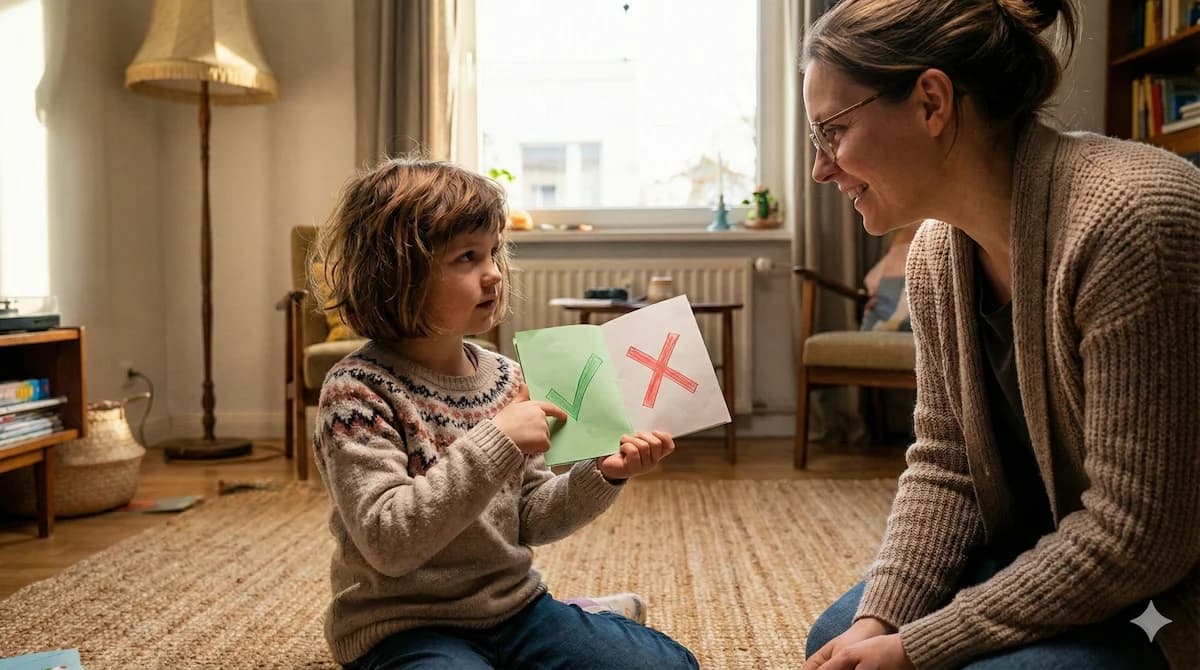
But perhaps the most powerful example comes from Adina's own family. Her daughter Zoe came home from school one day with a piece of paper she had made herself: "yes" with a tick on one side, and "no" with a cross on the other.
"She explained that that morning she just didn't feel like talking," Adina shares. "So she made that for herself. She literally made herself a low tech AAC board with a yes and a no so that she could point to the one that she wanted to show her friends so she could communicate with them."
I love the innocence and the amazing like simplicity of kids to just be able to go like you know there's no shame there's no stigma there's not it's just I didn't feel like talking right then I found another way. How beautiful is that?
Zoe had not been explicitly taught to make this tool. But she had seen various forms of AAC modelled over the years, and she felt safe enough to create her own solution without shame or hesitation. She even advocated for herself with her friends, showing them that sometimes she does not want to speak, and she can still join in another way.
This is the outcome of modelling diverse communication methods and creating environments where all forms of expression are valued. Children learn to advocate for their own needs naturally.
A call for systemic change
While individual families and therapists can make significant shifts, Adina also calls for broader systemic change. She expresses frustration with professional bodies, including Speech Pathology Australia, for what she sees as a gap between stated values and actual practice.
"They are excellent at talking the talk and doing absolutely nothing to reflect the commitments and the values that they claim to uphold," she says. From inaccessible conferences to podcast transcripts that require emailing and waiting days to receive, the barriers continue.
Yet Adina holds onto hope, referencing the song "A Change is Gonna Come." Things are shifting in the right direction, even if progress feels painfully slow.
For those with capacity, she encourages advocacy: writing emails, calling out insufficient practices, and standing up for change. And for allies who do not identify as neurodivergent or disabled, the invitation is clear: "Just be an ally and call out when something is not good enough and save some spoons for us."
Moving forward
All communication is valid. Whether through speech, gestures, AAC devices, written words, or a hand-drawn yes/no card, what matters is that individuals can express themselves and be understood.
If you are a parent preparing for a goal review, consider bringing these questions to the conversation. If something feels off about a goal, trust that instinct and ask why it exists. And if you discover your child's team is already doing affirming work, let them know you notice and appreciate it.
For families juggling therapy goals, reports, and observations from multiple professionals, Understanding Zoe can help you track insights and coordinate care across your support team, so important details don't slip through the cracks.
Because every child deserves communication support that sees them fully, honours their autonomy, and celebrates all the ways they connect with the world.
Connect with Adina Levy
- Website: Play. Learn. Chat. | Differently Aligned
- Free resources: playlearnchat.com/freebies
- Podcasts: Exploring Neurodiversity | Differently Aligned
- Instagram: @play.learn.chat | @differently.aligned
Pip is not a doctor or therapist. It helps you organise and prepare, not diagnose or treat.
In a crisis call 000. Lifeline 13 11 14. Kids Helpline 1800 55 1800. 13YARN 13 92 76.

Ready to put it all in one calm place?
Tell Pip one thing today. It remembers the rest.
Stored in Australia, encrypted. Cancel before day 8 and you won't be charged.
Related articles

Communication breakdown: How visual supports ease executive overload
Why do visual supports work when words fail? In this Neurodivergent Pulse episode, speech pathologist Jenn Winstone and behaviour support practitioner Jess Shahbazi explain executive functioning overload as a capacity issue, not a behaviour problem. They share how visuals create "anchors for emotional security" that help neurodivergent children understand, transition, and thrive. Includes practical strategies and a moving hospital story.
Read more
Beyond words: How to honour all types of communication
Communication extends far beyond spoken words. Speech therapist Christina Schmidt explores the full spectrum of human expression, from gestures and movement to silence and art,and shares practical strategies for parents and educators to recognise and honour how their neurodivergent child already communicates. Discover why we unconsciously prioritise speech, how to slow down and notice micro-moments of communication, and why treating communication as a human right transforms families and systems.
Read more
Every behaviour is communication: co-regulation guide
When a neurodivergent child is dysregulated, their frontal lobe is offline, making words inaccessible. This article, based on Episode 37 of the Neurodivergent Pulse podcast with speech pathologist Alana Cameron, reframes behaviour as communication and shows parents and educators how co-regulation actually works. Learn why "use your words" deepens dysregulation, how to recognise your own nervous system cues, and what neuroaffirming support looks like in practice, from meltdowns to classrooms.
Read more