Why affirming swimming lessons save lives: making aquatics safe for all
Autistic children are 160x more likely to drown, yet 91% of families leave aquatic services dissatisfied. Antoinette Spear of Autism Swim shares how to find truly inclusive swimming providers, why inclusion looks different for every child, and why water should be a place of belonging, not fear. Essential listening for parents, educators, and policymakers.
In short
Autistic children face a much higher drowning risk. Most families find swim programmes do not suit them. Inclusion is not only one to one lessons. Parallel classes and supported small groups work too. Look for an inclusion statement, social stories, poolside visuals and early notice of changes.
Autistic children are 160 times more likely to drown than their typically developing peers. It's a confronting reality. But what if the answer isn't just more supervision or more fear? What if we could create aquatic spaces where neurodivergent children don't just survive, but thrive?
In this episode of Neurodivergent Pulse, host Laetitia Andrac sits down with Antoinette Spear, General Manager of Autism Swim, to explore how we can transform swimming from a space of exclusion into one of confidence, belonging, and life-saving skill.
Antoinette brings a unique perspective to this conversation. Beyond her professional role leading an award-winning international charity, she's a parent of two neurodivergent children who has experienced firsthand how traditional aquatic programs often leave families behind.
"I have just always been one of those people that has just been so passionate about creating spaces where everyone can feel like they belong," Antoinette shares. "Through my life journey and my parenting journey... this world of inclusion means so much more to me personally now than it ever has in my whole life."
The hidden crisis in our pools
The statistics around water safety for autistic children are stark. Drowning is the leading cause of death for autistic children under the age of 14. Beyond the 160 times increased risk, Antoinette explains the factors that contribute to this crisis.
"Over 50% of children on the autism spectrum do have a propensity to wander and it's often towards bodies of water," she notes. This wandering tendency is often driven by sensory seeking or sensory avoiding behaviours. Add to this that some children may lack danger perception, and the need for effective water safety education becomes urgent.
Yet when families do seek support, they often come away disappointed. Autism Swim's own surveys reveal that over 91% of families within their networks have left aquatic services feeling dissatisfied with what's available to them.
This isn't something that supervision alone can address. It requires a fundamentally different approach.
Rethinking what inclusion actually looks like
One of the most valuable insights Antoinette shares is her challenge to a common misconception about inclusive swimming lessons.
"There's this misconception that if there is a neurodivergent child who has specific support requirements, they automatically should be accessing one-on-one or specialist provider services," she explains. "We're here to dispel this myth that inclusion looks like one offering and one offering only. Inclusion can look like lots of things."
Antoinette outlines three different models that can work:
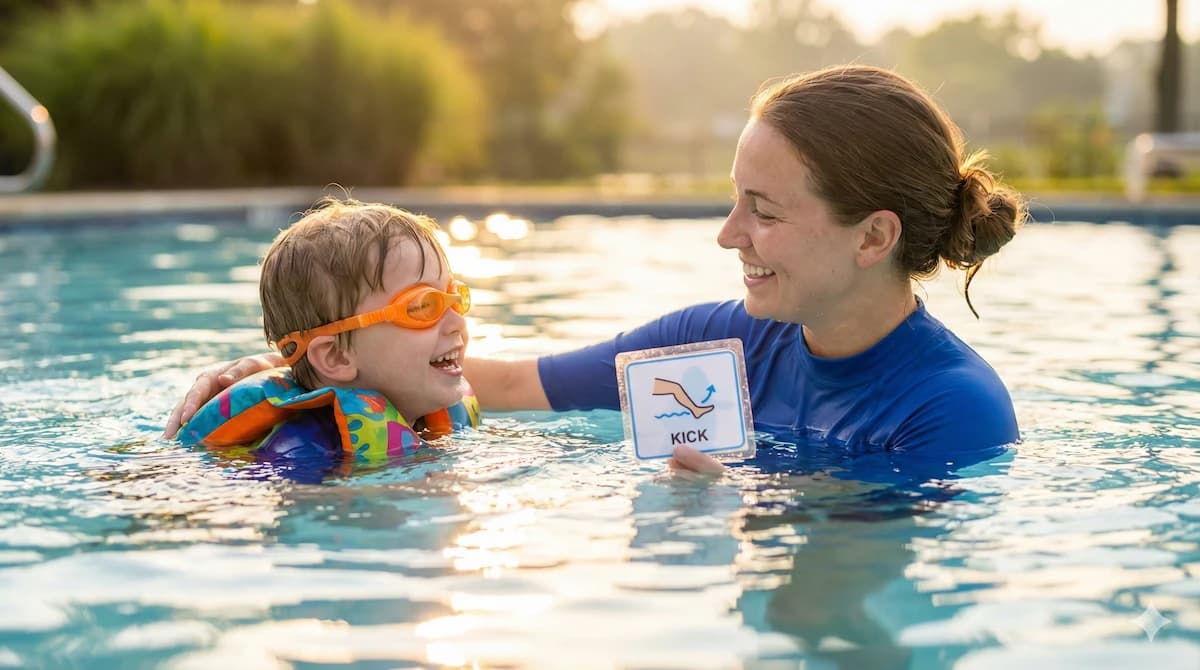
One-on-one sessions can be highly effective when done well. A good one-on-one experience might include using visual aids, understanding the sensory profile of the swimmer, and knowing whether a swimmer is sensory seeking or sensory avoiding, along with strategies to support them effectively.
Parallel classes offer another option. This might look like a neurodivergent swimmer participating in a class that runs alongside a mainstream offering, swimming in a lane next to other classes.
Small group classes with additional supports can benefit everyone. These might include an additional instructor or frameworks that meet the needs of neurodivergent participants while supporting the entire group.
The crucial point here is that exclusion often happens not through intention, but through design.
Neurodivergent children are often left out of mainstream programs like learning how to swim. Not always by intention, but just by design and how it's been designed and the offerings that have been available to them.
When swim centres look at a child's behaviour before looking at their strengths, interests, and abilities, exclusion happens before the child even walks through the door.
What to look for in an inclusive swimming provider
If you want to ensure you choose the right swimming provider for your child, here are a few suggestions to help you:
Start with the website. Look for a clear inclusion statement and an indication of the provider's commitment to accessibility. Providers who have completed Autism Swim's neurodiversity and aquatic certification will display an "Autism Swim approved" badge.
Look for pre-experience resources. Does the website offer social stories or visual guides that explain what a swimming lesson looks like? These resources benefit everyone, including culturally and linguistically diverse families who may appreciate seeing visuals of the centre's front door, change room locations, and what to expect.
Pay attention to how they enrol you. Instead of forcing families to squeeze their child's strengths and support needs into a medical notes section, inclusive providers ask questions like: What does a great session look like? What does success look like? What are your goals?
Watch for visual aids during lessons. Inclusive instructors might have a whiteboard poolside or laminated cards that help structure the lesson visually.
Notice how changes are communicated. This is often overlooked, but it matters enormously. If an instructor will be away for upcoming weeks, does the provider let families know in advance?
This challenge of managing transitions and unexpected changes is something many neurodivergent families face daily, across countless settings. Having your child's needs, triggers, and strengths clearly documented makes it easier to share this crucial information with new providers, whether that's a swim instructor, teacher, or therapist.
Pip remembers the appointments, the notes and the small wins, so you don't have to.
7 days free.
It is not just about safety in the water
While drowning prevention is crucial, Antoinette's vision extends far beyond survival. She wants neurodivergent people to fully participate in aquatic activities, not just tolerate them.
"The water shouldn't be treated as an environment, as something that is so dangerous that we can't... you need to be supervised 100% of the time and wrapped up in cotton wool," she says. "We need to have that dignity and risk-taking as well and being able to enjoy every part of our community."
This is particularly significant in Australia, where life often centres around water. "We're a warm country for most of the time," Antoinette notes. "We spend our time outdoors... and open bodies of water being an island means that a lot of our populations live near coastlines or have access to rivers and open bodies of water."
The goal isn't just safety. It's ensuring neurodivergent people can experience the same access to community life that everyone else enjoys.
We also would love a world where aquatics and water is a place not to fear or not to feel excluded from but rather a place to belong. It's about opening up different parts of our community and not only keeping our neurodivergent community safe but also welcomed and included.
A call for systemic change
Antoinette doesn't shy away from advocating for policy change. Her frustration with the current system is clear.
"The leading cause of death for autistic or children on the autism spectrum under the age of 14 is drowning. Yet we have got absolutely zero clarity around what support in aquatic environments could and should look like from a policy perspective and from a framework perspective."
She points to the lack of national consistency in education standards around water safety for neurodivergent children. She also challenges the tendency of support agencies like the NDIS to position swimming as purely "parental responsibility."
"I get so frustrated because yes, it's my job to do that, but it's also my job to make sure that my child is thriving in an environment. And if environments aren't built for them in mind, then we're at a stalemate here."
The message to policymakers, charities, associations, and governments is clear: take the drowning statistic seriously and create the frameworks that will keep neurodivergent children safe.
Finding your why
When asked what drives her personally, Antoinette's answer reveals the heart behind her work.
"We're on this earth for a short time and a good time. So, let's leave an impact and let's leave a legacy and leave it in a place that is better than how you found it."
Her commitment to inclusion runs deep, rooted in childhood empathy that still shapes her today.
"I have vivid childhood memories of needing to play with every doll because I was worried that my dolls would feel left out if they weren't all played with in the same equal way," she shares. "I think that's part of my nature... that empathy but also that adaptability and ensuring that everyone experiences things and can be understood just as much."
Taking the next step
If you're a parent navigating the aquatic world with a neurodivergent child, you're not alone. Here are some places to start:
Ask providers the questions Antoinette suggests: What does a great session look like? What does success mean for my child?
And remember that inclusion can look different for different children. That's not a limitation; it's an acknowledgement that every child deserves an approach that meets them where they are.
For those supporting neurodivergent families, whether as educators, therapists, or swim instructors, consider what small changes might open your doors a little wider. As Antoinette says, "We can't be everything to everyone and that's okay. But there are small actionable steps that every aquatic service provider can take."
Water doesn't have to be a source of fear. With the right support, it can be a place of belonging, confidence, and joy.
This article was inspired by Episode 5 of Neurodivergent Pulse, featuring Antoinette Spear of Autism Swim in conversation with Laetitia Andrac.
Pip is not a doctor or therapist. It helps you organise and prepare, not diagnose or treat.
In a crisis call 000. Lifeline 13 11 14. Kids Helpline 1800 55 1800. 13YARN 13 92 76.

Ready to put it all in one calm place?
Tell Pip one thing today. It remembers the rest.
Stored in Australia, encrypted. Cancel before day 8 and you won't be charged.
Related articles

Where is the village? Building neurodivergent community
Neurodivergent families experience isolation at twice the rate of neurotypical families, not because they can't cope, but because most spaces were never designed for them. In this episode, Laetitia Andrac (co-founder of Understanding Zoe) explores what real community looks like for neurodivergent people and families. She shares practical strategies for creating sensory-friendly, inclusive gatherings where everyone genuinely feels welcome, and explains how to build your village deliberately, right where you are.
Read more
Breaking down barriers: Overcoming neurodiversity bias
Neurodivergent people and their families meet a system that was not built for them. Assessment waits stretch on. Schools and workplaces still exclude. Behind it sits neurodiversity bias, the snap judgement that reads difference as a problem. Research shows people make that judgement in seconds, from style rather than substance. The Australian numbers point at the system, not the people.
Read more
The 5 things your neurodivergent child actually needs
Understanding your neurodivergent child's needs can be life-changing. Instead of forcing them to conform to "neurotypical" standards, it's important to acknowledge their unique qualities and support them in a way that helps them flourish. Here's what your neurodivergent child actually needs
Read more