Why affirming swimming lessons save lives: making aquatics safe for all with Antoinette Spear
Hosted by
Laetitia Andrac
Host of The Neurodivergent Pulse, CEO and co-founder of Understanding Zoe, and a neurodivergent parent.
With
Antoinette Spear
The Neurodivergent Pulse is Understanding Zoe's podcast for families raising neurodivergent children in Australia. Hosted by Laetitia Andrac, each episode is an honest conversation about autism, ADHD and everyday family life. In this episode, "Why affirming swimming lessons save lives: making aquatics safe for all with Antoinette Spear", you'll hear practical, neuroaffirming ideas you can use today.
Key takeaways
- Exclusion is often unintentional, but built into the design of swim programs.
- There’s no one-size-fits-all model.
- Parents should look for swim providers who communicate clearly, ask strengths-based questions, and share upcoming changes in advance.
- Water can be a place of safety, confidence, and joy, not fear. With the right support, every child deserves the chance to belong in the water.
Watch this episode
Prefer audio? Listen on Spotify
Loading the player...
Chapters
Show notes
How can we create an affirming and safe space by the pool for our neurodivergent children? Antoinette Spear, General Manager of Autism Swim, a global charity committed to making aquatic environments safer and more inclusive for neurodivergent people, is here to tell us.
We talk about the shocking statistics around water safety for autistic children, and how Autism Swim is tackling this crisis by empowering swim centres, educators, and families with neuroaffirming tools and knowledge.
Antoinette shares both her professional expertise and personal experience as a parent of neurodivergent children, offering practical, compassionate insight into what inclusive aquatic support can (and should) look like.
Whether you’re a parent, swim teacher, therapist or policymaker, this conversation is essential listening.
✨ Try Understanding Zoe free for 7 days – the neuroaffirming app turning every report, observation and meltdown into an actionable next step.
About the guest
Antoinette Spear is the General Manager of Autism Swim, an award-winning, international Australian charity and global leader in neurodiversity and aquatics. She brings a unique combination of lived experience as a parent of neurodivergent children and a professional background in financial services and tech startups.
Antoinette leads Autism Swim’s mission to reduce the disproportionate drowning statistics among neurodivergent people and ensure all aquatic spaces are safe, welcoming, and affirming.
🌊 Find an Autism Swim approved provider
💙 Donate to Autism Swim
📲 Free Water Safety App (iOS)
📚 Become an Approved Provider
📸 Follow @autismswim on Instagram
About the host
Laetitia Andrac (Autistic & ADHDer) is an award-winning entrepreneur, international speaker, and podcast host.
She is the bestselling author of Light It: How to Trust Your Intuition and Build a Thriving Business. With over 15 years of experience in consulting, strategy, and innovation, Laetitia has worked with industry leaders like Deloitte and Telstra.
Inspired by my journey as a neurodivergent parent, she co-founded Understanding Zoe, an AI-driven solution dedicated to supporting caregivers of neurodivergent children.
Her passion is creating a more neuroinclusive world, where everyone can thrive—whether in their homes, communities, or workplaces.
Frequently asked questions
Why are autistic children more likely to drown?
Autistic children are 160 times more likely to drown than typically developing peers. Over half also tend to wander, often toward water. This can come from sensory seeking or avoiding, such as escaping a loud noise. Some children also have less awareness of danger. This can lead them into unsafe places like backyard pools.
What should parents look for in a swim provider?
Look for a clear website that explains the service. It should share an inclusion statement and social stories about lessons. Autism Swim approved providers display a badge showing they have completed inclusive training. A good provider will ask about your child's strengths and goals. This should happen instead of asking only for medical details. They will also use visuals during lessons.
What is Autism Swim's Dippers program?
Dippers is a modified version of Nippers, the Australian beach safety program. It is a small group offering led by clinicians. This might be an occupational therapist or behaviour support practitioner. Dippers meets participants where they are at. It builds safety and confidence, not just swimming skills. This helps the water feel like a place to belong.
Should neurodivergent children always have one on one swimming lessons?
Not always. One to one lessons can work well. These use visual aids and understand a child's sensory profile. Inclusion can also look like parallel classes alongside a mainstream group. Or it could be a small class with extra instructors and support. There is no single model, and swim providers should offer more than one option.
What are the benefits of swimming beyond safety?
Learning to swim is not just about safety. Water can be a place of confidence, joy and belonging rather than fear or exclusion. In Australia, many people live near the coast or open water. Being able to swim lets children take part fully in outdoor life. Antoinette talks about dignity and risk taking, rather than being wrapped in cotton wool.
Transcript
Read the transcriptAbout 18 min read
Laetitia: Welcome to The Neurodivergent Pulse where we explore the often misunderstood world of neurodivergence with experts, parents, teachers, and therapists. Grounded in lived experience, each bite-sized episode gives you something practical to try. I am your host Laetitia Andrac, AI expert, neurodivergent mum and founder of Understanding Zoe. This podcast is recorded on Dharawal country. I acknowledge that sovereignty was never ceded. It always was and always will be Aboriginal land.
Laetitia: Hello Antoinette. Welcome to The Neurodivergent Pulse.
Antoinette: Thank you so much for having me. I mean, thrilled to be here.
Laetitia: It is such an honour to have you being able to share your story. So, before we dive deeper into safe swimming, into how to make it safe for our neurodivergent children to learn how to swim. Can you share a bit more about yourself and what led you to this space?
Antoinette: Yeah, thank you. To start off, I have just always been one of those people that has just been so passionate about creating spaces where everyone can feel like they belong. Through my life journey and my parenting journey, I am now a proud parent of two neurodivergent children. I have three children, but two have recently gone down their individual paths of getting their diagnosis. So, this world of inclusion means so much more to me personally now than it ever has in my whole life.
Antoinette: I've experienced firsthand how neurodivergent children are often left out of mainstream programs like learning how to swim or hitting mainstream goals and milestones like their typically developing peers. Not always by intention but just by design and how it's been designed and the offerings that have been, you know, available to them throughout their life and their journeys.
Antoinette: So when this role at Autism Swim came about for being a general manager, it just had my name all over it. We share the same, as Autism Swim, share the same initial. So I like to think that it's destiny, but rather it is just given me this incredible platform to weave in both my professional experience but lived experience and passion and to leave a legacy into a world that I am so passionate about as well.
Laetitia: I love that. And I never realised that Autism Swim as goes with Antoinette for sure. So, for anyone who's listening to this and may not be familiar with Autism Swim, can you share a bit more about what it is and what's unique about Autism Swim?
Antoinette: Absolutely. So, we're a charity and we exist to make aquatics inclusive for neurodivergent people. We do this because alarmingly children on the autism spectrum are 160 times more likely to drown compared to their typically developing peers. And we also do this because we know that over 91% of the families within our networks that we've surveyed have left their aquatic services being dissatisfied with the offering that's available to them.
Antoinette: So in order to address this, Autism Swim provides the skills, knowledge and resources to aquatic providers, that includes all health professionals, learn to swim providers and the broader community and we do this through our neurodiversity and aquatic certification. This gives these providers the knowledge and the ability to take actionable change within their communities.
Antoinette: In addition to that as well, we proudly run a program called Dippers. Dippers is modified Nippers. And if you're listening outside of Australia, you might be thinking, what is this? So Nippers is a beach safety program. The Autism Swim flare or unique part about it is that Dippers meets participants where they're at. It's a small group offering where clinicians, so usually an occupational therapist or behaviour support practitioner leads that group.
Antoinette: It's not just about swimming skills. For us, the Dippers program and all of our professional development is about taking actionable change to create safety, but also confidence. We also would love a world where aquatics and water is a place not to fear or not to feel excluded from, but rather a place to belong. So, it's about opening up different parts of our community and not only keeping our neurodivergent community safe but also welcomed and included.
Laetitia: I love that. Oh my gosh, you've answered some of my follow on question with that one, but that's so essential. Everything you mentioned there and how, something that I loved is when you said that aquatic and water is a place where everyone should feel included rather than excluded. And I just love that because it is really a place where our neurodivergent children love to be yet they're not very often feeling welcome.
Laetitia: So can you share with us what is different between a swimming lesson that may not be adapted for a neurodivergent child and a swimming lesson that may be adapted and may be affirming and will support them because I'm definitely one of those parents who tried Nippers, didn't work out. Fortunately, Dippers is not where I live now, but that's how I discovered about you, about Autism Swim through Dippers. A friend of mine sharing about Dippers being in Bondi. I was like, we moved away now. We're not Bondi anymore or Bronte. I forgot which beaches it was. I forgot it was Bondi or Bronte. But yeah, that's how I discovered about you.
Laetitia: And also I'm one of those parents who had my children going to swimming lessons but the fact of waiting while the other child is going, like so much sensory overload, so many things happening. So can you share with us some tips for any parents listening to this or any instructor listening to this, what are the differences?
Antoinette: Yeah absolutely. I'd love to start off with maybe dispelling some myths or explaining about our current landscape and how it's currently, or swimming lessons and particularly focusing on this skill of learning how to swim. So there's this misconception that if there is a neurodivergent child who has specific support requirements, they automatically should be accessing one-on-one or specialist provider services. That is absolutely a fact and there is truth to that. However, we're here to dispel this myth that inclusion looks like one offering and one offering only. Inclusion can look like lots of things.
Antoinette: So it can be in that one to one space and there can be some really effective outcomes from having that one to one interaction. A really well supported one-to-one experience might look like using visual aids, understanding the sensory profile of the swimmer, understanding things like if a swimmer is sensory seeking or sensory avoiding and strategies to help support that swimmer effectively in that environment. So that's what a one-on-one looks like.
Antoinette: Another option could be looking at running or participating in a class that's parallel to a mainstream offering. So it might look like being in the same pool as in a mainstream centre, but it might look like a neurodivergent swimmer swimming in a lane that's next to or alongside. And so there's that parallel participation there.
Antoinette: And then a third offering might look like having a learn to swim class or small group that might have additional supports in it. So, it might have an additional instructor. It might have additional frameworks that benefit the entire group but do meet the needs of that neurodivergent person.
Antoinette: So I think going back to, you know, dispelling the myths that exist out there, if there was more offerings in our community that tailored to each of those three examples, it opens up the door. And when we're looking at limitations before a person even walks into a centre where a swim centre looks at the child's behaviour, for example, before looking at the swimmer themselves and their strengths and what they, their abilities and what, you know, their interests, it automatically excludes. And again, it's coming back to this notion of how spaces aren't intentionally excluding, rather they exclude by design.
Antoinette: So going back to that framework of thinking of how can we be inclusive as possible, we can't be everything to everyone and that's okay. That there are small actionable steps that every aquatic service provider can take in those different offerings and contexts to just open that, I'm going to use the pun, open the pool a little bit wider so that more people can come in.
Laetitia: I love it. So what can parents look for to see if their aquatic provider are inclusive or are affirming or will be a space where their neurodivergent child will feel welcome?
Antoinette: I love this question because before joining Autism Swim I didn't know what to look for. I just went off, you know, the good vibes. So they're giving a good vibe only. And that's absolutely, that there has to be that, you know, that gut feeling or that instinct. I think don't discount that.
Antoinette: Something that we encourage our aquatic providers to offer are things like what does the experience look like when people are sourcing or trying to seek your service. So, we love it when there are, you know, things, simple things like a really clear website that explains what your services are, that proudly shares their like an inclusion statement, or gives an indication, a little plug for Autism Swim. So once an Autism Swim approved provider does gain their certification, they do get the little badge that says Autism Swim approved. That is a great demonstration of that provider's commitment towards inclusive aquatics. It means that they've invested in their professional development and have the skills and resources at their fingertips to be able to implement in a centre.
Antoinette: Also look for centres that go above and beyond in that pre-engagement piece. Do the websites have social stories on them that clearly explain this is what a swimming lesson looks like? You know, we should and can be expecting things like this. This is something that benefits everyone. It benefits our CALD community, so culturally linguistically diverse community. If you're not English speaking and you see visuals of what your front door of the centre looks like or where you're located or what the outside of the change rooms look like or where to find them. It benefits so many people. So there's that pre-experience part.
Antoinette: Also look at how they onboard and enrol you. So often, and at least this has been my personal experience, it really hurts a little part of my heart when I describe my children and the question is from a medical lens only. So when I'm required to provide more details and information in the medical notes section, absolutely there's a medical element to having a neurotype or having the diagnosis and I respect and understand that but don't make me put his support requirements or his strengths or what can help support them in the medical section. Have a conversation with me or ask me in a, what does a great session look like or what does success look like or what are some goals for you? So really asking those questions from a person centred lens is really important.
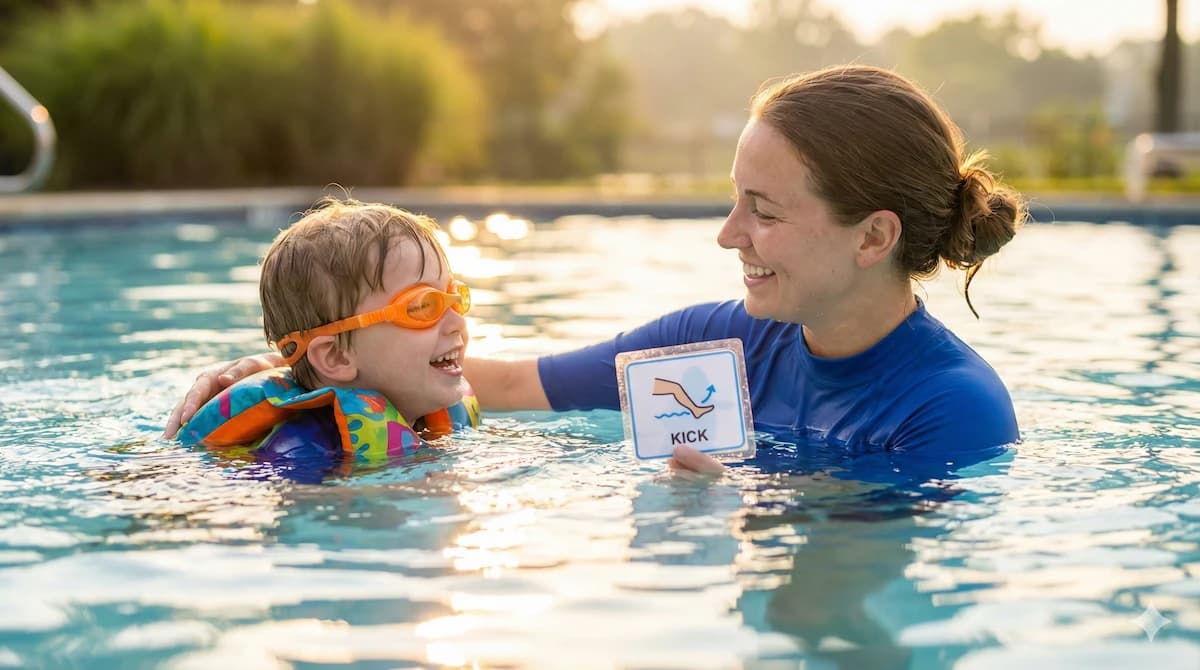
Antoinette: And then in the lesson itself, a great inclusive provider will use things like visuals and visual schedules. So if they have, you know, poolside a little whiteboard or laminated cards or something where that's incorporating the resources to help within the lesson, that's awesome.
Antoinette: Another really important thing and this is such an overlooked element is when the instructor, you know, might be away for the upcoming weeks. Let your family know. Let the participant or the swimmer know in advance. It is such a small step but, you know, share the load of managing transitions and changes with the families. Let the families help support you through that change. I don't know about you, Laetitia, but definitely from our experience when there is a change in an expectation that more often than not I'm experiencing more anxiety because I'm thinking, oh my goodness, I'm going to have to manage and help support through this. And I always think if I just knew just, you know, two minutes in advance, I could have had two more minutes of prep to help my child through this. So hopefully these gives you some tips and pointers.
Laetitia: That's really really good. That's really good. And as you were guiding us through those tips, I realised how much was missing in the places we went. So we tried three swimming provider before giving up for our own children swimming lessons. So yeah, so we ended up teaching them ourselves and then they go on with their school to do the swimming lessons and so it's kind of something else then because how do you make sure that in school the swimming lessons that they take are inclusive and that's another layer which, you know, we can talk about it but it's something that is really important.
Laetitia: Something that I wanted to ask you before I move to the last part of my question, which you mentioned the hard data around drowning. So of course that's a big data point and we want to encourage children who are neurodivergent to learn how to swim especially those who are really attracted by the water which is a case of children. What can you share with our listeners, other benefits that you see for children who learn how to swim in an inclusive and affirming?
Antoinette: Yeah absolutely. So I think getting back into the why, what, and the statistics as well, one of them that I didn't mention is their propensity to wander. So over 50% of children on the autism spectrum do have a propensity to wander and it's often towards bodies of water. And when we're looking at bodies of water, it's often to either that sensory seeking or sensory avoiding. So there are situational elements that come into play. So, if we're thinking about things like, you know, escaping a loud noise or escaping an uncomfortable feeling and with that, that feeling being drawn to areas that may not be safe. So things like backyard pools or even in situations like drowning, sorry not drowning, flooding, which can lead to drowning.
Antoinette: So in addition to that, some children on the autism spectrum also have a lack of perception around danger and danger awareness as well. So the same way that meeting like an immediate need to feel safe and calm, it might also lead them into dangerous places and situations.
Antoinette: So in terms of, you know, coming back to why it's important to have these life skills is obviously that safety element. But equally there's a sort of another sort of social element to this which brings me back to my very first point talking about unlocking these new spaces and places to be and to belong. The water shouldn't be treated as an environment as something that is so dangerous that we can't, you know, you need to be supervised 100% of the time and, you know, wrapped up in cotton wool. We need to have that dignity and risk taking as well and being able to enjoy every part of our community.
Antoinette: There is additional benefits as well when we're looking at, you know, particularly our Australian way of life. It is centred, we're a warm country for most of the time if we're not in the middle of winter. You know, we spend our time outdoors as a culture, as a society, and open bodies of water, being an island, means that a lot of our populations live near coastlines or have access to rivers and open bodies of water. So there are just so many layers to this and having that access to learning how to not only stay safe but also participate fully in these places is so important.
Laetitia: Yeah, that's beautiful. I love everything you said. It is like I could listen to you for hours, but we committed for this podcast to be bite-size and I know it's a challenge for us, but bite-size 20 to 30 minutes. So before I move to the last question, if you had like one message for policy makers, charities, association, governments on this topic, what would it be?
Antoinette: My one message would be that the leading cause of death for Autistic or children on the autism spectrum under the age of 14 is drowning. Yeah, we have got absolutely zero clarity around what support in aquatic environments could and should look like from a policy perspective and from a framework perspective. It's very grey this area, how it's currently funded and supported through our systems like NDIS and our education system.
Antoinette: I would love there to be some national consistency around what is it that we think is an acceptable level of education that should be provided or that we should work towards achieving. And I get really angry when we hear a lot of push back from NDIS or support agencies or frameworks like the NDIA saying that this is parental responsibility. It's your job as a parent to teach swimming. I get so frustrated because yes, it's my job to do that, but it's also my job to make sure that my child is thriving in an environment. And if environments aren't built for them in mind, then we're at a stalemate here. So, I'd love for that statistic to be taken seriously.
Laetitia: Yeah. And it's a huge statistic. Thank you so much, Antoinette. Before I let you go, I would love to know what personally, apart from the name of Autism Swim, what personally drove you on the mission to do that work.
Antoinette: Yeah. I just, we're on this earth for a short time and a good time. So, let's leave an impact and let's leave a legacy and leave it in a place that is better than how you found it. And so, for me, that inclusion is just so important. I have vivid childhood memories of needing to play with every doll because I was worried that my dolls would feel left out if they weren't all played with in the same equal way. So I think that's part of my nature is around that, you know, empathy but also that adaptability and ensuring that everyone experiences things and can be understood just as much. So that is that innate pull and mission there.
Antoinette: But equally as well, growing up on Australia's coastline, I grew up on the northern beaches. I still live on the northern beaches. You know that the water is such an important part and it's such a privilege to have access to and so that access piece is really important to me as well.
Laetitia: I love it. So I'm just going to close this podcast with one question which I didn't share with you prior which is what is your or your children favourite fidget?
Antoinette: Oh, my. Okay, so my 10-year-old son has got this zipper that he wears on his wrist or next to his watch because he needs a watch to make sure what time is, we need to stay on time and on task. And so it's a zipper and this is terrible for podcast because you can't see the visual of me zipping and unzipping. So, imagine like a bracelet. It zips it up and around. And I love it because it's something that he can take with him. I don't have to remember it. He's got it. It's on his person at all times. So, it's great. And it doesn't make a noise, it's something that he can quietly and discreetly use at any time. But I also love it too because it's his favourite colour and I think it's pretty cool.
Laetitia: I love that. Thank you, Antoinette. Thank you for joining the podcast today. For anyone who is listening to this and is curious to know more about Autism Swim or connect with you, how can they do that?
Antoinette: Absolutely. autismswim.com.au is our website. Also follow us on Instagram. So it's autism_swim as well as Facebook. Please please reach out. Send me a DM, send me an email, admin@autismswim.com.au. I love talking to people. So, yeah, come at me.
Laetitia: And that's how I reach out the first time to you, Antoinette. So, she definitely reply to those messages. So, thank you so much for coming on the podcast today.
Antoinette: Thank you so much for having me.
Laetitia: Quick pulse from Zoe. Zoe, how did you learn how to swim?
Zoe: I started.
Laetitia: Okay, Zoe, next question then. Do you remember your first swimming lessons?
Zoe: Oh, yes. I didn't like it because the teachers were mean to me.
Laetitia: Last question, Zoe, for this quick pulse. What makes you love being in the water and swimming?
Zoe: I love it because it's like flying but in water and when you come out of the water it feels like if you're flying right up.
Laetitia: Wow, I love this. Thank you Zoe for joining for this quick pulse.
Laetitia: That's a wrap for The Neurodivergent Pulse. If this helped, follow the show and leave us a quick review on your favourite platform. You can even share this episode with someone who needs it. You can learn more about our platform at understandingzoe.com.
Subscribe to The Neurodivergent Pulse.
Follow the show so a new episode finds you. It's free.


More episodes
View all
Nobody teaches neurodivergent people how to notice: Finding the patterns that work for you | Solo Episode
8 min
How to travel without masking: Creating neuroaffirming adventures
21 min