How to create neuroaffirming classrooms
What does it take for neurodivergent children to feel truly safe at school? Educator Millie Carr shares practical strategies for creating neuroaffirming classrooms on our podcast. From Universal Design for Learning to teaching equity over equality, discover how teachers and parents can work together to build inclusive spaces where every brain type belongs. With 96% of teachers feeling unprepared to support neurodivergent students, this conversation offers hope and a path forward.
In short
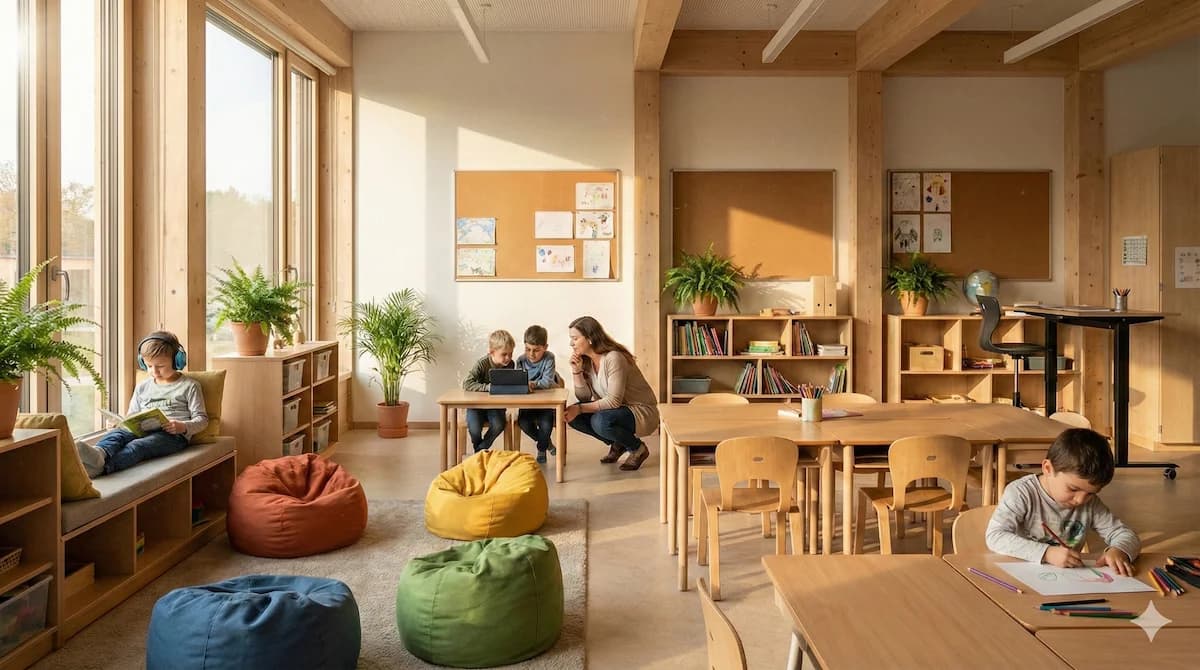
A neuroaffirming classroom prepares for difference from day one instead of adjusting later. Safety comes first, because children learn when they feel accepted. Universal Design for Learning is the practical start. Offer choice in how students show what they know. Vary seating, build in breaks and teach transitions. Teach equity, not sameness.
What does it take for a neurodivergent child to feel truly safe at school? Not just tolerated. Not just accommodated after the fact. But genuinely welcomed from day one?
This question sits at the heart of a recent episode of the Neurodivergent Pulse podcast, where host Laetitia Andrac spoke with Millie Carr. A neurodivergent educator with sixteen years of classroom experience, a parent of three neurodivergent children, and the founder of Unmasking Education, Millie brings both professional expertise and deeply personal understanding to this conversation.
What unfolded was a discussion rich with practical strategies, honest reflections on the challenges teachers face, and genuine hope for what classrooms can become.
What makes a classroom neuroaffirming?
For Millie, the answer starts before a single child walks through the door.
"For me, neuroaffirming classrooms is that we're looking at the classroom and we're preparing for the diversity in the classroom," she explains. "We're not coming in and we're not making adjustments after the fact. We're not going in and we're not saying, there's something wrong with these people."
Instead, neuroaffirming practice means "using really affirming positive language about the fact that everyone is different. There is diversity like there is diversity in flowers and other things. There is diversity in human brains and we need to cater to those brains in our classroom."
I think safety is a really big part of an affirming classroom, and the key thing that students need to feel to be able to feel like affirming and positive.
When children feel safe, they can learn. When they feel accepted for who they are, they can thrive.
Universal design for learning: A practical starting point
Theory matters, but parents and educators need tools they can actually use. This is where Universal Design for Learning (UDL) comes in.
Millie describes UDL as her "number one" recommendation for creating affirming classrooms. It involves three key elements:
Visuals
Visual
Technology written
In many classrooms, every student must demonstrate learning in exactly the same way: a written report, a test, a specific format. But as Millie points out, "obviously not everyone is going to excel and be able to do that in the same way."
Instead, she encourages teachers to offer choice: "You can represent your knowledge in a song. You can do writing if you want to do writing. If you would like to make a video, in a little group, if you'd like to do it by yourself, just giving those options and choice I think that makes it really affirming."
Beyond how students engage with content, Millie highlights the physical and emotional environment: "Making sure there is access to a variety of seating options and different preferences. Making sure you're checking in with students multiple times throughout the day. You're building in breaks, building in times for students to have transitions between and teaching them and co-regulating with them."
When students have ownership over how they learn and regulate, something shifts. "It gives students ownership and agency over their learning too because they're like, 'Well, I'm choosing to do this because I know I work better this way.'"
Why teachers resist (and how to approach them with compassion)
In a survey Millie conducted with nearly a thousand teachers, 96% said they did not feel able to cater to neurodivergent students in their classroom.
Ninety-six percent.
"They were not taught enough at uni," Millie explains. "A lot of teachers commented and said they did one module, so one module or two modules max on maybe autism. And that's all they had, and it was just basically what is autism. It wasn't, you know, this is how you can support an autistic person."
This lack of training creates fear, and fear creates resistance. "When there's resistance often I find resistance comes from fear and not knowing," Millie shares.
So what can parents do when they encounter this resistance? Millie's advice is clear: lead with compassion, not confrontation.
"Come at them in a really curious kind of manner and present the information you know about your child in a way that is like, 'I'd love you to try this. What do you think?'"
She recommends starting small: "My big tips are, come with compassion, come with curiosity, bring a couple of little tips, but don't present everything all at once because that can, for a teacher that doesn't know anything, be very overwhelming and they can get defensive."
Most teachers want to do the right thing by your child. They want to support them.
So if you come at them nice and small, drop little bits and pieces, talk to leadership as well, get them to look at universal design for learning as an option.
If you're preparing for a conversation with your child's school, Understanding Zoe can help you organise your observations and translate them into practical strategies to share with educators.
Pip remembers the appointments, the notes and the small wins, so you don't have to.
7 days free.
Teaching equity over equality
One challenge that frequently arises in affirming classrooms is other students asking, "Why does he get that? It's not fair."
Millie has direct experience navigating this. She recalls working with a class that received a new student who needed various accommodations: "The students were all talking about it's not fair, why does he get to sit over there and do this, and why does he get to do this, and it's not fair."
Her solution? Teaching the difference between equity and equality.
"A lot of the kids learn equality. I get, we all get the same. Well, if we all get the exact same thing, we're not all going to be actually catered to and there's going to be many people left behind."
She recommends incorporating conversations about difference into daily classroom life: reading neurodiversity-affirming books, using morning prompts that encourage empathy, and creating an environment where differences are understood and celebrated.
"Students and children don't have these biases from birth," Millie notes. "It forms as we teach them things. So yes, they might come with some biases from home, but we need to be the ones as a teacher that's with them six hours a day to build that environment of inclusivity and of difference."
Everyone gets what they need. Barriers are removed so everyone can get what they need. Not that everyone gets exactly the same. That's not fair.
When equity becomes the norm, accommodations stop being something to defend and become simply part of how the classroom works.
What gives us hope in the classroom
After sixteen years in education, Millie has watched the landscape shift.
"Comparatively to when I first started teaching, it's a world of difference in a lot of classrooms," she reflects. "And I see such great practice sometimes. And yes, not everyone's getting it all right, but they're giving it a go."
She notices teachers actively trying new approaches: "I've seen people swapping out some of those little things for more affirming things. And yes, they're not getting it 100% correct and that's okay, but I can see people trying."
Perhaps most encouraging is the language shift she's witnessing. "I see the language shift happening. I think the language shift kind of happens generally first in all these movements and then action kind of follows. So it's good that we're hearing that language shift."
And beneath it all is a truth worth holding onto: "Teachers don't get into the profession not wanting to support children. That's why they're there."
Moving forward together
Creating neuroaffirming classrooms isn't about perfection. It's about preparing for diversity rather than reacting to it. It's about replacing compliance with genuine connection.
Whether you're a parent navigating school conversations, an educator looking to grow your practice, or someone supporting neurodivergent children in any capacity, the principles Millie shares offer a starting point: begin with safety, embrace universal design, approach others with compassion, and teach equity from the earliest years.
This post is based on Episode 2 of the Neurodivergent Pulse podcast from Understanding Zoe. Try Understanding Zoe free for 7 days to access neuroaffirming support for your family.
Pip is not a doctor or therapist. It helps you organise and prepare, not diagnose or treat.
In a crisis call 000. Lifeline 13 11 14. Kids Helpline 1800 55 1800. 13YARN 13 92 76.

Ready to put it all in one calm place?
Tell Pip one thing today. It remembers the rest.
Stored in Australia, encrypted. Cancel before day 8 and you won't be charged.
Related articles

Play is learning: How curiosity helps neurodivergent kids thrive
What if play was never a break from learning, but the learning itself? In this episode, Angie and Kaycee Larney from Curious Me share why messy, chaotic, special-interest play is exactly what neurodivergent kids need. Learn how to shift from "be careful" to curiosity, honour your child's process, and trust that today's car-lining might be tomorrow's life skill.
Read more
Unschooling neurodivergent kids: Trust over curriculum
Unschooling offers neurodivergent families an alternative to traditional schooling by prioritising child-led learning, nervous system safety, and curiosity over curriculum. In this article based on Episode 24 of Neurodivergent Pulse, Melissa Crockett-Joyoue (founder of Weave ND) explains why regulation is essential for learning, how special interests become powerful learning pathways, and why parents must do their own healing work.
Read more
The hidden cost of AuDHD in academia
Neurodivergent students often perform well academically while experiencing severe burnout and exhaustion that parents rarely see. Jocelyn Green, an AuDHD student and advocate, explains why neurodivergent brains work twice as hard just to keep pace, why success stories can be harmful when they hide the cost, and what accommodations genuinely help. This episode challenges the myth that good grades equal wellbeing and invites parents to recognise the invisible toll of masking, the reality of autistic burnout, and the grace their child needs most.
Read more