Music for neurodivergent children: child-led approach
Music can be one of the most powerful supports for neurodivergent children, but only when the teaching approach matches how their brain learns. This article explores why traditional performance-based music lessons often fail neurodivergent kids, and how child-led, cooperative music learning unlocks regulation, executive function and genuine connection. Music therapist and ADHDer Tiziana Pozzo shares practical guidance on finding the right music environment, what to look for in a teacher, and how to support your child's music learning at home.
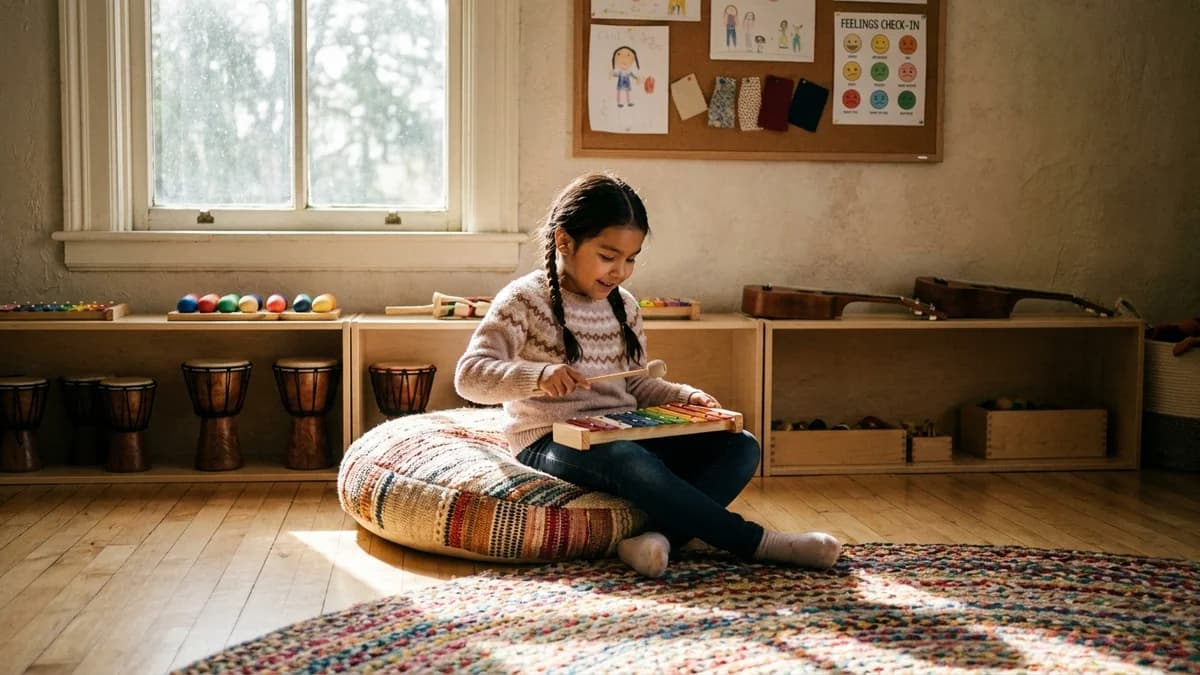
In short
Music therapy for autism and ADHD is one of the most powerful developmental tools available to neurodivergent children, but only when the environment matches how their brain learns. Music therapist and ADHDer Tiziana Pozzo explains that music activates attention, working memory, impulse control and self-regulation simultaneously, making it far more than a hobby. The problem isn't that neurodivergent kids can't do music; it's that performance-based, book-led teaching asks them to do the very things they find hardest. Look for teachers with music therapy training, improvisational backgrounds and a genuinely child-led approach, and remember: one instrument, one deep passion, is enough.
You signed your child up for piano lessons because you had a feeling. Music lights them up at home, they hum constantly, they bang on every surface like it's a drum kit. Surely this would be their thing. But three lessons in, the teacher is asking them to sit still and read from a book, and your child is melting down before you've even pulled into the car park. You quietly wonder: maybe music just isn't for them after all.
Here's the thing. The problem almost certainly isn't your child. It's the approach.
In Episode 33 of the Neurodivergent Pulse podcast, host Laetitia Andrac is joined by Tiziana Pozzo, music therapist, music educator, ADHDer and founder of Music Tree, a holistic music centre in London and a worldwide training movement for educators, to explore what music can genuinely offer neurodivergent children when the approach is right. Drawing on over 20 years of professional experience and her own lived experience as an ADHDer who began strict conservatoire piano training at age six, Tiziana makes a compelling case for moving beyond performance-based teaching toward something far more powerful: cooperative, child-led music learning that works with a neurodivergent brain rather than against it.
Does music therapy help autistic children?
Music therapy for autism works, but only when the environment matches how the brain actually learns. The gap between loving music and surviving music lessons is one of the most common experiences parents of neurodivergent children describe. A child who dances around the kitchen, who knows every lyric to every song, who picks up rhythms intuitively, can fall completely apart in a formal lesson setting. And when that happens repeatedly, families often draw the same conclusion: music isn't for my child.
That conclusion is almost always wrong. What those families have encountered isn't the limits of their child's musicality. It's the limits of a teaching model that was never designed with neurodivergent brains in mind. Understanding the difference is where everything changes.
In our research on neurodivergent families, one parent put it simply: "I took him to piano lessons...disaster. But then we found this YouTube teacher, and within ten minutes he was playing Hot Cross Buns with two hands. It's about finding the right environment. Those moments are what matter." It's a sentiment we hear again and again from families who haven't given up on music, just on the wrong version of it.
The benefits of music therapy for autism and ADHD
Music is a whole-brain workout, and for neurodivergent children, that matters. The benefits of music therapy for autism and ADHD go well beyond learning an instrument. As Tiziana explains, "Music, we know now, works on a lot of executive function, activates a lot of parts of the brain at the same time." The research has deepened considerably in the last decade, and what it shows is striking.
"When music is played, or also when it's just listened, there is a total activation of the brain," Tiziana says. Playing an instrument, singing in a group, even listening attentively: all of these engage the brain in ways that directly support the functions neurodivergent people often find most challenging. This connection between creativity and regulation in ADHD brains is something we've explored in depth elsewhere. Here's what music actively works on:
Attention: Staying with a piece, tracking where you are, noticing what others are playing
Working memory: Holding a melody or rhythm in mind while executing it physically
Coordination: Synchronising hands, breath, voice and body in real time
Cognitive flexibility: Adapting when the tempo shifts, when someone else changes direction, when improvisation opens up
Self-regulation: Managing frustration when a passage is difficult, staying in the group when someone else makes a mistake
Impulse control: Waiting for your cue, not rushing ahead, holding back when the music calls for it
Emotional connection: Group music-making synchronises brainwaves between players, creating a felt sense of being in tune with others
Music therapy takes this even further. Because it can be entirely customised, a skilled music therapist might work non-verbally with an autistic child who finds language overwhelming, using instruments, movement and gaze instead. For a child with ADHD, body music, rhythm and grounding exercises can organise the nervous system in ways that talk-based approaches simply can't reach. "We might think it's just about playing an instrument," Tiziana says, "but it's about, you know, singing in circle, singing in choir. So many possibilities."
Why traditional music lessons don't work for neurodivergent kids
Performance-based music lessons ask neurodivergent children to do the very things they find hardest, and then measure them on how well they comply. Sitting still for extended periods, replicating written music with precision, practising the same technical passage repeatedly: these demands clash with how neurodivergent brains learn and sustain motivation. For families who have tried music lessons with an autistic or ADHD child and found them a battle, this mismatch is almost always the reason.
Tiziana is clear-eyed about this from her own experience. "You can't just ask neurodivergent person to stay hours on the piano and practice, which was what was asked to me." The intense repetition that classical training requires can work, she notes, but only when the motivation comes entirely from within. Discipline imposed from the outside rarely holds.
The stakes here are real. According to Understanding Zoe's research findings, 64% of parents of neurodivergent children often feel exhausted, compared with 42% of parents of neurotypical children, and 64% feel overwhelmed, compared with 32%. When a music environment adds to that distress rather than relieving it, the cost to the whole family is significant.
Music is going to be beneficial instead of traumatic, basically.
That line captures what's really at stake. When the environment is wrong, when the demands are mismatched, when a child is asked to perform rather than explore, music stops being a resource and starts being a source of shame. The child who melts down at lessons isn't failing at music. They're responding to a system that was never built for them.
Pip remembers the appointments, the notes and the small wins, so you don't have to.
7 days free on iPhone and Android.
Child-led music learning: what it actually looks like
Child-led music learning starts with a simple shift: the child's ideas, impulses and creativity become the curriculum, not a distraction from it. At Music Tree, Tiziana has built an entire methodology around this principle, and the results look very different from a traditional lesson.
"They come with a lot of ideas, a lot of impulses, a lot of creativity," she says of neurodivergent children. "So that can be a very rich source where we can take, and then create the class on that." Rather than arriving with a lesson plan fixed in advance, the facilitator observes, responds and weaves the child's contributions into the session as it unfolds.
Music Tree offers multiple formats to suit different needs: parent-and-child groups where an adult's presence supports a younger or more anxious child; group classes for piano, violin and ukulele; and multi-instrumental sessions where children explore across different sounds. Group settings, in particular, build something that one-to-one lessons often can't: real-time regulation practice. When you're playing in a group and someone else makes a mistake, you have to stay. You have to manage your frustration and keep going. "There's a lot of control on impulses as well," Tiziana notes. That's not a side effect of group music-making. It's one of its most valuable features.
"If you're not interested in what you're doing, there's no way you're actually putting any effort in it." This is the foundation of the approach. Interest-led engagement isn't a concession to a difficult child. It's the only reliable engine for deep learning, a principle that extends well beyond music, as we explore in our piece on interest-led play as the foundation for deep learning.
What to look for in a music teacher for an autistic child
Finding the right music environment for a neurodivergent child means asking different questions than most parents think to ask. Credentials matter, but not in the way we usually assume. "My suggestion is to potentially look out for teachers that are also music therapists," Tiziana advises. "Always have a look for somebody that has the double vision." A teacher who understands both music education and child development can hold the whole child, not just the instrument.
This matters more broadly than one family's experience. Research from Understanding Zoe found that 39% of parents of neurodivergent children want teachers and health professionals to be neurodivergent-informed, making it one of the most commonly cited needs among families looking toward a better future for their children.
Genre background is also worth considering. "Go to maybe a jazz musician or somebody that improvise or compose their own songs, their own pieces. They already come from a much lower level of self-judgment, and therefore they can accept better the ideas of the children." A teacher trained purely in classical performance has spent years learning to replicate music written by others with precision. That's a very different relationship to sound than one built on improvisation and composition, and it shapes how they respond when a child goes off-script.
Before committing to any teacher or programme, Tiziana encourages parents to ask directly: "Ask question, ask a lot of questions on what is their goal. Is their goal to make your child pass exams or is actually nurturing their musicality and using music to develop other skills." Here are some specific questions worth taking into any first conversation:
What is your goal for my child in the first six months?
Do you have training in music therapy or child development, as well as performance?
Do you teach from a book, or do you build sessions around what the child brings?
Are improvisation and the child's own ideas welcome in your sessions?
Can I observe a session so I can support my child's learning through the week?
Do you offer group settings as well as one-to-one lessons?
How do you adapt when a child is dysregulated or disengaged?
A teacher who welcomes these questions is already a good sign. One who seems thrown by them is telling you something important.
Are music lessons good for children with ADHD?
Yes, but sustained engagement with one or two genuine passions serves neurodivergent children far better than a fragmented week of many activities. This is one of Tiziana's most direct challenges to the way many families structure their children's time, and it's worth pausing on.
The cultural pressure to keep children busy, stimulated and exposed to many different things is real. But for neurodivergent kids, moving from swimming to dance to music to art across the week creates a constant stream of new environments, new demands and new transitions. That's exhausting, and it works against the depth of engagement where executive function develops. Parents of neurodivergent children already spend around 33 hours each week on caregiving, with nearly 10 of those hours going to emotional regulation, advocacy and administration alone. A packed activity schedule adds to that load rather than lightening it. Our guide on how activity overload drains neurodivergent children explores this in practical detail.
One instrument a week. It's enough. They don't need three instruments a week.
Tiziana draws an analogy that resonates: watching a long, slow film works better for developing sustained attention than watching ten short episodes back to back. "Slowing down, taking time, getting bored, which is super hard" are not signs that something has gone wrong. They are the conditions under which real learning takes root, a philosophy explored further in our piece on trusting curiosity over a packed schedule.
Laetitia's own family arrived at this conclusion through experience. There was a time when the girls were enrolled in many activities. Now it's two: singing and music together, and gymnastics. "The girls are diving deep," she shares. It's an invitation, not a prescription. But if your child's week feels like a relay race, it might be worth asking which one or two things they would choose to keep.
This is also where Understanding Zoe can be a genuine companion for parents. When you're slowing down and watching your child more closely, noticing what lights them up and what drains them, having a place to capture those observations and turn them into informed next steps makes all the difference. Knowing what to look for, and what to ask teachers and therapists, starts with knowing your child.
Music as family connection
Parents don't need to be musicians to support their child's music learning. What they need is willingness to engage, and the courage to ask the teacher how they can help.
Tiziana encourages parents to go beyond dropping their child at the door. Asking the teacher, "How can I support my child through the week? Can I come into the session and actually observe what you're doing so I can support my kid better during the week?" transforms music from a weekly appointment into something that lives in the home. Music Tree offers parent classes for exactly this reason: when a parent learns a little alongside their child, the whole week changes.
Laetitia shared a moment from her own family that captures this beautifully. When her daughter Zoe started learning guitar, Laetitia took out her own old guitar, dusty and out of tune. They played together, and something shifted: Zoe began teaching her mum what she was learning. That act of teaching built Zoe's confidence in a way that being taught couldn't. And it gave them a connection, a shared language, that went far beyond the instrument. For more on building genuine connection with neurodivergent children, the PACE framework offers a powerful lens for any parent wanting to deepen their relationship.
After any music session, one simple question can open that conversation: what did you like? What didn't you like? Let the answer guide what comes next. That's not just good parenting. It's the Music Tree approach in miniature.
Conclusion
Music can be one of the most powerful supports available to a neurodivergent child. Not because it teaches them to perform, but because, in the right environment, it trains the brain functions they need most, builds regulation and resilience, and creates genuine connection with the people they love. The key word is environment. The approach has to match the child, not the other way around.
If your family has had a difficult experience with music lessons, that experience is worth honouring. Then set it aside. It was information about the wrong fit, not a verdict on your child's relationship with music. Look for cooperation over compliance, curiosity over correction, and a teacher who sees your child's ideas as a resource rather than a disruption. Trust what you know about your child. You are, as Laetitia reminds every parent listening, the expert on them.
Frequently asked questions
Does music therapy help autistic children?
Yes, music therapy for autism has strong evidence behind it. Because music engages multiple areas of the brain simultaneously, it supports the executive functions that autistic children often find most challenging: attention, working memory, self-regulation and social connection. Crucially, music therapy can be delivered non-verbally, using instruments, movement and gaze, making it accessible for children who find language overwhelming. The key is that it is tailored to the individual child, not delivered as a one-size-fits-all programme.
Are music lessons good for children with ADHD?
Music lessons can be beneficial for children with ADHD, but the approach matters. Traditional performance-based lessons that require sitting still, reading notation and repeating technical passages can be a poor fit. Music therapy for ADHD, or lessons with a therapeutic, child-led approach, work with the ADHD brain rather than against it. Rhythm-based activities, group music-making and improvisation are particularly effective because they organise the nervous system and build impulse control in ways that feel engaging rather than demanding.
What music is best for neurodivergent children?
The genre matters far less than the environment. Any music that genuinely engages your child is the right music. What the research points to is that active, participatory music-making, playing, singing, moving, is more beneficial than passive listening. For children with ADHD, rhythm-based and body-percussion activities are particularly grounding. For autistic children, familiar, predictable musical structures can provide comfort, while improvisation can offer a safe space for self-expression.
What is the difference between music therapy and music lessons?
Music therapy is a clinical intervention delivered by a qualified music therapist, with goals focused on developmental, emotional or neurological outcomes rather than musical performance. Music lessons are focused on teaching an instrument or musical skill. The distinction matters for neurodivergent children because music therapy for autism or ADHD is designed around the child's needs, not a curriculum. Some educators, like Tiziana Pozzo, bridge both worlds by bringing therapeutic principles into music education, which is what makes their approach so effective for neurodivergent learners. For a broader picture of what neuroaffirming learning environments actually look like, our conversation with educator Millie Carr is a valuable companion.
Connect with Tiziana and Music Tree
🌐 Website: musictreeuk.com
📸 Tiziana on Instagram: @tiziana.musictree
🎵 Music Tree UK on Instagram: @musictree_uk
🌿 Music Tree Retreats on Instagram: @musictree_retreats
🎶 In Sydney? Check out Music N Me, founded by Laura Kahar, offering a neurodiversity-affirming approach to music learning
✨ Try Understanding Zoe free for 7 days and turn what you notice about your child into meaningful, neuroaffirming next steps
Pip is not a doctor or therapist. It helps you organise and prepare, not diagnose or treat.
In a crisis call 000. Lifeline 13 11 14. Kids Helpline 1800 55 1800. 13YARN 13 92 76.

How music supports neurodivergent brains with Tiziana Pozzo
Listen nowReady to put it all in one calm place?
Tell Pip one thing today. It remembers the rest.
Stored in Australia, encrypted. Cancel before day 8 and you won't be charged.
Related articles
Play is learning: How curiosity helps neurodivergent kids thrive
What if play was never a break from learning, but the learning itself? In this episode, Angie and Kaycee Larney from Curious Me share why messy, chaotic, special-interest play is exactly what neurodivergent kids need. Learn how to shift from "be careful" to curiosity, honour your child's process, and trust that today's car-lining might be tomorrow's life skill.
Read more
Neuroaffirming music therapy and how it helps with connection and regulation
Music therapy for neurodivergent children isn't about learning to play an instrument. Registered Music Therapist Brianna Dahlstrom explains what genuinely neuroaffirming music therapy looks like: maximising strengths rather than normalising differences, creating safety before pursuing outcomes, and offering a nourishing pathway to nervous system regulation that many neurodivergent people find more accessible than talk-based approaches. Discover how to identify affirming practitioners and why playfulness is essential therapeutic work.
Read more
Art of belonging: ADHD, creativity & regulation
This article explores ADHD through a transformational lens, featuring Madeleine Jaine Lobsey, founder of Wondiverse. Rather than viewing ADHD as a deficit, this episode reframes it as a regulation challenge and source of innovation. Key topics include: why ADHD is fundamentally about nervous system regulation, how creativity and play support self-regulation, the grief and empowerment of late diagnosis, why divergent thinking drives innovation, and how offering choice and control creates safety.
Read more