Why we built Understanding Zoe: The story behind the mission | Solo Episode
Hosted by
Laetitia Andrac
Host of The Neurodivergent Pulse, CEO and co-founder of Understanding Zoe, and a neurodivergent parent.
The Neurodivergent Pulse is Understanding Zoe's podcast for families raising neurodivergent children in Australia. Hosted by Laetitia Andrac, each episode is an honest conversation about autism, ADHD and everyday family life. In this episode, "Why we built Understanding Zoe: The story behind the mission | Solo Episode", you'll hear practical, neuroaffirming ideas you can use today.
Key takeaways
- Why so many families feel like they are drowning in information but lacking clarity
- The invisible load of coordinating care across multiple professionals
- Why every neurodivergent profile is unique (and systems often miss that)
- How lived experience + AI became a powerful support tool
- The reality of building a neurodivergent-led social enterprise
- Why making the invisible visible is essential for systemic change
Watch this episode
Prefer audio? Listen on Spotify
Loading the player...
Chapters
Show notes
Why does Understanding Zoe exist… really?
In this deeply personal solo episode, Laetitia takes you behind the scene… not into strategy decks or product features, but into the real lived experience that sparked everything.
This is the story before the research. Before the app and before the business.
It’s the story of a parent navigating overwhelm, systems that didn’t connect, and a child who needed to feel seen, safe and understood.
If you’ve ever felt like you’re holding too much, juggling too many reports, or trying to connect dots that were never designed to fit together — this episode will resonate deeply.
✨ Try Understanding Zoe free for 7 days – the neuroaffirming app turning every report, observation and meltdown into an actionable next step.
About the host
Laetitia Andrac (Autistic & ADHDer) is an award-winning entrepreneur, international speaker, and podcast host.
She is the bestselling author of Light It: How to Trust Your Intuition and Build a Thriving Business. With over 15 years of experience in consulting, strategy, and innovation, Laetitia has worked with industry leaders like Deloitte and Telstra.
Inspired by my journey as a neurodivergent parent, she co-founded Understanding Zoe, an AI-driven solution dedicated to supporting caregivers of neurodivergent children.
Her passion is creating a more neuroinclusive world, where everyone can thrive—whether in their homes, communities, or workplaces.
Frequently asked questions
Why did Laetitia create Understanding Zoe?
Laetitia was a neurodivergent mother drowning in paperwork. Reports from therapists and schools all used different formats and language. She used AI to find common themes and pass ideas to Zoe's teacher. This became Understanding Zoe.
Is every neurodivergent person's experience the same?
No. Every neurodivergent person has their own profile. Autism, ADHD and other diagnoses look different in each person. Meeting one Autistic person only tells you about that person. Zoe's teacher understood this better after seeing her profile in the app.
What did Understanding Zoe's research find about caregivers?
The research found parents spend 33 extra hours a week supporting neurodivergent children. This includes 10 and a half hours on advocacy and admin tasks. It found that 63% of these parents are neurodivergent too. It also found that 93% feel unseen and misunderstood. It found that 56% feel unsafe to disclose at work.
What can the new Understanding Zoe app do?
You can generate reports and give permission at a more detailed level. You can talk with Pip to record observations, which build into trends. The app can spot patterns in those trends. It can pull out reminders and medication details from documents. It can also send you reminders.
Is Understanding Zoe only for children?
No. Understanding Zoe was built to support neurodivergent children and their families. The redesigned app now also supports adults who are neurodivergent themselves. It means people can use it across their whole life, not just childhood.
Transcript
Read the transcriptAbout 12 min read
Laetitia: Welcome to Neurodivergent Pulse, where we explore the often misunderstood world of neurodivergence with experts, parents, teachers, and therapists. Grounded in lived experience, each bite-sized episode gives you something practical to try. I am your host, Laetitia Andrac, AI expert, neurodivergent mum, and founder of Understanding Zoe. This podcast is recorded on Dharawal country. I acknowledge that sovereignty was never ceded. It always was and always will be Aboriginal land.
Laetitia: Welcome to the Neurodivergent Pulse podcast. I am Laetitia Andrac. I am your host. I just want to acknowledge straight away that this episode is a little different. If you have been listening to the last couple of episodes, we usually have a guest coming on the podcast, and then we did a mini-series where I talked a lot about PDA, and how I actually use Pip, how our AI coach was in Understanding Zoe. And those episodes were very close to my heart, but this one is even closer, because today I want to go back to the very beginning, because I got a lot of questions asked around why we created Understanding Zoe, where it comes from, before the research, everything before any of it. Zoe was born, and I am giving myself this permission to record this podcast, because it is going to be my fifth year of being self-employed, of leaving the corporate realm, where my last role was general manager in Telstra in big data and AI.
Laetitia: So, I really want to take a moment to reflect as I celebrate 5 years of being self-employed. And for many neurodivergent folks who may be listening to this podcast, you chose also the path of self-employment, and it's not always an easy path, for sure. There is definitely moments of hardship, and also moments of pure joy and the ability to leverage my monotropism and be really focused on what I'm passionate about.
Laetitia: So, as this week we are relaunching the Understanding Zoe app, a completely redesigned, rebuilt from the ground up version that we've been quietly building on in the last few months based on all the feedback that we received, but also inspired by the research and expanding it to more people to be supported within the app, adult being supported.
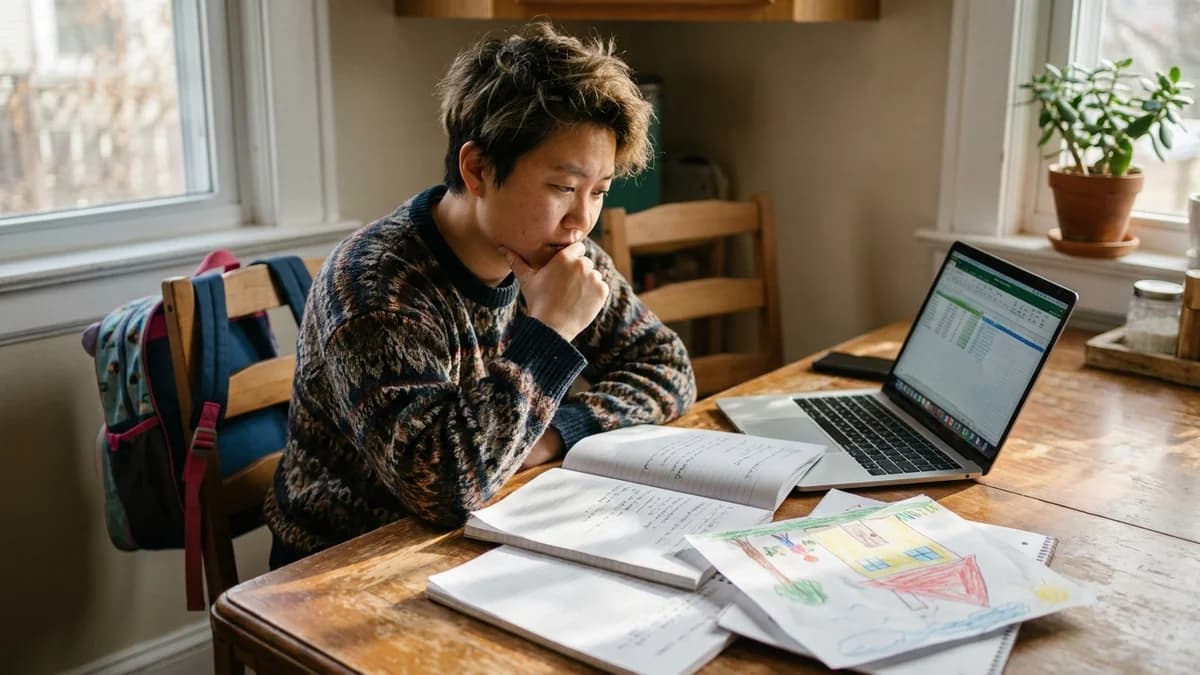
Laetitia: I just want to take you back to the beginning, which was 2 and 1/2 years ago, when I was a neurodivergent mother drowning in paperwork, having hundreds of thousands window open all the time, and Zoe was really struggling with food cans, food refusal, and the reports were coming in from everyone, the beautiful humans supporting Zoe in her care village, from speech therapy, occupational therapy, psychologists, school observations, and each one of them was containing core information that were getting lost because they were all written in different format with different language, and sitting in different folder on my laptop, on my phone, on email, via SMS. It's just like everything was going everywhere, and then I had my daughter who needed support and I had a care team where everyone was doing their own part, but I had no ways to bring it all together and guarantee for Zoe to feel safe, seen, heard, understood. And being a human, we can just thrive in this world that was not built for her.
Laetitia: So, I am someone who spent 15 years and beyond that actually as a strategy consultant. I worked for Monitor, I worked for, you know, big firms, Deloitte, and I consulted in many, many different place and I know how to organise information yet I was drowning and I knew all the parents were too because I was talking to other parents who were raising neurodivergent children.
Laetitia: And as I started using AI very early on in my career back in 2014, I was just like, maybe I could use AI for Zoe. And, you know, start finding out what are the common theme across these reports, finding out the support ideas recommended by some therapists to then pass on this message to the teacher. Maybe wondering about homeschooling and school camps and all of those things.
Laetitia: And actually, this is where everything came together and as I was helping me to have this AI which we call the Understanding Zoe and we shared it with her teacher, I just was like maybe it can help all the family and this confirmation came a few weeks only 2 weeks after starting using it by Zoe's teacher and I'm allowed to share this and I asked for permission and we received a beautiful email from her about it.
Laetitia: But this is where Understanding Zoe started. It started on our kitchen table, not in a boardroom, not in a pitch deck, really trying to get our daughter to feel safe to go back to school.
Laetitia: And this email from her teacher confirmed everything, that it was helping more than, you know, lots of the training and lots of the things, because Zoe having her own profile, like every neurodivergent folks listening to this, you all have your own profile. And this is where thinking that autism or ADHD or PDA or dyslexia or dyspraxia or dyscalculia or OCD or GDD bipolar looks like this is wrong. Yet a lot of people think that it's one box and this is how you are behaving and you are experiencing the world, and but no, all of us have different experiences as we all know now.
Laetitia: And so that's where, you know, we like this sentence in the neurodivergent community, which is once you've met one Autistic, you've met one Autistic, or once you've met one ADHD, you've met one ADHD, or, and this is where for Zoe's teacher just opened up a new way of seeing Zoe and supporting her and realising the demands that were put on Zoe and so on.
Laetitia: So we kept building Understanding Zoe for a few families on the side of me running my own consultancy, and Johan was now my co-founder and full-time in the business for the last year. We did that on the side for about 10 families, and this is when we realised that it was time to incorporate this as a social enterprise, and it was back in October 2024.
Laetitia: Because from the beginning, Johan and I, we were both doing all the things and we were doing this on the side, but then we decided to go all in one after the other. So I went all in at the end of 2024, early 2025, February 2025, and Johan left his corporate role in April 2025 to join the journey full-time.
Laetitia: So, we made this decision quite early that this was not just going to be a startup, a social enterprise. It was really going to be something that was about a mission, a mission that was way bigger than us.
Laetitia: And this is where from the get-go I wanted to do research, and I wanted to release a research that we released back in November 2025 around making the invisible visible. And as a neurodivergent founder, I shared a lot on Substack around my own experience building this business, growing this business, and, you know, moving from, I left corporate, I'm running my own consultancy for a few years, working from home with my own accommodation, loving it, to then going into the startup world where there are some expectation of you, and having to show up a certain way, and going to a lot of stuff, and then all of that.
Laetitia: So, you can go and read those Substack, because going through the founder journey was very different, as I was, you know, intentionally deciding what I wanted to do and what I didn't want to do.
Laetitia: And I mentioned quite quickly around the data and creating our own research, and this is because one of the questions that kept popping up for me as I was building Understanding Zoe was, where is the data? Everything from lived experience show us that what we're doing is something that's needed. Yet, there is absolutely no research that's based on lived experience showcasing the invisible load at scale that caregivers and neurodivergent adults are taking on.
Laetitia: And this is when we did that research on thousands families, I was not expecting for those numbers to be so high. 33 hours of work, you know, 33 hours, sorry, 33 extra hours a week to support neurodivergent children, including 10 and 1/2 hours for advocacy and administrative tasks and so on, which is really what I feel. Then 63% of those parents raising neurodivergent children being themselves neurodivergent. 93% of the parents feeling unseen and misunderstood. 56% of those parents feeling unsafe to disclose at work. It's just like all of this made our own experience and the experience of the user of the platform be visible at scale.
Laetitia: So, making the invisible visible was published in late 2025, and it became the backbone of what we're building. And this is where I think lived experience doesn't replace data, but when lived experience is within the data and we build research with us, everything changed. And this is what we wanted with that research.
Laetitia: So, to finish this quick short episode, a bit of storytelling, a bit of going everywhere. I know I had scripted this. I'm just not really following my script, but I hope this is enjoyable anyway, to guide you through the journey.
Laetitia: But today is a big milestone, because Understanding Zoe was kind of launched as a minimum viable product, as we call it, like the first version. And it has been helping family for sure since it launched back in end of November, December 2024 to the public, after launching to a waitlist in October 2024.
Laetitia: But we knew from the beginning that it was a prototype. It was an MVP, a proof of concept. The real version, the one that we built and released in the last few days. This is what we wanted. This is, you know, a completely redesigned, rebuilt, something that is cleaner, faster, more intuitive, with features that we wanted to have, like the ability to generate reports, the ability to see patterns, the ability to extract from a document the core reminder and the core medication information, all the cool support ideas. All of that we wanted this from the get-go.
Laetitia: And sometimes it's about being patient, which is not my strength, and really really building something with intention and with a community.
Laetitia: So now, as I said, in the app you can generate reports, you can have really, like, this ability to give permission within the CareKit Edge app to way more granular level. You can, just by talking with Pip, remember about observations and so on, which then goes into trends. It can identify pattern. It can, you know, just give you a reminder.
Laetitia: And so it's really something that we wanted to build for quite some time, and I'm very proud about what we've built. And we will keep iterating and improving. We're actually in the work for something quite groundbreaking, for which we received a grant to develop, which is going to change everything for many families and many neurodivergent folks.
Laetitia: As now we go beyond supporting families, we also support adults who are themselves neurodivergent. So I want to close this episode by saying something, which is thank you. Thank you for everyone who came on the journey early on, who shared their feedback, who were part of the co-design, who contributed in any way for this to not just be an idea, not just be serving one child, Zoe, but actually serving many of us.
Laetitia: And Zoe means life in Greek. Yeah, I had a special interest in Greek and Greek mythology. When I was younger, I learned Greek at school, ancient Greek. And so Zoe means life.
Laetitia: So, really understanding Zoe is about understanding life and feeling understood through your life span. So, it goes beyond one child.
Laetitia: Now, this app is live. It's here to support everyone who feel they are drowning with everything that they have to hold, and they need this second brain. They need this partner that is retaining this information and making it available to anyone who needs to understand them better.
Laetitia: So, thank you so much for being here, for listening, for trusting this platform and for everything. We're here to play the long game. We are not here to just be an overnight impactful business. We're here to for decades to come.
Laetitia: So, thank you so much for future share this episode with anyone who is curious about the behind-the-scenes of the journey. Leave a review on any podcast platform. That always helps to find your ears. Without further ado, I say thank you so much, and go and download the new version of the app on the App Store and Google Play Store. Thank you. Bye.
Laetitia: Welcome to another pulse check with Zoe on the Neurodivergent Pulse podcast. So, Zoe, as we are launching the new app that we built, and we are curious to hear from you, how does understanding Zoe help?
Zoe: It helps that teachers actually understand me and know that I have problems in the class.
Laetitia: Yeah? So, for instance, what did it change?
Zoe: So, usually people would have just told me what to do all the time. They would have always been very rough on me. But, since I understand, since they got Understanding Zoe, they've been a little more kind to me and helping me with more stuff.
Laetitia: Mhm. Thank you, Zoe, for sharing that. What did they put in the classroom for you? What did they do differently in the classroom?
Zoe: Oh, they put in a little quiet area for when I'm angry, so that when I'm angry at someone or I'm angry at myself, I can go inside it and play with little fidgets.
Laetitia: Mhm. That is beautiful, and all the children can go as well, right?
Zoe: Yeah. Everyone can.
Laetitia: That's beautiful. Thank you, Zoe, for sharing. Bye.
Zoe: Bye.
Laetitia: That's a wrap for Neurodivergent Pulse. If this helped, follow the show and leave us a quick review on your favourite platform. You can even share this episode with someone who needs it. You can learn more about our platform at understandingzoe.com.
Subscribe to The Neurodivergent Pulse.
Follow the show so a new episode finds you. It's free.