Communication breakdown: How visual support ease executive overload with Jessica Shahbazi and Jennifer Winstone
Hosted by
Laetitia Andrac
Host of The Neurodivergent Pulse, CEO and co-founder of Understanding Zoe, and a neurodivergent parent.
With
Jessica Shahbazi and Jennifer Winstone
The Neurodivergent Pulse is Understanding Zoe's podcast for families raising neurodivergent children in Australia. Hosted by Laetitia Andrac, each episode is an honest conversation about autism, ADHD and everyday family life. In this episode, "Communication breakdown: How visual support ease executive overload with Jessica Shahbazi and Jennifer Winstone", you'll hear practical, neuroaffirming ideas you can use today.
Key takeaways
- What executive functioning overload really looks like, and how to support it.
- Why visual supports can work better than verbal instructions for overwhelmed nervous systems.
- How to make transitions and school routines easier with task breakdowns and visual cues.
- What “co-design” means when it comes to communication tools for kids and adults.
- The ripple effect of clear communication.
- Why assistive tech like MyComms can empower families, not replace therapists.
Watch this episode
Prefer audio? Listen on Spotify
Loading the player...
Chapters
- Welcome and introducing the guests
- What executive functioning overload means
- Why visual supports work so well
- Keeping support consistent across settings
- Introducing the MyComs app
- The ripple effect of clear communication
- A hospital visit made easier
- Personal favourite visual strategies
- Zoe's favourite visual
Show notes
How can we reduce communication breakdowns for neurodivergent learners, across every setting?
In this affirming and practical episode, Laetitia is joined by Jess and Jenn, the co-creators of MyComms, a communication accessibility app supporting children, families, and professionals with visual supports that actually work.
Drawing from years of experience across education, behaviour support, assistive tech and speech pathology, Jenn and Jess share how their unique collaboration is helping neurodivergent individuals understand and be understood in the moments that matter most.
They unpack executive functioning overload, school transitions, and meltdowns, and explain why visuals aren’t just helpful, they’re essential.
Whether you're a parent, teacher, therapist or just visual yourself (hello Post-its), this episode will show you how visuals can be anchors for emotional security, and how personalisation can make all the difference.
✨ Try Understanding Zoe free for 7 days - the neuroaffirming app turning every report, observation and meltdown into an actionable next step.
About the guest
Jess is a highly experienced and empathetic Teacher, Behaviour Support Practitioner and Inclusion Consultant with a focus on executive functioning, behaviour and meaningful inclusion. Her work spans classroom teaching, behaviour support and inclusion consulting, bringing practical expertise in creating environments that enable learning, communication and independence.
Jenn is a highly experienced Speech Pathologist specialising in complex communication needs, inclusive practice and assistive technology. Jenn lectures medical students at Macquarie University and has completed senior-level leadership training through the Association of Independent Schools, building a strong foundation in education leadership, organisational change and collaborative practice.
Together, Jess and Jenn have created MyComms, a communication accessibility platform designed to ensure that every person can understand and be understood in the moments that matter most. Their combined transdisciplinary expertise drives a focus on co-design, real-world application, and tools that reduce communication barriers across home, school, health, disability and aged care settings. Through MyComms and their professional learning programs, Jess and Jenn are championing a future where communication support is accessible, adaptable and genuinely inclusive for people of all ages and communication profiles.
💻 Website: https://www.commspec.co
📸 Instagram: @mycomms.au
📱 App Store: Download MyComms on Apple
📱 Google Play: Download MyComms on Android
About the host
Laetitia Andrac (Autistic & ADHDer) is an award-winning entrepreneur, international speaker, and podcast host.
She is the bestselling author of Light It: How to Trust Your Intuition and Build a Thriving Business. With over 15 years of experience in consulting, strategy, and innovation, Laetitia has worked with industry leaders like Deloitte and Telstra.
Inspired by my journey as a neurodivergent parent, she co-founded Understanding Zoe, an AI-driven solution dedicated to supporting caregivers of neurodivergent children.
Her passion is creating a more neuroinclusive world, where everyone can thrive, whether in their homes, communities, or workplaces.
Frequently asked questions
What is executive functioning overload in children?
Executive functioning overload happens when a child's brain admin centre has too much to manage. It is a capacity issue, not a behaviour problem. Signs include forgetting familiar steps, freezing, or having big emotions over small things. A child might also struggle to shift between activities. They may not start a task they want to do.
Why do visual supports help neurodivergent children?
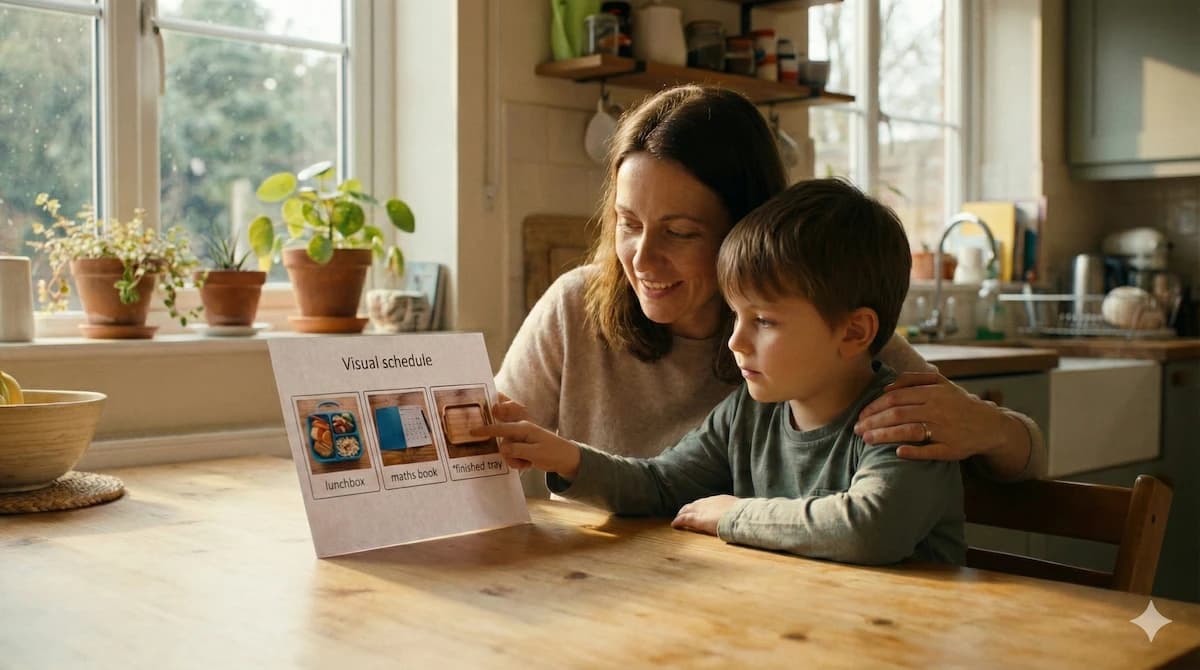
Spoken words disappear as soon as they are said. Visuals stay the same every time, like a stop sign at an intersection. This makes them a reliable, predictable cue. A task can be broken into a numbered picture sequence. For example: get your book, finish the sheet, then hand it in. This helps a child move through the task on their own.
How can families keep visual supports consistent everywhere?
Continuity is tricky because home and school are very different. School follows a strict timetable and set meal times. Home life has different siblings, energy levels, and changing routines. Consistent, tangible supports help bridge this gap. A tool like MyComs helps families create visual supports. These can be daily schedules or weekly calendars. Families can then print and share them everywhere.
What are the benefits of clearer communication for neurodivergent people?
Clearer communication brings benefits beyond the original problem it solves. Children become calmer, and so do the adults around them. Families see fewer meltdowns and more independence. Jenn calls this interdependence rather than independence. People build stronger relationships and take part more in daily life.
How can visuals help prepare a child for hospital visits?
One mother used personal photos to prepare her son for a hospital procedure. She photographed the actual anaesthesiologist and the operating room beforehand. She showed him the photos as it was happening. For the first time, he seemed to understand what was going on. He even smiled. Afterwards, he was not traumatised and felt empowered. The family became more confident about future medical appointments.
Transcript
Read the transcriptAbout 29 min read
Laetitia: Welcome to The Neurodivergent Pulse, where we explore the often misunderstood world of neurodivergence with experts, parents, teachers, and therapists. Grounded in lived experience, each bite-sized episode gives you something practical to try. I am your host, Laetitia Andrac, AI expert, neurodivergent mum, and founder of Understanding Zoe. This podcast is recorded on Dharawal country. I acknowledge that sovereignty was never ceded. It always was and always will be Aboriginal land. Hello, Jenn and Jess. We are doing it. Welcome to The Neurodivergent Pulse podcast.
Speaker: Thank you so much for having us. We're so excited to be here.
Laetitia: Me too. Oh my goodness. The way we met was divinely guided. It was first online, and then we started talking a lot about how we need more women, or people who identify as women, in technology, and bringing technology to the disabled community. So, thank you so much for being here. Before we start the podcast, I always love to give an opportunity to the guests to introduce yourself and your journey, because there is always a beautiful story behind the work that we all do. So, can you share a bit about your own journey? What led you to do what you're doing now?
Jenn: Oh, that's such a beautiful question. Um, so my background, by the way, it's Jenn for the listeners. Um, I am a speech therapist by trade. So, I've been a speechie for a number of years now, but I've been working sort of in the disability space since I was a student at university. Um, where does the journey begin? I think it started in lots of different spaces. I started in sort of private practice, and then I moved into schools, and quite quickly, when I moved into schools, I realised how quickly that environmental shift changes, um, and how important the environment is for, um, young learners that are neurodivergent. Um, I've always been a big champion for families. Um, I think the tools and the skills that I have as a speechie only stretch so far unless I'm also empowering families to, you know, have the right resources, the right tools, the right adjustments, um, to really empower and lead the people that they care so deeply for. Um, so, a speechie, I'm also a mum. Um, and obviously, with Jess, I'm the co-founder of a beautiful assistive technology called MyComs.
Laetitia: Thank you. Thank you, Jenn. Jess, would you like to introduce yourself as well?
Jess: Of course. Thank you. So, I'm Jess, and my background is in teaching. I'm also a positive behaviour support practitioner. I started off my career in early childhood, and very quickly gravitated to the neurodivergent learners in my classroom. And it was just something that, you know, I was magnetised to those learners and those learners were magnetised to me, and it was just a beautiful relationship. It was a great place to start my career. From there, I moved very quickly into transdisciplinary settings, where I got to learn a lot from different allied health professionals. Um, from there, I moved to regional New South Wales, where I currently work as an inclusion consultant and a key worker. And I think for me, my journey really started before I had a lot of the language around executive functioning, around neurodivergence, around anything, you know, that we kind of speak about today. But what I did see was the unique strengths and needs of those children in my classroom. So, I've learned a lot from those children and those families, and I'm really grateful for everyone I've met along the way. I think that continues. Meeting Jenn was also a turning point for me, and she brought this really beautiful clinical depth and curiosity to the communication and the learning in my classroom. We approach things really differently, as we do, from speechie and teacher, but I think that's what makes it really beautiful. And I think, um, creating MyComs and then starting up this journey together has been a really deep dive into our learning, but we continue to collaborate and bring our strengths forward.
Laetitia: I love it. Thank you so much to both of you for giving this beautiful introduction. And I will add to that that you're both very affirming, and we share a set of values, which is really, um, looking at a strengths-based approach rather than a fixing mindset and approach. And that's where I just appreciate our relationship, and I have lots of respect for what you're doing and who you are. So, you mentioned it very quickly, Jess, around executive functioning. So, when we speak about executive overload, what does it really mean in the context of neurodivergent children, and how can we support them better? And I know you're all about visual support, but can you explain a bit for us what it means, this executive overload, executive functioning struggle that we may face?
Jenn: I think I'll jump in there. Um, executive functioning is a really complicated thing to talk about, and I think before we talk about overload, it's important to recognise exactly what executive functioning is.
Jenn: Now, I have been in this space for a number of years, and what I find is that it's important to grab little digestible pieces of what executive functioning is. Every time, you know, just now at a conference, or I'm in a space for learning, or I'm reading a research paper, I find myself discovering new things. Um, and that is simply because the more you know, the less you know. So, looking at it today in terms of the conversation of what is overload, I really wanted to just share a very manageable piece of what executive functioning is, and then, you know, layer in what is an overload. So, the best way, and the best starting point, to understand what executive functioning is, is about recognising that it's the brain's admin centre. Um, it helps us organise information. You know, remember what to do next, shift between ideas, and the big one, manage emotions. So, these skills take years to develop, um, and they grow at different rates for different people, and are very sensitive to things such as stress, uh, language load, unpredictability, and, of course, um, fatigue. So, executive functioning overload is what happens when the admin centre has more to manage than it can hold.
Jenn: And why that's interesting is that it's not a behaviour problem. It's a capacity issue. When the admin centre is sort of in that state of overwhelm, and I'm sure a lot of the families listening today will recognise this, is that we start to see things like, you know, forgetting steps of a familiar task, or, you know, getting stuck or freezing, big emotions in moments that feel quite small, uh, trouble shifting from one activity to another, being unable to start a task even when they want to, or behaviour that can often look oppositional, but where actually it's really just an overload. Um, a good example might be a school-aged child, so a little eight year old who's just come in from lunchtime. Um, and being in the context, Jess and I, of being in schools, we do see this quite often. Um, and that is, they come into the classroom, and as the teacher or the educator in that space, we might say something like, "Okay, grab your maths book, grab your maths book, finish what we did yesterday, um, remember to hand it in, and then we're going to start this task." Oh, I've already forgotten the instructions I gave you. But really, you know, those sorts of, um, demands or instructions require lots of things. And that includes four steps. Um, shifting from play, being in the playground, to a space of learning and focus. You have to, um, manage noise within the classroom. You have to find materials. Um, and you really do need to settle down that body and that nervous system and prepare for attention. If their person's executive functioning, sorry, I should say, is quite stretched, tired, hungry, tricky time in the lunch, in the playground, or they've just simply been processing too much language across the day, those steps and that instruction from their beautiful teacher, educator, can pile up really quickly. And that overload would look like them sitting still and not starting.
Jenn: Them getting up repeatedly just to change pencils, saying, "I don't want to do that." Melting down over the smallest piece of frustration within the task, or refusing, shutting down, or, in many cases, leaving the room. So, none of this means that that child doesn't care, or that they're not capable. It means that their admin centre in the brain has just reached capacity.
Laetitia: Thank you, Jenn, for giving that very clear example, which was my follow-up question. So, it's perfect. You gave us an example which is very tangible, and I can really experience this as a mother of a child who has maybe a window of tolerance that is different to other children, and their admin centre is, you know, kind of quickly overloaded. And so, that's where I would love to ask you, how can we make this easier? And, in this example, let's go back to this example, what are the visual cues, or how visual could really help in, it can be just for you.
Speaker: Is it me? However,
Speaker: I don't know. One of you could.
Jess: I can jump in. I can jump into your examples. So, visuals are really helpful, Laetitia, because if you think about words, they're invisible. They move really quickly. We all say them a little bit differently. So, I might pause and say something. You might be a fast speaker. I might be a loud speaker. And everyone is going to have their preferences. So, language is hard in that way, because as soon as they come out, they're gone. Whereas visuals, they're here to stay. They're concrete. They often don't change. So, let's say, you know, a road sign, for example, I can reliably look at that stop sign every time I'm at that intersection. And that's a really reliable cue for me to know, yep, this is where I stop. It's really clear. I know what to do. It's always here. So, visuals are really, really powerful. They can create really predictable routines. So, returning to that example of the boy who's moved from the playground into the learning space, so he was given four steps. I can't remember exactly what they are. I think that was a maths book, finishing a sheet of work, handing it in, and then getting started on the next task. So, thinking about those four steps, how I might support that young learner in my classroom is, I might have a task breakdown. And what that looks like is a numbered sequence. So, breaking that task into manageable steps. So, rather than saying that whole instruction as one, because that will be what it is interpreted as, I'll break it into four steps. I might have a visual cue of number one, a picture of their maths book, or the maths book's tub, where they know where to retrieve it. Number two, I might have a picture of the worksheet that we worked on yesterday, as a really clear prompt. This is what we were doing yesterday. The third picture, and with the number three, I might have a picture of, um, the tub where I collect those worksheets and those books, so they know that's where they handed it in. And then, number four, I'll have a photo of the new task. So, it's really clear where they are up to in that sequence. And children can then independently move through that without feeling like they have to do all four things at once, or that they haven't done some of it, or they've done it in the incorrect order. It's just a really easy way to support not only that boy, but the whole classroom. So, if I was supporting that boy with that sequence, I wouldn't just provide that support to him. I would likely put it up on the board, or draw it on my blackboard, or have something similar to that, so that the whole class can use it, because likely everyone will benefit from it.
Laetitia: I love what you said, Jess and Jenn. Thank you so much for sharing that. And something that I was reflecting on as you were talking is, um, so my daughters both attend Montessori school, and I'm not promoting Montessori school whatsoever, you know, every school is different, they're an independent school, but the one that we found is so suited for our children because of those visual cues, they're everywhere in the classroom. Every time I go there, there's pictures everywhere. There are steps. The children can move their name in different places, knowing what they're doing. You know, who is feeding the fish and the chicken, who is doing maths, who is doing, you know, their table, like the times table, or whatever it's called. So, when we go as parents to see those classrooms, it's just this kind of sense of peace, because they all know what's happening next. And that's something where, then, you have this beautiful classroom, or at home you're providing this beautiful support and accommodation. But what's difficult is then you move to the grandparents' house, or you move from a home where everything is very supportive to a class where maybe they don't have, you know, the chance of having Jess as a teacher, or a teacher that is very supportive, or the teachers that we have in the girls' school, and then this breakdown. So, how can we assure this continuity? Like, what are the solutions out there to really ensure, is it like moving around with one of those sheets about, you know, the food, for instance, you know, we know that lots of neurodivergent kiddos may have a co-occurring ARFID, and so, how can we ensure that the time of eating is not creating stress, there are steps and there are things, so how could we guarantee this continuity? And feel free to talk about, um,
Jess: Thanks, Laetitia. I think continuity and consistency is tricky, and it's something that we talk about every day, when we're talking to families, when we're talking to schools. It's something that is a challenge for everyone. And I think that's because contexts essentially are so different. So, you know, a home life is always going to be much less predictable than what school life looks like. You know, school's bound by the same kind of time structures, the same meal times. It's really rigid in that way, they have a timetable, and they're bound to follow it. Whereas home life, you know, you've got different siblings, you've got illnesses, you've got different energy levels, you've got someone might be away for work, you know, so all of these different factors can compound to a level of unpredictability. I think the main thing that, um, has worked really effectively for us is having consistent, tangible supports.
Jess: So, um, Laetitia very kindly mentioned MyComs. So, MyComs is a visual supports app that Jenn and I have co-produced. It's made in consultation with people with lived experience. So, families such as, you know, parents and carers of children with autism and different types of disability, um, different types of neurological differences. And so, we really wanted to lean on that experience, as well as our clinical experience, of what is going to be helpful. So, thinking again about that concept of, you know, what is happening next, that's a really easy question for us to ask. That's not always easy for the children that we support. And so, if they can't ask that question, it's our obligation to give them that information anyway, and ensure that it's met their need. So, consistency of supports, I think we have to lean on technology. We're in a technological age. I know it's hard, because screen time is very contentious. Um, but this doesn't have to look like screen time.
Jenn: I think, using a support like MyComs, you know, you can create visual supports that are task breakdowns. You could create a daily schedule, for example, to show the different transitions across your day. You could create a weekly calendar, so your child knows when they're at mum's house, when they're at another carer's house, um, when they have swimming lessons, when they have a dentist appointment. It's all visually shown, and that support can then be printed and shared across environments. So, we developed MyComs because we wanted a flexible way to ensure consistency, but also to give families that empowerment. Currently, we know that, you know, most families who are using visual supports, they're really relying on their therapists, such as their speech therapists, their educators, you know, their behaviour support practitioners, to be resourcing them. That's really hard when that therapist is busy, when they're sick, when they have to move to another state. Um, and so, how can families also access that strategy? That's why we've created MyComs, because it's really easy to create visual supports. Anyone can pick up and do it. There's templates on there. There's examples on there. Um, that's something that can be easily shared across the whole team.
Laetitia: I love it. You answered so many of my follow-on questions with this one, and it's really powerful, because I really think that technology should enable.
Speaker: Yeah.
Laetitia: Rather than be cumbersome and painful. And this is really where I love the synergy we have between Understanding Zoe and MyComs, in the fact that we are not using technology to replace expertise and knowledge. We are using technology to enhance and guarantee this continuity and this consistency, which is actually what's really missing, I guess, in the ecosystem. So, I just, um, wanted to ask you this question, which is, what do we see as being the ripple effect of that when we have a child, or even an adult, who is having clear steps, clear visual communication tools at their disposal, through MyComs, or another way, through, you know, if you prefer to say, with your therapist, and you have a chance that your therapist is always creating those visuals for you. Again, we are not here to replace, but how, what have you seen becoming then easier? What is the ripple effect? Because I always think that when we use a tool like MyComs, like Understanding Zoe, we see that, yes, it's solving this pain point, this problem, but then we can see a ripple effect in other spheres of life, other spheres that may not be, you know, thought about early on. So, yeah, go ahead. What has been the positive impact, the ripple effect?
Jenn: Oh, it's an interesting one, because, you know, there are so many users out there, and we might not always touch what their personal ripple effect is, but we do hear back a lot from users, and I think it brings up an example of a conversation I had with a parent this week. But we know that when communication is clearer, we see children that are more calm. We see calmer adults. And that's a big part of this as well. I mean, when we're communicating, there are two people in a communication exchange. And as the parent, I know myself that can be the biggest point of dysregulation, is when you have a child who is fundamentally experiencing that point of friction. We see fewer meltdowns. Uh, we see more independence, or a term that Jess and I like to use more so, is interdependence. We see stronger relationships. We see more participation, more engagement. Um, you know, the parent I spoke to this week, and again, it, like you said before, beautifully, Laetitia, this is not to replace a therapist, I am a speech therapist, I do have a really strong, um, you know, I wouldn't say influence, but I have a really strong need, and, um, professionally I want to lean in with families and problem solve things that feel tricky. Um, but co-design of those supports is important. Um, me assuming what a routine looks like versus what a routine actually looks like is two very different things. And I think that co-design, with consultation with families or the person themself, you know, let's brush our teeth, how can we break this down, or let's make a daily schedule, like, I know we said we're going to go to McDonald's today, but what are some things we can do first? If that child has that ability, bring in codees, and then the ripple effect will go into other places. I think it's also how you use that tool in a really considered and caring way. But the best thing, so, going back to the comment I made earlier, I connected with a parent this week, and she'd had it on her phone, I think, for two months, and hadn't used it, which is so fun. I'm definitely preaching to the choir there, of, you know, good intent. Um, she just said it was so easy. It was just so easy to make a communication support, such as a choice board. She said that communicating that something wasn't happening till Sunday was easy. I mean, how many times at the moment are we saying that Christmas, oh, it's in this many sleeps. I mean, our Christmas tree has been up since November, but, like, it is really hard to communicate those messages without an anchor. And she said, suddenly, there was an anchor, and the anchor was personalised. It was a photo of the grandparent that was coming to visit. And it wasn't something that was a word that disappeared the second she said it. It was shared in front of them. The photo of Nana was right there, and the days before Nana were clearer, and it wasn't a point of stress. It was a point of understanding. So, the ripple effect is big, but I think we're still being new in the space, where we're hearing different ripples, and I think all of them have impact on Jess and myself.
Laetitia: Yes, I love that. Sorry, Jess, you wanted to say something.
Jess: Yeah, I wanted to share an example of the ripple effect in practice. Um, so, one of the users, she's a beautiful mum. She, um, has two young children who, um, are autistic and also have an intellectual disability. So, one of her boys, um, has a lot of physical health concerns as well. And so, they're often in and out of the hospital. They have, um, he's had to undergo a few surgeries, um, and he's only a few years old. So, it's quite stressful for them as a family. And this particular parent shared with us that it wasn't necessarily the medical, you know, event itself that was stressful. It was the lead up to, and then what followed after, because often what would happen is that event would be quite traumatic for that young boy, because, you know, he didn't feel informed. He didn't know what was happening. He didn't know when it would end. And so, um, after, you know, returning home, he often wouldn't be able to leave the home for, um, days or weeks, unable to attend school. The ripple effect on that family was massive. As you can imagine, people need to go to work. People need life to continue functioning, but it had to come to a screaming halt because it was too much.
Laetitia: Yeah.
Jess: They used MyComs with him, um, during a hospital visit, and he had to go under. So, she managed to get photos of the actual anaesthesiologist and the actual room that they would be operating in. And she showed him the photos as it was happening. It was the first time that she saw him beckon the anaesthesiologist close to him. He looked at the photo, looked at her, smiled, and for that mum, she said that was the first time that I really saw that he comprehended what was happening. And for him to smile in that environment was so significant for her, she could not believe it. That then had a beautiful ripple effect, in that he was not traumatised. He felt empowered. The next day, he actually wanted to revisit her phone and just look at the photos, to really reflect on the experience. But now, as a family, they feel so much more empowered to have medical experiences and to go to appointments and do the things that they have to do as a family that are non-negotiable. So, I think that story brings us to tears all the time, um, because it's just so special. But I think that's an example of what a simple bit of information can do.
Laetitia: I love it. And this is where, what I love with MyComs. MyComs is about understanding what's going to happen. Understanding Zoe is about feeling understood. And without understanding what's going to happen, or what's, you know, happening right now, what you're going to do next, and so on, and then without the other part, of feeling understood, your sense of safety is actually really impacted. And that's where we always go back to safety, or I always go back to safety. You can disagree with me there, Jenn and Jess. But we have, um, really two rules in our family, is it safe and is it respectful, and those are very simple rules, only those two rules, respectful towards oneself and others, and safe towards oneself and others. And those are, you know, things that really, I think, are embedded in this concept. So, thank you so much for sharing that story, Jess. It was really moving for me as well. And, um, and I know that sometimes a visit to the dentist, you know, not going as, you know, extreme as going to the hospital, having that kind of step of preparation, you know, showing what the room looks like, who is going to be the person, really helps in our family to de-escalate the demand and the overwhelm and the feeling of, oh my goodness, what's going to happen next, and so on. So, thank you so much. So, before I let you go, because we're already at time, I just want to ask you, what is one visual or one strategy you personally can't live without? I can share mine if you want, but, uh, yeah,
Speaker: You go first, for sure.
Laetitia: Oh, you want me to go first? It's when I record the podcast. Because otherwise, it happened to me in the past, I had another podcast before, for about four years, so it's not like I'm a new podcaster, it's just, I need those steps, because I get into the conversation and I forget to record, or I forget to, you know, pull up the questions that I've prepared. So, I have those visuals posted, and steps that are here, that I can be like, okay, so do this, do that, do this. And it's as simple as post-it notes for me. But that's something that really helps me, and I can't live without post-it notes. Maybe because I'm a former strategy consultant, but post-it notes are my life. Um, so yeah. So, that's me. What about you?
Jenn: Oh, I'll go first. Um, mine is a weekly calendar. So, in MyComs, we have weekly calendars, and they're great, and I use, my children both have one, because I'm a personal user as well, but I have one in there myself. And that weekly calendar is my meal planner. And it just takes that executive functioning load off my brain, so I know how to plan out my week. Because the second I feel like the kids go out the door, they're straight back in, and it needs to be on the table, and Jess will laugh, because it always seems it should just be bolognese, really. So, um, but a weekly planner is just such an important one, you know, for me, and my needs, and the demands in my life, but also for my children, because there's always something to look forward to in that. And there's also things to solidify and say, hey, like, you know, Jess was talking about before, some things are non-negotiable. Um, and they can cause friction, but it's important that there's at least a level of forewarning that they're going to happen. So, absolutely, a weekly calendar for me.
Laetitia: I love it. What about you, Jess?
Jess: Uh, for me, I think it's Instagram. That's probably a visual support for me, because if I'm going to a new restaurant, or I'm looking up, you know, an Airbnb, I'm looking up a park, even when I was going cherry picking last weekend, I was like, I'm going to look them up on Instagram, and I'm going to look at the photos, and I'm going to see if that's the kind of sensory environment I want to be in. And I think those photos, you know, when you talk about safety, Jenn and I often talk about photos as being an anchor for emotional security. They just bring so much, um, connection, but also a real sense of safety, you know, and I think that's something I probably use all the time.
Laetitia: I love it, and it's so true, and we say that a picture is equivalent to a thousand words. So, that's really that, and I do the same, you know, before someone's telling me we go to this restaurant, I look at, you know, the menu, of course, but also their Instagram, what does this meal look like, is it something that I feel is too, is it too small? Does it look too elaborate? Will I feel safe eating this? You know, it's like those moments where, I love it, it's so good. Such a simple one, but it's true. I rely on it too.
Jenn: Can I add on that as well, that with MyComs, the one thing that families do love about it, and why we built it the way we did, is that it is somebody's personal photos. And I think in our industry, a lot of people that, you know, are tapping into this podcast might go, "Oh, yeah, we use visuals." And often they are cartoon drawings, and there is a space for that. But the difference between a cartoon and a photo is very different, because a drawing of a classroom versus the classroom your child is going to can be the difference between understanding and transitioning versus, I'm confused. So, you know, a little bit like Instagram, I was laughing, Jess, because I, Jess Instagrams a lot, but Jess is very quiet on Instagram. I should be more like Jess. But, um, the idea is that there's anchored meaning. You know, when we book a hotel, we scrutinise those photos. When Jess goes cherry picking, she's looking at the photos, the details, looking at cartoon images. The information is so salient, and it anchors exactly what to expect. And that's exactly why we built MyComs, so that families could put their camera roll into supports and reflect their life, not someone else's.
Laetitia: I love it. So, I had a tagline for you, because, you know, I'm like, I'm a former strategy consultant, and I look, oh, it's like you are the Instagram of communication, you know,
Jenn: This is it, like, you know, how, like, we are the Airbnb of this, we are the Instagram of that,
Laetitia: This is it. So, for anyone who made it this far on the podcast, I would just love for the listeners to know how they can find out more about MyComs. How can they connect with each of you? What are the ways for that? And it will be all written in the show notes.
Jenn: So, MyComs, because it's been asked before, is spelled M, Y, C, O, M, S, and the best way of remembering it is to think it's called My Communication Supports. We're available on Android and Apple. Um, you can download us. We're about to release the iPad version, which is very exciting. So, if you're listening today, that means you can download it. Um, we're available in Australia, but very soon we'll be available internationally, which is important, um, to reach those families that are curious and in need. Otherwise, we're also on Instagram. So, MyComs felt the same way before dot a u u. So, please jump on. Please give us a follow. We also offer professional development to, um, allied health services, schools, preschools. Um, and we're really excited. It's definitely first and foremost, we're clinicians. Um, we're educators, and then, you know, women in tech is maybe a bit of a stretch,
Jenn: secondary, but we're learning, and we're very excited and very humbled by the opportunity to help families the way that we do.
Laetitia: Thank you. Thank you, Jess and Jenn, for coming today on the podcast.
Speaker: Thanks for having us, Laetitia. It's been great.
Laetitia: Welcome, Zoe, for another episode of The Neurodivergent Pulse. And I am going to ask you a question right now. Zoe, what kind of pictures or visuals help you remember what to do?
Zoe: Um, it, like, says everything, like, it says, for example, the rules, like, we use kind voices and words. Um, and also the pictures that bring you to another world.
Laetitia: And where do you see more often those visuals, and how do they help you?
Zoe: Um, I mostly see them in the class, and they help me by telling me how the world really is.
Laetitia: So, which one is your favourite visual of all of them?
Zoe: Um, we've got this very nice picture in my class of, um, Maria Montessori, um, sitting down with children, reading a book.
Laetitia: And you like this picture?
Zoe: Yeah.
Laetitia: What does it say?
Zoe: It doesn't say anything. It's just a picture.
Laetitia: Yeah. But what does it mean for you when you see that picture?
Zoe: Um, it means others have already been in the school, and like me.
Laetitia: Thank you, Zoe, for sharing today.
Zoe: Bye.
Laetitia: Bye. That's a wrap for The Neurodivergent Pulse. If this helped, follow the show and leave us a quick review on your favourite platform. You can even share this episode with someone who needs it. You can learn more about our platform at understandingzoe.com. Thanks for listening.
Subscribe to The Neurodivergent Pulse.
Follow the show so a new episode finds you. It's free.