Every behaviour is communication: co-regulation guide
When a neurodivergent child is dysregulated, their frontal lobe is offline, making words inaccessible. This article, based on Episode 37 of the Neurodivergent Pulse podcast with speech pathologist Alana Cameron, reframes behaviour as communication and shows parents and educators how co-regulation actually works. Learn why "use your words" deepens dysregulation, how to recognise your own nervous system cues, and what neuroaffirming support looks like in practice, from meltdowns to classrooms.

In short
Knowing how to calm a dysregulated child starts with one shift: stop expecting words and start offering presence. Every behaviour is communication, and during dysregulation the part of the brain that produces language is offline. As Alana Cameron explains, "nervous systems speak well before the words come out," which means co-regulation is what actually helps: less language, no questions, a calm adult who stays present. This applies whether you are navigating a meltdown, a shutdown, or a silent stare. Validation comes before problem-solving. Name the feeling, signal safety, and let the nervous system settle. Start there, and the rest becomes possible.
You say it with the best intentions. Your child is melting down, words are failing, and you reach for the one thing that feels logical: "Use your words." And then you watch it make everything worse. The crying intensifies. The shutdown deepens. They look at you like you've asked them to solve a maths problem in a language they've never heard.
If that moment sounds familiar, you are not doing it wrong. You were just never taught what to do instead. Neither were most of us. That exhaustion is real and widely shared: according to our research on neurodivergent families, 64% of parents raising neurodivergent children often feel exhausted and 64% feel overwhelmed, compared with 42% and 32% of parents raising neurotypical children. The gap is not a reflection of effort. It is a reflection of a system that never gave anyone the right tools.
In Episode 37 of the Neurodivergent Pulse podcast, host Laetitia Andrac speaks with Alana Cameron, speech pathologist, neurodiversity advocate and founder of NeuroNurture, about what neuroaffirming support actually looks like when children are overwhelmed, dysregulated or unable to access spoken language. Drawing on both her clinical training and her own experience as a neurodivergent person, Alana offers a shift that changes how you see every meltdown, shutdown and silent stare: nervous systems speak before words do, and connection is what helps them settle.
Every behaviour is communication: what is your child's body saying?
The single most important shift Alana offers is this: stop asking how to stop the behaviour, and start asking what the behaviour is saying. "Well, everything, every behavior is some form of communication. So at the heart of it, that's where we should all be looking at in terms of what are they communicating," she says.
That includes physical outbursts, sensory seeking, withdrawal, stimming and intense verbal reactions. All of it is a message from a body that is trying to make something known. Seeing behaviour as communication matters most during meltdowns and shutdowns, because communication extends far beyond spoken words. Even children who have plenty of words when they are calm cannot reach those words during dysregulation. "Even if they have all the words when they're regulated and calm, they're still not accessible clearly in the moments when they're dysregulated," Alana explains. The words have not disappeared. The access to them has.
This reframe changes how we respond. Instead of asking "how do I get them to stop this?", the question becomes "what is their body trying to tell me?"
Why "use your words" makes meltdowns worse
When a child is dysregulated, their frontal lobe is effectively offline. That is the part of the brain responsible for logical thinking, reasoning and language. Prompting them to communicate verbally in that moment does not just fail to help; it can deepen the dysregulation by adding pressure to a system that is already overwhelmed. And none of this is your fault. You were doing what felt logical.
Alana is direct about this: "Don't push them if, especially if they're shutting down. Don't ask them to keep doing the thing or ask them more questions. They're shutting down. Their frontal lobe, which is where our logical thinking is, is turned off." There is no one available to reason with. The kindest thing an adult can do is stop expecting words and start offering presence instead.
Nervous systems speak well before the words or however we communicate come out. So it's less words the better, no questions.
This is not about giving up on communication. It is about understanding that co-regulation has to come first, and that a calm, present nervous system beside a dysregulated one is doing more work than any prompt ever could.
How to calm a dysregulated child: what co-regulation actually looks like
Knowing how to calm a dysregulated child starts with one counterintuitive truth: it is not a technique you perform. It is a state you model. Co-regulation means your regulated nervous system becomes the anchor for theirs, and that happens through presence, not prompts. For parents who want to go deeper on understanding your child's nervous system through a polyvagal lens, occupational therapist Kaya Lyons offers a useful framework for recognising early cues before overwhelm escalates.
Alana's practical guidance is concrete. Instead of instructing a child toward a safer outlet, you show them. "Instead of, you know, throwing a pillow at someone, it's modeling throwing a pillow at the wall or at the bed, or punching a pillow on the bed if they're needing that kind of outlet." If they need calm, you create calm nearby. You build the Lego. You sit quietly. You let them come to you when they are ready.
Here is what that looks like in practice:
Use fewer words, not more. Questions and instructions add cognitive load to an already overwhelmed system.
Skip the questions entirely. "Why did you do that?" and "Can you calm down?" are both inaccessible during dysregulation.
Get on or near their level, without crowding them. Proximity signals safety; looming signals threat.
Model the regulating action you want to see. Punch the pillow into the bed yourself. Build the Lego nearby. Show them what settling looks like.
Let them know you are there with simple language: "I'm here when you're ready. I can see you're super frustrated, sad, angry. That's okay."
Wait without pushing. The child will come back to connection when their nervous system is ready. Your job is to still be there when they do.
When an adult stays regulated and available through a meltdown, without withdrawing, punishing or escalating, the child's nervous system learns that connection survives hard moments. That is worth more than any technique.
Pip remembers the appointments, the notes and the small wins, so you don't have to.
7 days free on iPhone and Android.
How to recognise your own dysregulation cues before responding
You cannot co-regulate a child if you are already dysregulated yourself. It is the part that trips up even the most well-intentioned parents and educators, and it rarely gets enough attention.
It helps to understand just how much parents of neurodivergent children are already carrying before a meltdown even begins. On average, parents spend around 10.5 hours every week on emotional regulation, advocacy and administration alone, on top of roughly 30 hours of caregiving overall. By the time a hard moment arrives, the nervous system has already done a full day's work.
"You need to know your own dysregulation cues," Alana says, "which comes into play around that re-parenting framework." Before you can stay regulated beside a melting-down child, you need to know what your own escalation feels like in your body. For practical co-regulation strategies for neurodivergent families, including what this looks like when partners experience the world differently, the UZ founders share their own story.
Common dysregulation cues to start noticing in yourself:
Racing thoughts that are hard to slow down
Heart rate rising faster than the situation seems to warrant
The urge to snap, yell or say something you will regret
Words tumbling out without making sense
Physical tension in your jaw, shoulders or chest
A sudden narrowing of focus, where everything feels urgent and nothing feels manageable
Alana is honest that this is ongoing work, not a box to tick. "Some days as well, if my client kid has, you know, lost their rocker and is flipping their lid, I have to work extra hard to stay in my body to help them co-regulate. We're not perfect. We're all humans, and we all have our own nervous systems." If a trained speech pathologist still has to actively work at this, a parent doing it in the middle of a school morning rush is not failing. They are doing something genuinely hard.
Learning your own cues is not a personal failing to correct. It is a foundational skill that most of us were never given the chance to build. If you are finding it hard to track all of this alongside the daily demands of supporting a neurodivergent child, Understanding Zoe can help you capture observations, meltdown patterns and what you notice about your own responses, so the insights from conversations like this one do not get lost in the rush of daily life. Try it free for 7 days.
What neuroaffirming support looks like in the classroom
A teacher is not just managing a curriculum. They are regulating up to 30 nervous systems at once, and their own nervous system sets the tone for every single one of them. "The teacher's nervous system speaks for the whole class, and then the class and the peers, we all kind of feed off each other subconsciously, unknowingly," Alana explains.
For neurodivergent students, this effect is amplified. They are picking up on emotional cues, body language, light, sound, smell and the tap of a pen across the room, often at a higher intensity than their neurotypical peers. That means they reach dysregulation faster, and they need more from the environment to feel safe enough to learn. For a deeper look at what neuroaffirming classrooms look like in practice, including Universal Design for Learning and how teachers and parents can work together, we have explored this in depth elsewhere.
Alana's advice to teachers is simple, and it costs nothing:
Be a human first before your job because that's when, as humans, we want to connect to another human, to another human.
Families feel this deeply. Research with parents of neurodivergent children consistently shows that affirming, respectful language and genuine human connection are among the things they value most, with 62% saying affirming language is very important and a further 26% saying it is quite important. The words adults use, and the warmth behind them, shape how children see themselves.
Connection is what regulates. When a student has a safe person in the room, someone who knows them, sees them and is genuinely interested in them, that relationship becomes the scaffolding everything else rests on. For more on building authentic connections with neurodivergent young people, including the PACE framework and repair strategies, psychologist Isobel Ziatas offers a practical guide. Teachers already know their students deeply by the end of a year. The invitation is to let that knowing show, especially in the hard moments.
Validation before problem-solving: the sequence that actually works
Validation is not the same as agreement. It does not mean telling a child their behaviour was fine. It means acknowledging that their feeling is real, and that real feelings are allowed.
It's okay if you have feelings, no matter what's kinda happening. Because a feeling is always valid because it's what you're feeling in the moment.
Laetitia shared in the episode that ADHDers reportedly receive up to 20,000 more pieces of negative feedback by age 12 than their neurotypical peers. The cumulative effect of that is visible in many neurodivergent adults, including Laetitia herself, who described still apologising constantly today: "I must be doing something wrong because I don't do it in the way society and norms are expected of me." Chronic over-apologising and self-doubt are often the long-term residue of childhoods where feelings were corrected rather than validated. Shame tends to follow.
That sense of not being seen or believed runs through the whole family system, not just the child at the centre of it. Understanding Zoe's research findings show that 93% of parents of neurodivergent children say their experience feels misunderstood or invisible. Validation, it turns out, is something everyone in the family needs.
Alana puts it plainly: "your brain doesn't give up until it's, it feels heard." A child who is not getting validation will keep escalating, not because they are being difficult, but because their nervous system is still trying to get the message through. Validation interrupts that loop. Simple language works: "I can see you're frustrated. That's okay. I'm here when you're ready." No fixing. No redirecting. Just presence and acknowledgement, first.
What neuroaffirming support looks like in practice
Connection, when it is real, is something you can feel from across a room. Alana shared a story from a recent visit to a high school that captures what neuroaffirming support looks like when it is working.
Her client, a student who had spent the morning getting up and down from her chair and moving around the room, settled into a play-script reading task she loved. There was no prompting to start. The teacher sat beside her, and they looked at each other and smiled as the class took turns reading aloud. "Seeing that connection of the teacher and the child together, and seeing how easily that meant the child getting the learning task done... It just happened because there was connection, and I could feel the connection from the other side of the room."
No prompts. No corrections. No "why aren't you doing it?" Just a teacher being a human beside a student, and a student who felt safe enough to learn. Not a perfect script or a flawless technique. Small, genuine moments of connection that made everything else possible.
This week, see if you can notice one of those moments, at home or in the classroom. They are already happening. The invitation is to protect them, and to create the conditions where they can happen more often.
Frequently asked questions
What is the difference between an autistic meltdown and a shutdown?
A meltdown and a shutdown are both responses to nervous system overload, but they look very different. A meltdown tends to be outward: crying, physical outbursts, intense verbal reactions. A shutdown is inward: withdrawal, silence, going still or unresponsive. Both are involuntary responses to overwhelm, not deliberate behaviour. Understanding which one your child is experiencing helps you respond in the right way, because both need safety and reduced demands, not prompts or questions.
How do you calm a dysregulated child without making it worse?
The most effective way to calm a dysregulated child is to reduce demands and offer co-regulation rather than instructions. Use fewer words, skip the questions, and get near them without crowding. Model the calm or the outlet you want to see: sit quietly, build something nearby, or show them how to punch a pillow into the bed. Let them know you are there: "I'm here when you're ready." Your regulated nervous system beside theirs is doing more than any prompt. For more on tracking patterns and responses, Understanding Zoe can help.
What does autistic dysregulation feel like from the inside?
Dysregulation feels like losing access to your own thinking. The logical, language-producing part of the brain goes offline, which is why words become unreachable even for children who are usually articulate. Sensory input feels louder and more urgent. Emotions arrive with no buffer between the feeling and the reaction. For many neurodivergent children, this happens faster and more intensely than for neurotypical peers, which is why co-regulation from a calm adult matters so much: it gives the nervous system something external to anchor to.
Why does my child lose their words during a meltdown?
During a meltdown, the frontal lobe, the part of the brain responsible for language, reasoning and logical thinking, is effectively offline. This is not a choice or a manipulation. As speech pathologist Alana Cameron explains, even children who have plenty of words when calm cannot access them clearly during dysregulation. Asking them to "use their words" in that moment adds pressure to an already overwhelmed system. The words come back when the nervous system settles, which is why helping with autism meltdowns starts with regulation, not communication. Understanding why visual supports work when words fail can help you build practical tools for these moments.
Connect with Alana
Website: neuronurture.co
Instagram: @neuronurture.co
Email list (written for teachers, valuable for parents too): sign up at neuronurture.co
Pip is not a doctor or therapist. It helps you organise and prepare, not diagnose or treat.
In a crisis call 000. Lifeline 13 11 14. Kids Helpline 1800 55 1800. 13YARN 13 92 76.

Ready to put it all in one calm place?
Tell Pip one thing today. It remembers the rest.
Stored in Australia, encrypted. Cancel before day 8 and you won't be charged.
Related articles

Rejection sensitivity in kids with ADHD: A parent’s guide to building confidence and connection
Explore the misunderstood world of rejection sensitivity in kids with ADHD through heartfelt stories and practical advice. This guide unpacks why everyday setbacks hit so hard, the unique challenges for culturally diverse families, and step-by-step neuroaffirming strategies to foster resilience and confidence. Whether you're navigating stigma or searching for support, discover how compassion and understanding can transform your family’s journey.
Read more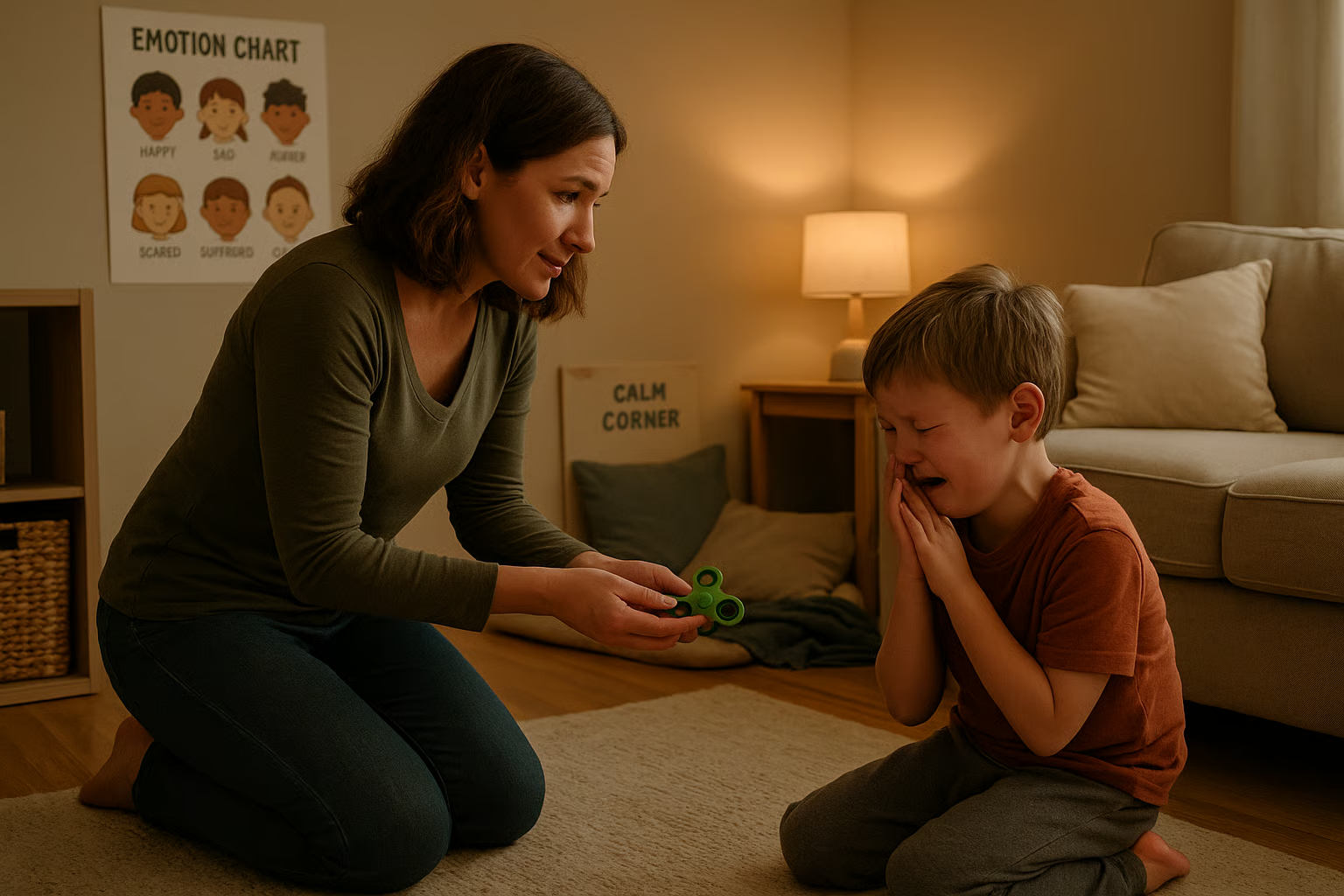
Calm in the chaos: Practical, hopeful strategies for managing emotional outbursts in neurodivergent children
Dive into a compassionate, action-packed guide for parents navigating emotional outbursts in neurodivergent children. Discover how to confidently distinguish meltdowns from tantrums, identify triggers, and apply neuroaffirming strategies that soothe big emotions. Through relatable stories and easy-to-use resources, this article empowers families to transform chaotic moments into opportunities for connection, resilience, and hope. It reminds you that calm is possible, and you’re never alone.
Read more
Communication breakdown: How visual supports ease executive overload
Why do visual supports work when words fail? In this Neurodivergent Pulse episode, speech pathologist Jenn Winstone and behaviour support practitioner Jess Shahbazi explain executive functioning overload as a capacity issue, not a behaviour problem. They share how visuals create "anchors for emotional security" that help neurodivergent children understand, transition, and thrive. Includes practical strategies and a moving hospital story.
Read more