Raising neurodivergent children: How to embrace the chaos
What if your child didn't need fixing, and neither did you? Tracey Jewel shares her journey as an AuDHD mum, exploring radical acceptance and the power of micro moments when raising neurodivergent children. Discover why embracing the chaos isn't giving up, how to reconnect with your own self-care tools, and finding joy in the day-to-day reality of who your child actually is.
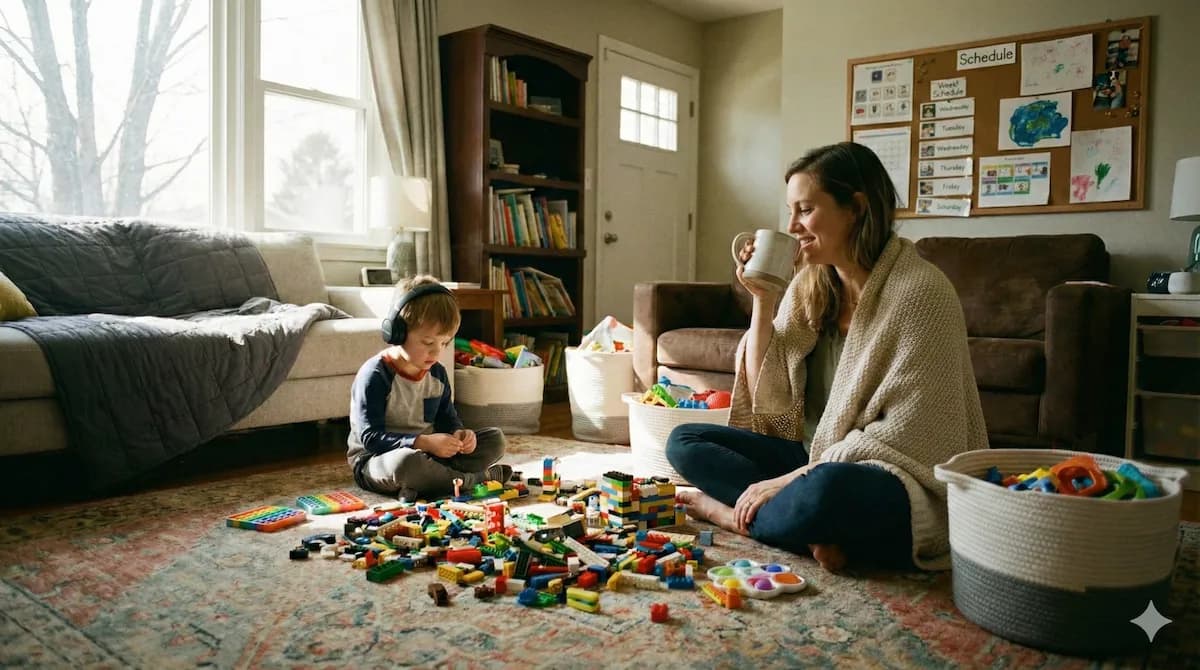
In short
Tracey Jewel is an AuDHD mum and founder of Inclusive Mamas Club. She says embracing the chaos is not giving up. It means dropping the false hope that life starts once things settle. Notice the micro moments of connection instead. And find your own comfort tools, not just your child's.
What if you stopped trying to fix anything? For parents raising neurodivergent children, that question can feel radical. We are surrounded by therapy recommendations and intervention plans. There is well-meaning advice about helping our children "catch up" or "fit in". But what if the path forward is not about fixing anyone at all?
In Episode 17 of the Neurodivergent Pulse podcast, Laetitia Andrac sat down with Tracey Jewel. Tracey is an AuDHD mum, carer and founder of Inclusive Mamas Club. Their conversation moves through the daily chaos, the grief and the unexpected magic. They talk about shifting from "doing it right" to radical acceptance. That shift can change everything.
As Tracey shares, embracing chaos does not mean giving up. It means showing up. For our kids, for ourselves, and for the micro moments of joy in between.
When professional experience meets lived reality
Tracey's journey into neurodivergent parenting began with what she calls a "life circle full moment." She had over 15 years in the disability sector, including NDIS and aged care. Nothing quite prepared her for becoming a parent. She was now navigating those systems from the other side.
"It's very different when you work in a sector and then it lands," Tracey explains. "You're suddenly a mum navigating the paperwork and the therapies and government and schooling and education and support work and everything."
Her son Frankie was diagnosed at three years old. Tracey faced the same bureaucratic maze she had once helped others through. Now it carried the added weight of parental love and worry. This eventually led to her own late neurodivergent diagnosis. It brought beautiful lessons and profound challenges.
Some 63% of parents raising neurodivergent children are neurodivergent themselves. For them, Tracey's story will feel deeply familiar. Lived experience and professional knowledge are valuable. Neither shields us from the emotional reality of the journey.
Why "embracing the chaos" isn't giving up
Laetitia was pregnant with her daughter Zoe. Well-meaning friends gifted her "What to Expect When You're Expecting". It is the bible of Australian parenting books. But as Zoe grew, nothing matched.
"Where does my baby fit in this book?" Laetitia recalls wondering. "She doesn't sleep in this way. She doesn't do the napping."
Tracey knows this frustration intimately. "Where is the what to expect when you have a neurodivergent child book?" she asks. "I'm still waiting for that book."
There is a gap between expectation and reality. That is where "embracing the chaos" becomes essential. The idea is rooted in therapy work around radical acceptance. Life with a neurodivergent child does not follow the standard script.
"I feel like that is so true when you do get that diagnosis or you're trying to navigate life with a neurodivergent child because you can't do the everyday things that we take for granted," Tracey explains. "Like going to the shops is suddenly something that takes, you know, half a day just to get there for 5 minutes sometimes or you stay in the car."
It matters to recognise the trap of "false hope". You wait constantly for things to improve. You wait for the chaos to settle. You wait for life to finally begin.
Sometimes you get in this loop of waiting and hoping for things to be better. And when you live this life, because it is such a spectrum and it does change every day, I think that becomes almost a false hope. You're setting yourself up like always waiting for that day to suddenly be happy.
Instead, Tracey and her family "flipped the script". They found joy in who their son actually is. Not in who they hoped he might become.
The power of micro moments
Tracey is honest about the grief that accompanies this journey. When she recorded this episode, her son Frankie was in "hypo mode". He was very withdrawn. He did not want to leave his room or engage with toys.
"There's some grief in that because I want to engage in play, you know, and do things with him," she shares. "So I have to go through my own process of that, but also get past that and connect where he is."
Connection, Tracey has learned, often happens in tiny, unexpected moments. She describes sitting near Frankie with her tablet or a book. Not touching. Just being present. He follows coloured balls on his screen, his current special interest. Hours might pass in silence. Then:
"He'll turn to me and he'll go, 'Those balls are handsome, Mom.' Like, he says they're beautiful, but he says, 'They're handsome. Those balls are handsome.' And he's got the most wicked sense of humour. And I will, that will just light me up."
These micro moments of connection require presence and attention to notice. They will not look like the connection in parenting magazines. But as Tracey explains: "When he's in such a withdrawn moment, you have to hang on to those things."
Savour the small moments rather than mourn the absence of bigger ones. That lets grief and joy coexist. "I feel all the grief that it doesn't look a certain way," Tracey acknowledges, "but oh my goodness, when those little connection things happen and he comes out with like the cutest things, I'm just like my heart just lights up."
Pip remembers the appointments, the notes and the small wins, so you don't have to.
7 days free.
Where did your tools go?
One of the most striking realisations came from Tracey's peer support groups. Mums shared the sensory tools they had bought for their children. Weighted blankets, fidget toys, chew toys. Tracey noticed something troubling.
The house is just like every room is taken over by all these tools to help our children. And of course, this is what we do, right? Where's our tools? Where did our tools go?
Tracey realised her own comfort items were tucked away in cupboards. Those were the things that filled her cup. Her fluffy sensory cushions and textured blankets. Her quirky coffee mugs with inspirational sayings. Her crystals and oracle cards. All hidden, all unused.
"When have we had a moment of writing down and purchasing a couple of things that we love?" she asks. "Going to a day spa is out of the question at this point in my life. So, let's bring some of those tools home and have them around us where we can actually access them."
Understanding Zoe's research covered over 1,000 families. Parents of neurodivergent children consistently report higher exhaustion and overwhelm. That is compared with parents of neurotypical children. Finding ways to fill our own cups is not indulgent. It is essential.
As Tracey puts it: "If we have a bit of a full cup, we all know and the research shows of course that then we can co-regulate our kids and we can actually be in an open mind to find those connection points."
Her suggestion is simple but profound. Write your own list of all the things that fill you up. Not the sensory toys for your kids. The ones for you.
Reconnecting with your inner child
Tracey has also found unexpected connections through playfulness. She revisits her own childhood interests. Frankie's meltdowns are often marked by repeated phrases like "Don't look at me". Tracey has developed a creative approach.
"I put on like a goofy or a Mickey Mouse voice and repeat it back to him, but get it wrong. So, then he has to, you know, say it back to me, but say, 'No, I'm saying this.' And then he starts laughing and then we start laughing."
It does not always work, Tracey is quick to add. But tapping into her own inner child creates real connection. It works during difficult times.
Raising Frankie has also allowed Tracey to do things she missed in childhood. She grew up in the 80s with rigid gender roles. She played with dolls while her brother got Lego. "Now having a beautiful boy, I love playing with Lego, you know, like, and building things, things that I missed out on as a kid."
Laetitia shares a similar experience. As a child she was obsessed with dogs and never got one. So she leapt at the psychologist's suggestion. A dog might help Zoe's anxiety. "Don, we're getting a dog," she remembers saying to her husband. The dog now serves as a therapy dog for the whole family. But as Laetitia admits, "It's my dog. I am just so happy to have him."
These experiences point to something beautiful about neurodivergent parenting. You get to heal alongside your children. You rediscover parts of yourself you buried long ago.
Finding support without waiting for perfection
As Tracey wisely notes, even therapist recommendations often do not work as expected. Parents try speech therapy, OT, psychology and dietitians. They still find approaches that do not quite fit their child.
"You have to give up the desire that everything's going to work for you or that it's going to be perfect," she advises. "It might have worked last week and this week it's an absolute hard no."
Do not search for a perfect cure-all. Tracey suggests building on what works, however small. "Hold on to the micro moments that do work and just build on that like building blocks."
Tracey's Inclusive Mamas Club offers peer support groups online and in person. They are for mums and female caregivers of neurodivergent children. Sometimes the most valuable resource is not another therapy. It is knowing you are not alone.
What radical acceptance actually looks like
Embracing the chaos is not about giving up on your child or yourself. It is about releasing the fantasy of how things "should" be. It is about finding genuine connection in how things are. Your child is Autistic, ADHD, dyslexic or otherwise neurodivergent. That is who they are. Not something to grow out of.
Stop telling us that they'll grow out of it. Help us find joy in those moments of difficulty or help us find the support and the understanding that we need.
The chaos is not going away. But within it, there are micro moments of pure connection waiting to be noticed. There is your inner child, ready to play Lego or finally get that dog. There are your own comfort tools, waiting to be retrieved from storage.
And there is a community of parents who understand. They are ready to remind you of something. You do not have to wait for the chaos to end. Joy is available within it.
This article is based on Episode 17 of the Neurodivergent Pulse podcast by Understanding Zoe. Find the Neurodivergent Pulse podcast wherever you listen to podcasts. Tracey Jewel's full conversation is in Episode 17.
Reflection prompt: what is one comfort tool you have tucked away? Could you bring it back into your daily life this week?
Connect with Tracey Jewel on Instagram and explore Inclusive Mamas Club for peer support groups.
Pip is not a doctor or therapist. It helps you organise and prepare, not diagnose or treat.
In a crisis call 000. Lifeline 13 11 14. Kids Helpline 1800 55 1800. 13YARN 13 92 76.

Ready to put it all in one calm place?
Tell Pip one thing today. It remembers the rest.
Stored in Australia, encrypted. Cancel before day 8 and you won't be charged.
Related articles
Neurodivergent parent overwhelm: From crisis to clarity
Neurodivergent parents raising neurodivergent children face a dual load that rarely gets named or supported. In this episode, Michael Coles, a 51-year-old autistic ADHDer and neurodiversity advocate, shares how capturing overwhelming moments transforms them from crises into patterns and plans. Learn how tools that reduce cognitive load, connect fragmented information, and affirm parental self-care can shift families from reactive overwhelm into proactive clarity. Michael's honest conversation reveals that supporting yourself is foundational to supporting your child.
Read more
Tips for raising a neurodivergent child: mindset over method
After an autism diagnosis, parents often feel they need the right method or technique. Autistic family consultant Maisie Soetantyo argues the opposite: mindset matters far more than method. This article explores why curiosity and radical acceptance are the most practical tools for neurodivergent parenting. Learn how to trust yourself as a parent, protect your child's identity, and create a home where they can simply be themselves.
Read more
Late realised AuDHD motherhood: overstimulation to understanding
For many women, motherhood is when AuDHD finally becomes visible. Samantha Johnson, a late-identified AuDHD mother and lived experience educator, explores why the combination of executive function demands, sensory load, and postpartum hormone shifts makes masking unsustainable. Learn how each developmental stage compounds the load, why parenting gets harder (not easier) for neurodivergent mothers, and practical strategies for managing overwhelm without pushing harder.
Read more