In short

Executive dysfunction is when starting, organising or finishing tasks is far harder than it looks. You know what to do. You may badly want to do it. The task still will not start.

Executive functions are the mental skills that help you plan, focus and switch. Stress and poor sleep make them harder for everyone.

Source: Adele Diamond, University of British Columbia, Executive Functions, Annual Review of Psychology, 2013.

We use “executive dysfunction” because it is what most people search for. In our community we say executive function differences, because nothing is broken.

It is common in ADHDers and in many Autistic people. This page is about tasks: starting, switching and finishing. It does not cover the emotional side of ADHD.

What executive dysfunction feels like from the inside

Many people describe a wall between knowing what to do and doing it.

You might sit for an hour, fully aware of the email you need to send. Or you start five things and finish none. Or the first step is so unclear that nothing happens at all.

It can be worse on some days than others. That makes it easy for other people to say you managed yesterday. It also makes it easy to blame yourself.

What executive functions actually are

Executive functions are the mental skills that help you plan, focus and adapt.

In 2013, Adele Diamond of the University of British Columbia reviewed the research. She described three core executive functions.

The first is inhibition, which means holding back an impulse or ignoring distractions. The second is working memory, which means holding information in mind while you use it. The third is cognitive flexibility, which means switching between tasks or ways of thinking.

Planning, organising and problem solving all build on these three. So when one is stretched, many everyday tasks feel harder at once.

3

Core executive functions: inhibition, working memory and cognitive flexibility.

4

Everyday strains that weaken them: stress, lack of sleep, loneliness and lack of exercise.

Source: Adele Diamond, University of British Columbia, Executive Functions, Annual Review of Psychology, 2013.

That second point matters. A hard week can make tasks feel impossible. That is not a lack of effort. It is how executive functions work in every brain.

Why tasks won't start for ADHDers and Autistic people

For many ADHDers, executive function differences are at the heart of daily life.

Podcast

“I certainly have many of those”

“So for ADHD in particular it would be mostly around your executive functioning struggles. I certainly have many of those.”

Johanna Badenhorst, clinical psychologist and ADHD mentor, speaking on The Neurodivergent Pulse, episode 21, 17 February 2026.

Johanna was assessed as ADHD herself as an adult. She describes how the sheer number of steps can overwhelm. The order of tasks gets muddled, and noise adds to the load.

For Autistic people, she says, overstimulation and inertia can play a bigger part. That means the shift between tasks is often the hardest bit. We explore this on our page about Autistic inertia.

If you are Autistic and ADHD, both can happen at once. Our page on AuDHD explains why the two can pull in different directions.

What helps with executive dysfunction

Trying harder rarely works. Changing the setup often does.

Johanna explains why visuals help so much. In her words: “visuals are really helpful because they externalise basically our brain.” That means they move the planning outside your head. “So we don't have to do all that deep thinking and organisation in that moment.”

Her other rule is to regulate first. She uses the phrase “connect before you redirect”. She applies it to herself, before she asks herself to prioritise.

Planning around executive function differences and energy

Executive function is easier when the plan matches the energy you actually have.

“Every morning, as a routine I've developed into my day, I eat my breakfast and then I sit down with Pip and I plan out my day based on my energy... rather than manically spending ten hours dusting and cleaning because I'm scared I'll never get this energy back again.”
Jasmine, an Autistic and ADHD adult in Australia.
Read her full story about planning a day around energy you cannot predict.
A woman sitting on her bed with a mug, starting the day
Jasmine's story, an Understanding Zoe case study.

Jasmine used to live in a cycle of boom and bust. When energy arrived, she spent all of it at once. Then she crashed.

Planning against the energy she has, rather than a fixed list, broke that cycle. The tasks did not change. The plan did.

Supporting a child with executive function differences

Children need the same thing adults do: less to hold in their heads.

Mornings are often the hardest time, with many steps and a fixed deadline. Our article on ADHD mornings shares practical ways to ease them.

Visual schedules and checklists help children see what comes next. Read more in how visual supports ease executive overload.

A free guide for families of ADHDers

How to Understand and Support Your ADHDer. It explains how ADHD works, without blame or shame. It includes home strategies and school scripts you can adapt.

Download the guide
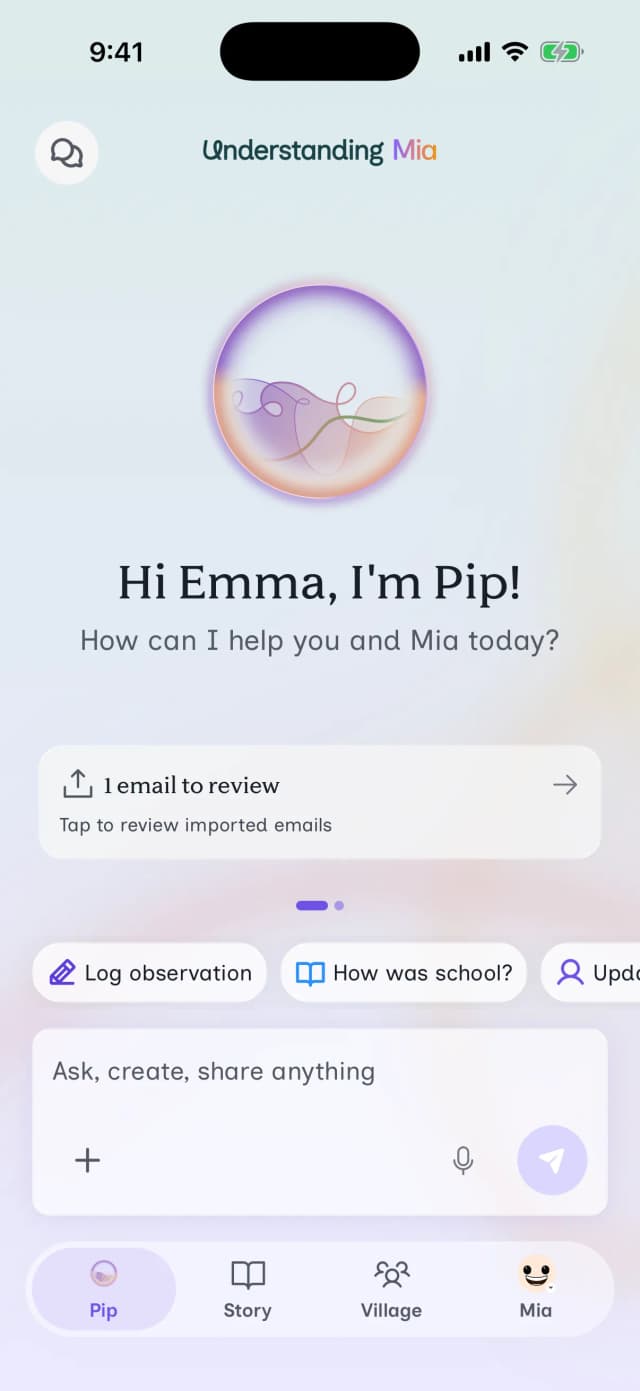
The Understanding Zoe app open on a phone, showing Pip's home screen

Where Understanding Zoe fits

Some days the plan works, some days it does not. Understanding Zoe helps you see why.

Pip* is your pocket coach inside the Understanding Zoe app. You talk to it by voice or text about what actually happened today. It writes the day down and gives you something to try straight away.

Over time it shows you patterns you were too tired to notice. Observations, appointments, reports and strategies all live in one private place.

You can invite people who support you, like a partner, a friend or a psychologist. You choose what each person sees, document by document.

Pip is not a doctor and not a therapist. It helps you organise and prepare. It does not assess and it does not treat.

* Pip has nothing to do with the UK benefit called PIP, the Personal Independence Payment.

Their words, not ours

Rated 4.6 on the App Store

Real reviews from neurodivergent adults and parents. See the reviews.

“In just 3 days, UZ has changed my life. It's helped me work out concrete strategies for a deeply distressed nervous system, and provides insight and affirmation I wouldn't let myself see.”

AubreyDB · Neurodivergent adult · App Store

“As a late Diagnosed Neurodivergent, this has helped me so much to understand who I actually am.”

Laura M · Neurodivergent adult · Google

“This is the only one that doesn't make my daughter sound like a problem to be managed. I jot down what's happening day to day and it quietly pulls out the patterns I'm too tired to notice myself.”

yoyo_e · Parent · App Store

As featured in

Startup Daily SmartCompany Channel 9 Mums and Co Women's Agenda Education Today ABC

Questions people ask us

Is executive dysfunction a diagnosis?

No. It describes a pattern, not a condition. Executive function differences are part of how ADHD is described. They are common in Autistic people too.

Everyone's executive functions dip under stress, poor sleep or loneliness. For ADHDers and many Autistic people, the dip is bigger and more frequent.

Is executive dysfunction the same as being lazy?

No. Laziness is not wanting to do something. With executive function differences, you often want to do it. You still cannot start.

That gap between wanting and doing is exhausting. Many people blame themselves for years before they learn it has a name.

How is this different from Autistic inertia?

They overlap. Autistic inertia is a pull to keep doing what you are already doing. Sometimes that means doing nothing. It makes starting, stopping and switching hard.

Inertia is often described as one part of executive function differences in Autistic people. We cover it on its own page about Autistic inertia.

Can executive function improve?

A 2013 review by Adele Diamond concluded that executive functions can improve with practice. It also notes that stress and poor sleep hold them back, so easing those can help.

In daily life, changing the setup often helps more than trying harder. Lists, visuals, reminders and support all take the load off your working memory.

How do I explain executive function differences to other people?

Be specific about what is hard and what helps. For example, “I find it hard to start big tasks. Breaking them into steps with dates helps me.”

Written instructions, clear deadlines and fewer switches between tasks help many people. You do not have to share a label to ask for them.

If today is a hard day

Understanding Zoe is not a crisis service. If you are in danger now, call your local emergency number. That is 000 in Australia, 999 in the UK and 911 in the US.

For support in Australia, call Lifeline on 13 11 14. In the UK, call Samaritans on 116 123. In the US, call or text 988.

Nothing on this page is medical advice. It does not assess anyone. It is not a substitute for care from a professional who knows you.

Keep reading