AuDHD means being Autistic and ADHD at the same time. The word joins the two. For the people who live it, they do not come apart.
It is common. A 2019 review pooled 96 studies. About 28 per cent of Autistic people had also been assessed as ADHD. Across the wider research, estimates reach 50 to 70 per cent.
An AuDHDer is not half one thing and half the other. It is one way of being, with needs that can pull against each other. That pull is why generic advice for autism, or for ADHD, so often misses.
This page is about the combined profile. We write about autism and ADHD separately in our autism and ADHD topics.
What AuDHD feels like from the inside
Many AuDHDers describe it as two strong pulls inside one brain.
The Autistic side often wants depth, sameness and predictability. The ADHD side often wants novelty, movement and something new. Both are real needs, and both are yours.
So you might plan the perfect routine and then find it unbearably dull by Thursday. You might long for company, then need everyone to leave. You might need quiet to think, and music to start.
Autism and ADHD also share a lot of ground. These are the overlaps AuDHDers describe most often.
Executive function. Planning, starting and switching tasks can be hard on both sides.
Attention. Focus can lock onto one thing, or drift from thing to thing.
Sensory differences. Noise, light and touch can feel stronger, or be actively sought out.
Big feelings. Emotions can arrive fast and take a long time to settle.
Social energy. Social time can be tiring on both sides, for different reasons.
The overlap runs deep. A 2017 Radboud University paper, drawing on earlier twin and family studies, notes that about 50 to 72 per cent of the genetic factors behind autism and ADHD overlap.
Clinical psychologist Brianna Thomas, who is AuDHD herself, calls it the tug-of-war brain.
Podcast
“One blended operating system”
“Being AuDHD is not like having two different hats, you put on one then you put on the other. ... At the same time they are the one blended operating system, and you really can't separate them out.”
Brianna Thomas, late-identified Autistic and ADHD clinical psychologist, speaking on The Neurodivergent Pulse, episode 7, 28 October 2025.
Brianna describes the pull most clearly in the senses. “You might be hugely sensory seeking and sensory avoidant at the same time, within the same sense.” Loud music you chose can feel good while background chatter is unbearable.
The same push and pull shows up with people, time and emotions. That is not you being inconsistent. It is two real needs asking for space at once.
Why generic advice for autism or ADHD often fails AuDHDers
Advice built for one side can quietly work against the other.
Routine is often suggested for Autistic people. For an AuDHDer, a strict routine can soon feel like a cage. Then it gets dropped. That can look like failure when it is really boredom.
“Try something new” is common ADHD advice. For an AuDHDer, too much change can cost more energy than it gives back. The new thing is fun until it tips into overwhelm.
Body doubling means working alongside another person to help you start. It helps many ADHDers. For some AuDHDers, the social effort can cancel out the benefit.
The answer is rarely choosing one side. Brianna's approach is to name what each side wants. Then look for a middle that meets both.
How common is AuDHD?
Being Autistic and ADHD is common. It has only been officially possible to be assessed as both since 2013.
28%
Of Autistic people across 96 studies had also been assessed as ADHD.
50 to 70%
Of Autistic people also have ADHD, the range cited in the wider research literature.
2013
The year the DSM-5 first allowed autism and ADHD to be assessed together.
The two numbers come from different kinds of research. The 28 per cent pools formal assessments across 96 studies. The 50 to 70 per cent is the wider range in the literature. Results vary a lot with how ADHD traits are measured.
A 2017 Radboud University paper draws on earlier studies of children. It notes that across different studies, 22 to 83 per cent of Autistic children met ADHD criteria. Between 30 and 65 per cent of ADHD children had significant Autistic traits.
Before 2013, the manual clinicians used did not allow both to be identified together. A whole generation of adults was assessed under those older rules, or not at all.
That is part of why many AuDHDers are only now finding each other. They are finding the word too.
Why AuDHD is often identified late
One side can hide the other. Many AuDHDers are identified as ADHD first, and as Autistic years later.
ADHD traits can be louder and easier to spot. Autistic traits can sit underneath, covered by masking. Masking means hiding or copying behaviour to fit in, and it is sometimes called camouflaging.
Brianna was identified as ADHD first, then as Autistic about two years later. Laetitia was assessed as ADHD at five, but her parents chose not to tell her. She found out she was Autistic after her daughter Zoe was assessed.
Unmasking can bring relief, and it is not equally safe for everyone. It can carry more risk for women and LGBTQIA+ people. The same goes for people in Black, Brown, Indigenous or Asian (BBIA) communities. Many people are in more than one of these groups, and the risk adds up. You get to decide where it is safe for you.
“It helps me focus a bit, not a lot, but it does help me focus a bit. Understanding Zoe helps with the monotropism focus that I have, because Pip understands how much focus I have.”
Laura McLean, Autistic and ADHD, assessed in her fifties after twenty years of being wrongly assessed as bipolar.
Read her full story: Laura, on the app she shows her doctor.
Laura's story, an Understanding Zoe case study.
Monotropism describes attention that goes deep into a few things at a time. It is a common Autistic way of focusing. For Laura, knowing the word helped her plan around it.
What helps AuDHDers day to day
Start from both sets of needs, then build the middle together.
Name both needs, then look for the middle. What does the Autistic side want right now? What does the ADHD side want? Often there is an option that meets both.
Keep the anchor, change the details. Same time, same place, new playlist. Predictability without boredom is possible.
Plan around energy, not the to-do list. Your capacity changes from day to day. Energy accounting helps, and we explain it on our page about Autistic burnout.
Protect deep focus, and warn before switching. Being pulled out of focus costs a lot. A few minutes' warning makes the switch easier.
Treat sensory needs as real, in both directions. Noise-cancelling headphones for chatter, and loud music you choose, can both be the right answer.
Let go of the shame about inconsistency. Doing something yesterday does not mean you can do it today. Capacity moves, and that is information, not failure.
Children feel the tug-of-war too. Naming it can be very soothing.
Brianna uses Dan Siegel's idea of “name it to tame it”. Ask what the ADHD part wants, maybe to move. Ask what the Autistic part wants, maybe a weighted blanket. Then find a way to meet both, like rolling under a blanket on the floor.
Many parents of AuDHD children are AuDHD themselves. Looking after your own nervous system first is not selfish. It is how you have enough left to share.
A free guide for families of ADHDers
How to Understand and Support Your ADHDer. It explains how ADHD works, without blame or shame. It includes home strategies and school scripts you can adapt.
Two sets of needs, one life. Understanding Zoe holds both, so you can see what actually helps.
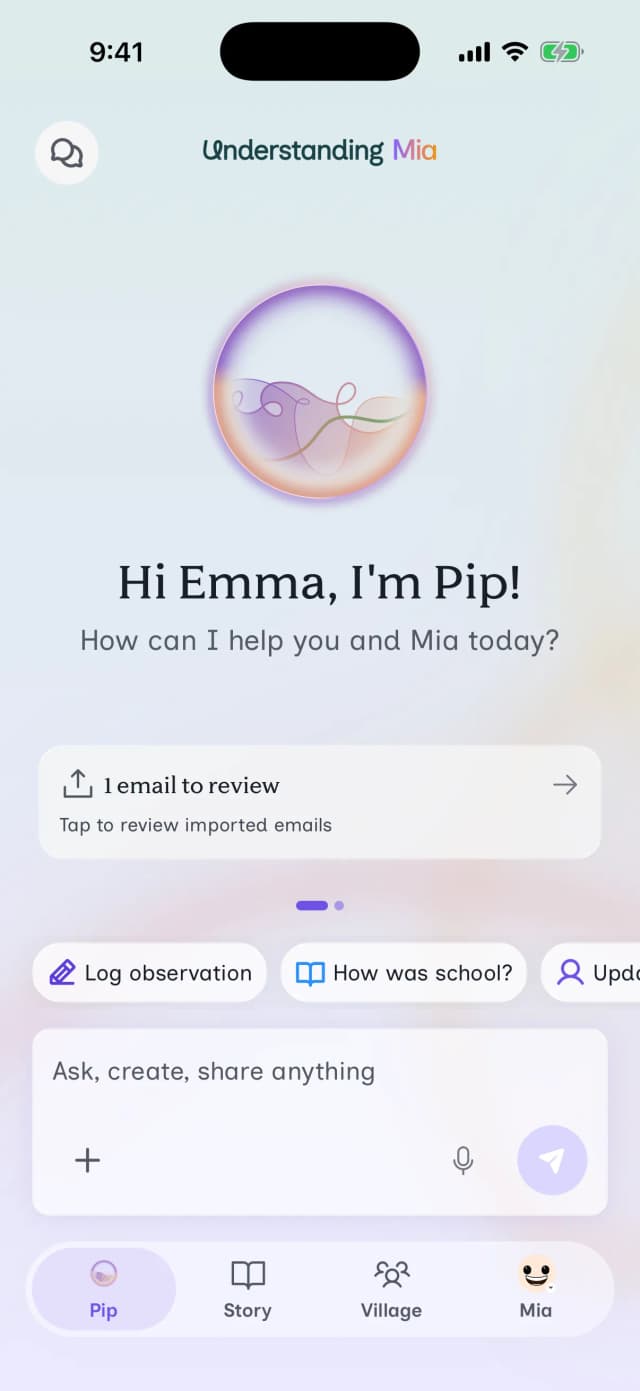
Pip* is your pocket coach inside the Understanding Zoe app. You talk to it by voice or text about what actually happened today. It writes the day down and gives you something to try straight away.
Over time it shows you patterns you were too tired to notice. Observations, appointments, reports and strategies all live in one private place.
You can invite people who support you, like a partner, a friend or a psychologist. You choose what each person sees, document by document.
Pip is not a doctor and not a therapist. It helps you organise and prepare. It does not assess and it does not treat.
* Pip has nothing to do with the UK benefit called PIP, the Personal Independence Payment.
Their words, not ours
Rated 4.6 on the App Store
Real reviews from neurodivergent adults, parents and therapists. See the reviews.
“As a late Diagnosed Neurodivergent, this has helped me so much to understand who I actually am.”
Laura M · Neurodivergent adult · Google
“In just 3 days, UZ has changed my life. It's helped me work out concrete strategies for a deeply distressed nervous system, and provides insight and affirmation I wouldn't let myself see.”
AubreyDB · Neurodivergent adult · App Store
“As a therapist, to be able to both recommend and utilise this app with families is incredible. Creating space to connect, grow and thrive.”
Kaya L · Therapist · Google
As featured in
Questions people ask us
Is AuDHD an official diagnosis?
Not as one word. Clinicians assess autism and ADHD separately, using the DSM-5 or the ICD-11. AuDHD is the word the community uses for being both.
The DSM-5 manual was published in 2013. Since then, a person can be assessed as Autistic and ADHD together. Before that, the manual did not allow both.
How common is it to be Autistic and ADHD?
It is common, and the number depends on what is measured. A 2019 University of Toronto review pooled 96 studies. About 28 per cent of Autistic people had also been assessed as ADHD.
Other research finds far more. Clinicians in Créteil, France, looked at this in 2022. They note that the wider research puts it at 50 to 70 per cent.
Many AuDHDers, especially adults, women and gender diverse people, are still unrecognised.
Why do my routines work one week and fail the next?
For many AuDHDers, routine meets a real Autistic need for predictability. Then the ADHD side gets bored, and the routine stops working.
It is not a failure of willpower. Try keeping the anchor steady and changing the details. For example, take the same walk at the same time, with a new podcast.
How do I know if I am AuDHD, and not just Autistic or ADHD?
Many people notice it when advice for one side keeps failing. Another sign is recognising yourself in both descriptions, sometimes on the same day.
Self-identification is valid, and assessment is not always easy to get. If you do seek one, look for a clinician who knows both. Experience with adults matters too.
Is AuDHD the same as a PDA profile?
No. A PDA profile, short for pathological demand avoidance, is its own description. Some AuDHDers also have a PDA profile, and Laetitia is one of them. Read more on our page about pathological demand avoidance.
If today is a hard day
Understanding Zoe is not a crisis service. If you are in danger now, call your local emergency number. That is 000 in Australia, 999 in the UK and 911 in the US.
For support in Australia, call Lifeline on 13 11 14. In the UK, call Samaritans on 116 123. In the US, call or text 988.
Nothing on this page is medical advice. It does not assess anyone. It is not a substitute for care from a professional who knows you.
 Registered NDIS provider