Interoception is the sense that tells you what is happening inside your body. It is how you notice hunger, thirst, tiredness, pain and the need for the toilet. For many neurodivergent people, these signals arrive late, faintly or very loudly.
A 2025 review of 31 studies found mixed results in autism. Some studies found Autistic people noticed body signals less, some more, and some found no difference.
Source: Klein, Witthöft and Jungmann, Johannes Gutenberg University Mainz, Interoception in individuals with autism spectrum disorder, Frontiers in Psychiatry, 2025.
That is why you might realise you are starving only when you feel shaky. Or you might not notice you are overwhelmed until it is already too much.
We also have a page on alexithymia, which is about naming emotions.
Every body is different. These patterns come up often for neurodivergent people.
Interoception differences are about how strongly, and how early, body signals reach you. Here are some common ways they show up in daily life.
Interoception differences are common in Autistic people and ADHDers. They can also shape eating, which we cover on our page about ARFID.
Occupational therapist Kelly Mahler describes two common experiences.
“Sometimes certain body signals for them are not strong enough for them to recognise. So, maybe they're not picking up signals that are telling them when their body is hungry, or when they're getting overwhelmed.”
Kelly calls this a muted experience. Many people tell her they notice body signals only when they get very big.
Others have an intense experience, where one or two signals feel very strong. Some describe many signals at once, like inner chaos. Each is a real difference, not a mistake.
The research is still young, and the findings are mixed.
In 2025, researchers at Johannes Gutenberg University Mainz reviewed 31 studies of interoception in autism. They looked at children, teenagers and adults.
Some studies found Autistic people noticed body signals less. Others found more, or no difference. The researchers said different methods probably explain much of this.
That fits what many Autistic people say. Interoception is personal, and there is no single Autistic pattern.
Studies of interoception in autism were reviewed in 2025.
Adult studies were pooled for heartbeat accuracy, with no clear difference found.
Source: Klein, Witthöft and Jungmann, Johannes Gutenberg University Mainz, Interoception in individuals with autism spectrum disorder: a systematic literature review and meta-analysis, Frontiers in Psychiatry, 2025.
Body signals shape how much you can do, and when you need to stop.
When hunger, pain or tiredness go unnoticed, they still drain you. The cost just arrives later, often all at once.
Laetitia Andrac, co-founder of Understanding Zoe, links interoception to her own burnout. In her twenties, she was struggling with interoception. She was not feeding herself the way she needed to.
If that sounds familiar, see our page on Autistic burnout. It explains how hidden load builds up.
“I don't think they take into account that stuff such as being too hot or being in too much pain or just being too tired. I don't think a lot of people appreciate that, that just those things can be so overwhelming that it's that difficult to do anything else.”
Suzanne, an Autistic adult in a University of Manchester study, 2021.
You do not need to feel signals the way others do. You need ways to catch them in time.
Body signals can be easy to miss. Understanding Zoe helps you notice the patterns over time.
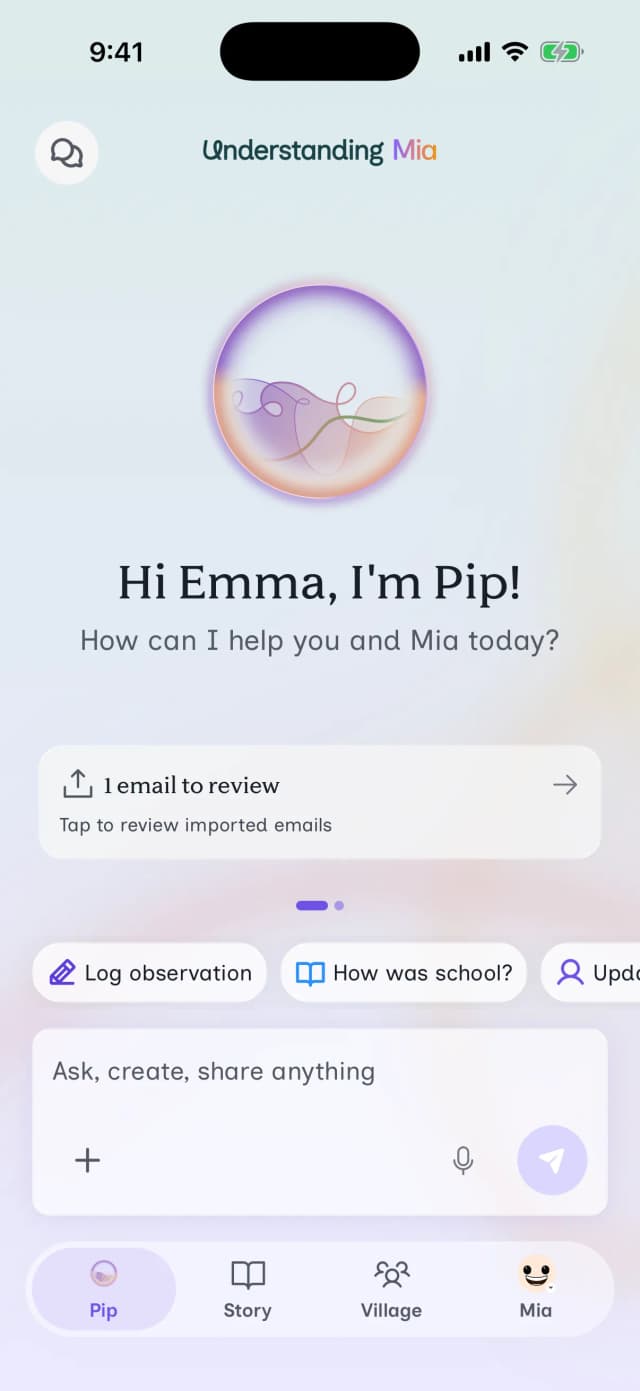
Pip* is your pocket coach inside the Understanding Zoe app. You talk to it by voice or text about what actually happened today. It writes the day down and gives you something to try straight away.
Over time it shows you patterns you were too tired to notice. Observations, appointments, reports and strategies all live in one private place.
You can invite people who support you, like a partner, a friend or a psychologist. You choose what each person sees, document by document.
Pip is not a doctor and not a therapist. It helps you organise and prepare. It does not assess and it does not treat.
* Pip has nothing to do with the UK benefit called PIP, the Personal Independence Payment.
Real reviews from neurodivergent adults and therapists. See the reviews.
“In just 3 days, UZ has changed my life. It's helped me work out concrete strategies for a deeply distressed nervous system, and provides insight and affirmation I wouldn't let myself see.”
AubreyDB · Neurodivergent adult · App Store
“As a late Diagnosed Neurodivergent, this has helped me so much to understand who I actually am.”
Laura M · Neurodivergent adult · Google
“As a therapist, to be able to both recommend and utilise this app with families is incredible. Creating space to connect, grow and thrive.”
Kaya L · Therapist · Google
Interoception is the sense that tells you what is happening inside your body. It covers signals like hunger, thirst, tiredness, pain, temperature and needing the toilet.
It also helps you recognise emotions, because many feelings start as body sensations. A racing heart or a tight chest can be the first sign of worry.
Some people have what occupational therapist Kelly Mahler calls a muted experience. Signals only become clear once they are very strong.
So hunger may only register when you are already very hungry. Overwhelm can work the same way. It may only show up in a meltdown.
Yes. Some people describe an intense experience, where body signals feel loud or constant. It can be hard to focus on anything else.
Others describe many signals at once, like inner chaos. None of these patterns is wrong. They are different ways of experiencing your body.
Interoception is about noticing body signals, like hunger or a racing heart. Alexithymia is about naming emotions and describing them.
They often travel together, because emotions show up in the body first. We cover naming feelings on our page about alexithymia.
Many people find it gets easier with gentle practice. Kelly Mahler suggests curiosity. Wonder what your body is telling you, without pressure to answer.
Regular check-ins and reminders also help. The aim is not to feel your body the way others do. It is to understand your own signals better.
Understanding Zoe is not a crisis service. If you are in danger now, call your local emergency number. That is 000 in Australia, 999 in the UK and 911 in the US.
For support in Australia, call Lifeline on 13 11 14. In the UK, call Samaritans on 116 123. In the US, call or text 988.
Nothing on this page is medical advice. It does not assess anyone. It is not a substitute for care from a professional who knows you.