Dissociation and felt safety: understanding autistic shutdown
Autistic shutdowns and dissociation are nervous system survival mechanisms, not behaviour problems. In this episode with occupational therapist Stephanie Robertson, discover why neurodivergent brains are more likely to use dissociation, how trauma is shaped by post-event support rather than the event itself, and concrete strategies for offering felt safety when someone you love is overwhelmed. Learn the 'change the pot, not the plant' framework for adjusting environments instead of trying to fix people.

In short
Autism shutdowns and dissociation are nervous system responses that make sense once you understand them. Steph Robertson explains that neurodivergent anxiety and trauma are shaped not by the event itself but by how the nervous system adapts and how a person is supported afterwards. Autistic and ADHD brains are more likely to use dissociation as a coping strategy, which means the quiet, compliant child may need just as much support as the one who is visibly overwhelmed. When someone dissociates or shuts down, the most helpful response is felt safety: presence, sensory comfort and connection without pressure. The single most powerful pot change you can make this week is to sit with a distressing emotion rather than rushing to fix it.
She comes home from school and goes quiet. Not the comfortable quiet of someone winding down, but the type of shutdown where she's there but somehow not there, eyes a little distant, responses a beat too slow. You hover nearby, wanting to help, not sure whether to speak or stay back. You try a question. Nothing much comes back. You try sitting closer. She doesn't pull away, but she doesn't come toward you either. And you're left standing in the kitchen wondering: is she okay? Did something happen? Am I making this worse by pushing?
What looks like withdrawal, or shutdown, or neurodivergent anxiety, is often something the nervous system is doing on purpose. Once you understand what it's doing and why, the way you respond can change completely.
In Episode 43 of the Neurodivergent Pulse podcast, host Laetitia Andrac is joined by Stephanie Robertson, a neurodivergent occupational therapist, speaker and advocate with more than a decade of experience in trauma-responsive and neurodiversity-affirming care. Steph is autistic, ADHD, cPTSD and part of a plural system, and she brings that lived experience alongside her clinical and research background to a conversation about what dissociation actually is, why neurodivergent nervous systems are more likely to use it, and what genuinely helps when someone you love is overwhelmed.
Understanding how nervous systems adapt
The most important reframe in this episode is also the most compact. Steph first encountered it while working with an organisation supporting children who had experienced sexual assault, and the data she came across there shifted how she understood everything that followed.
The trauma isn't the event. The trauma is how the body adapts post the event.
What that means in practice is that whether a difficult experience becomes a lasting trauma depends on an interplay of factors: the individual's nervous system, their personality, their neurotype, the environment they were in, and how they were supported afterwards. Two children can go through the same thing and come out of it very differently, not because one is stronger or more resilient, but because their nervous systems, and the responses they received, were different.
This matters for parents because it gives permission to take a child's responses seriously without needing a dramatic event to justify them. School can be traumatic. Social exclusion can be traumatic. The accumulation of small things, what some call little-t traumas, can compound into something the body carries for years. As Steph puts it, "it's not the event, and it's also not our place as, say, the adult, the therapist, the whatever, to decide what might then become traumatic for someone else."
The flip side is equally worth holding: how a child is supported after a hard experience shapes what happens next. Post-event support is not a footnote. It is where a great deal of the healing either happens or doesn't.
Shutdown, meltdown, or dissociation: what's actually happening?
Autistic shutdown symptoms can be easy to miss because they look like stillness. The child who goes quiet, follows instructions on autopilot and causes no visible fuss may be in just as much distress as one who is visibly overwhelmed. Understanding the difference between a shutdown, a meltdown and dissociation helps parents respond to what is actually happening rather than what they can see on the surface.
Dissociation is a normal, natural thing the brain can do, and every human being does it sometimes. The challenge is that it exists on a wide spectrum, and the presentations at different points on that spectrum look very different from the outside.
The spectrum runs roughly like this:
Daydreaming and zoning out: The most familiar end. Your mind wanders during a meeting, or you drive from one place to another and realise you don't quite remember the journey. This is mild, common and not a cause for concern.
Depersonalisation: A sense of not quite recognising yourself or your own body, feeling detached from your own experience as though watching from a distance.
Derealisation: A sense that the world around you doesn't feel quite real, that you're in an altered or unfamiliar version of your environment.
Dissociative amnesia: Gaps in memory, particularly around distressing events, where the brain has not stored or made accessible certain experiences.
Dissociative disorders: At the far end of the spectrum, where separate identity states or significant memory gaps begin to impact day-to-day functioning in ways that are diagnosable and require specialist support.
Dissociation becomes a concern, Steph explains, when it starts affecting someone's daily life. But it is important to understand why it happens at all, because the reason is not weakness or a failure of coping. As she puts it, "dissociation really is the core survival mechanism that comes in. You know, we get our freeze, fight, flight, flop. This is dissociation coming in. It's like, let's shut everything down because we can't fight our way out of this." The brain separates from the body to keep it safe. That is a remarkable thing, not a problem.
For neurodivergent children specifically, there is now research to support what many parents and educators have sensed. "We also know now through research that autistic and ADHD brains are more likely to use dissociation as a coping strategy than, uh, non, like allistic or non ADHD and autistic brains," Steph says. Understanding energy accounting to prevent neurodivergent burnout can help explain why the quiet, compliant child who seems to be coping may actually be running on empty, going under the radar because their nervous system has found a way to separate from what's happening around them. According to Understanding Zoe's research on neurodivergent families, 64% of parents raising neurodivergent children often feel exhausted, compared with 42% of parents of neurotypical children, and the emotional load on both sides of that relationship is rarely visible from the outside.
How to help an autistic child during a shutdown
Offering felt safety is the most helpful response when someone is dissociating or in shutdown, and it looks very different from the instinct to bring them back. Trying to snap someone out of a dissociative state, calling their name sharply, asking them to focus, can feel intrusive and unsafe from the inside. The nervous system went there for a reason, and forcing it back before it's ready doesn't address that reason.
Steph is clear: "the best thing we can do is offer felt safety. So it's a case of allowing them to be in that slightly different state, that dissociative state, but it might be bringing them a comfort item. It might be offering a safe food. It might be just sitting next to and having a parallel play engagement." The goal is not reconnection. The goal is safety. Reconnection tends to follow naturally once safety is established.
If you are wondering how to get out of an autistic shutdown, or how to support your child through one, these concrete strategies are a starting point:
Bring a comfort item: A familiar object, a soft toy, a weighted blanket, something that belongs to them and feels safe. You don't need to say anything when you offer it.
Offer a safe food: Something they reliably enjoy and find regulating. Keep it low-key, no expectation attached.
Sit alongside in parallel: Be present without directing. Read near them, do something quiet of your own. Your calm presence is doing work even when nothing is being said.
Offer deep pressure if that helps: For children who find pressure regulating, a hug or a weighted item can be grounding. Follow their lead on whether touch is welcome.
Remove dysregulating input: Dim harsh lighting, reduce noise, loosen tight clothing if possible. Reduce the sensory load rather than adding to it.
Bring in a special interest: Gently introduce something joyful and familiar to them. Steph finds that children are often naturally drawn back into connection when something they love enters the space, without any pressure to perform that reconnection.
Get curious later, when they're back: Once they've settled, open a gentle conversation about what felt right in that moment and what they might want next time. Their answers will tell you more than any checklist.
The co-regulation piece is what ties this together. For more on co-regulation and how it works in practice, our guide with speech pathologist Alana Cameron explores why connection is more powerful than correction when a child is overwhelmed. As Steph explains, "When we are co-regulating, we are organically sort of brought back into the body in order to share in that connection with another human." Your regulated nervous system is an invitation, not a demand. It says, "I'm here with you, but I'm not trying to get in and, like, change how you are. I'm just offering that support."
Pip remembers the appointments, the notes and the small wins, so you don't have to.
7 days free on iPhone and Android.
Late identification, internalised ableism and finding your way home
For many adults reading this, Steph's personal story will land somewhere close to the chest. She collected mental health diagnoses for years before being identified as autistic and ADHD, a pattern that is particularly common for AFAB people whose presentations didn't fit the narrow clinical picture that shaped early diagnostic criteria.
What makes her story striking is that she was already working as a paediatric occupational therapist when this was happening. Her daughter had been identified as autistic at five. She had immersed herself in the neurodiversity-affirming paradigm as a special interest. And still, the internalised ableism held. "I'm not disabled enough to be autistic," she thought. "If I take the right medication, if I just try harder, be a better person, I won't have these challenges."
What shifted was seeing other late-identified women share their stories publicly, recognising the same collection of diagnoses, the same exhaustion, the same sense that something had never quite clicked. That was when she explored it for herself, and was quickly identified as autistic and ADHD. "It allowed me to just breathe for a second because I felt like, it wasn't, there wasn't something wrong with me." She felt like she belonged. And from that point, she could start building a life that actually worked for her neurotype rather than one built around trying harder to fit a mould that was never made for her.
If you are a parent who recognised yourself somewhere in that story, alongside your child, you are not alone in that. Research from over 1,000 Australian families found that more than three in five parents raising neurodivergent children also identify as neurodivergent themselves, whether through formal assessment or self-identification. Our conversation on late-identified AuDHD motherhood and what changes after discovery explores this experience in depth, including the grief and the relief that can follow. The relief Steph describes is available to you too.
We were not designed to do this alone
Western culture has pushed us toward independence in ways that don't serve families, and especially don't serve families navigating neurodivergence. The expectation that we should manage privately, without burdening others, without needing help, is not a neutral cultural value. It is one that isolates people who are already carrying a lot. Parents of neurodivergent children spend an average of 10.5 hours every week on emotional regulation, advocacy and administration alone, on top of around 30 hours of total caregiving (see our full research report). That is a second job most people around them never see.
Steph's vision of a real village is built on interdependence rather than transactions. "Finding people where you can support swap with, 'I'll do a load of laundry for you, I'll cook a meal for you,'" she says. "And it becomes interdependence, right? Where we're actually allowing ourselves to rely on other human beings for support." One person finds cooking manageable; another finds laundry easier. The exchange is not about keeping score. It is about recognising that we all have different capacities on different days, and that asking for help is not weakness.
For neurodivergent families specifically, neurokin community carries its own particular power. "Having community that are also in the same boat so that you have a sense of connectedness, neurokin, is so powerful," Steph says. We explored why community matters for autism parents in depth with Vanessa Gauci from the Autism Community Network, including the practical steps to finding your people. Walking alongside others who understand the experience eases the weight of isolation. Children grow up seeing that their experience is shared. Adults feel seen rather than explained.
Laetitia reflected on this during the episode, becoming visibly emotional as she described her own family's experience of living 24 hours from home and learning, slowly, to let new people in. Being on the other side of that discomfort, she said, has been game-changing. The vulnerability required to be seen is real, and it is worth it.
Adjusting the environment instead of the child
The most practical framework from this episode is also the most memorable.
If a plant is not growing, you don't change the plant. You change the pot, and its soil, and its light, and its water.
Laetitia offered that phrasing back to Steph in the episode, drawing on the framework Steph has been teaching for years. When families are asked what they most want for their children's futures, the answer is not better behaviour or easier compliance. Nearly half of parents in a national study of over 1,000 Australian families said their greatest priority is simply for their child to feel safe and accepted as they are. The pot-change framework puts that aspiration into practice.
Applied to a child, or an adult, who is struggling, this means looking at the environment before looking at the person. "All human emotions, or experiences, whether it's anger, dissociation, fear, sadness, they have a place and they're there for a reason. They help keep us safe. They help keep us alive," Steph says. The distress is not the problem. The distress is information about the pot. Our conversation on shifting from fixing behaviour to adjusting the environment explores what this looks like inside real family life, including practical co-regulation strategies.
The most accessible pot change, and the one Steph recommends starting with, is interpersonal. When you see your child overwhelmed, rather than rushing to fix the feeling, try staying in it with them. "If you can sit for a moment and go, 'I'm just gonna ride this with you. I'm gonna be with you in it. We're gonna allow this to be experienced because it is valid,' even in that, we have actually changed the pot." You have changed the interpersonal environment that person is experiencing their distress in. That is a real and meaningful shift, even when it doesn't feel like enough.
From there, you can start looking at the more practical pot changes:
Interpersonal presence: Sit with them. Stay regulated. Don't try to fix or redirect. Your calm is the intervention.
Lighting: Harsh fluorescent light is dysregulating for many neurodivergent nervous systems. Lamps, natural light and dimmer switches are low-effort adjustments with real impact.
Clothing and temperature: Scratchy seams, tight waistbands and uncomfortable fabrics are a constant sensory load. Removing them is removing a stressor.
Noise and sensory input: Reduce background noise where possible. Offer noise-cancelling headphones. Create a quieter space to come back to after school.
Expectations: Consider whether the expectations around a particular time of day, transition or activity are calibrated to your child's actual capacity, not an average child's capacity.
Sensory regulation tools: Weighted items, fidgets, movement breaks, comfort objects. These are pot changes, not rewards or crutches.
If you want support turning what you notice into small, concrete adjustments, Understanding Zoe is built for exactly that: helping families translate observations, meltdowns and reports into affirming next steps, without adding another overwhelming thing to manage.
For anyone at the beginning of the road
Steph closed the episode with a message she directed at anyone who is where she once was: collecting diagnoses, trying harder, wondering what is wrong with them. It is worth quoting in full.
There is nothing wrong with you. You have a unique energetic frequency or humanness about you that exists for a reason, and you have something to offer the world.
She knows how dark and lonely it can feel. She knows the weight of everyone's expectations, the exhaustion of masking, the grief of understanding yourself late. If that resonates, our episode on the invisible cost of masking and neurodivergent burnout offers an honest account of what that experience looks like from the inside. And she also knows what becomes possible on the other side: finding your neurokin, giving yourself space to unmask even in the privacy of your own home, making room for more of what feels genuinely good. Gradually, you can reshape your days so that more of them fit you, rather than the other way around. That is not a small thing to work toward.
Being seen in your essence is, in itself, something that heals.
Meet Steph Robertson
Steph Robertson is an occupational therapist whose perspective is shaped by both clinical work and lived experience. Through her practice, SGR Occupational Therapy, she delivers training, presentations and practical resources across schools, private practice and Monash University, all grounded in a neuroaffirming approach that asks who gets to define what counts as normal, and whether that definition is serving anyone.
She is also autistic, ADHD, cPTSD and part of a plural system, which means her interest in dissociation is not purely academic. When she talks about what it feels like when the brain separates from the body to stay safe, she is drawing on something she knows from the inside. You can follow her work on Instagram at @sgroccupationaltherapy.
Frequently asked questions
What is the difference between an autism shutdown and a meltdown?
A shutdown is an inward withdrawal response where the nervous system goes quiet to protect itself, while a meltdown is an outward release of overwhelm. Both are involuntary nervous system responses, not choices or behaviour problems. During a shutdown, a child may go still, stop communicating and seem unreachable. During a meltdown, the distress is more visible. The neuroaffirming response to both is the same: reduce demands, offer safety and stay regulated yourself.
How long does an autistic shutdown last?
Autistic shutdowns can last anywhere from a few minutes to several hours, and in some cases longer. There is no fixed timeframe because recovery depends on the individual, the intensity of the trigger and the conditions available afterwards. The most important factor is not time but environment: reducing sensory load, removing demands and offering calm presence tend to shorten recovery more than any active intervention.
How do you help someone get out of an autistic shutdown?
The most effective approach is not to pull someone out of a shutdown but to make it safe enough that they can return on their own terms. Offer a comfort item, a safe food or quiet parallel presence without expectation. Reduce sensory input where possible. Gently introduce something connected to a special interest if the moment feels right. For more on building this kind of environment, see how Understanding Zoe supports families.
Can shutdowns and dissociation happen together?
Yes, and they often do. Dissociation in autism is the nervous system's way of separating from an overwhelming experience to stay safe, and a shutdown can be one expression of that. Research now confirms that autistic and ADHD brains are more likely to use dissociation as a coping strategy than non-autistic brains. Understanding this connection helps explain why a child can appear calm or compliant during a shutdown while still being in significant distress.
Connect with Steph Robertson
Website: sgroccupationaltherapy.com
Instagram: @sgroccupationaltherapy
Pip is not a doctor or therapist. It helps you organise and prepare, not diagnose or treat.
In a crisis call 000. Lifeline 13 11 14. Kids Helpline 1800 55 1800. 13YARN 13 92 76.

Ready to put it all in one calm place?
Tell Pip one thing today. It remembers the rest.
Stored in Australia, encrypted. Cancel before day 8 and you won't be charged.
Related articles

Rejection sensitivity in kids with ADHD: A parent’s guide to building confidence and connection
Explore the misunderstood world of rejection sensitivity in kids with ADHD through heartfelt stories and practical advice. This guide unpacks why everyday setbacks hit so hard, the unique challenges for culturally diverse families, and step-by-step neuroaffirming strategies to foster resilience and confidence. Whether you're navigating stigma or searching for support, discover how compassion and understanding can transform your family’s journey.
Read more
The 5 things your neurodivergent child actually needs
Understanding your neurodivergent child's needs can be life-changing. Instead of forcing them to conform to "neurotypical" standards, it's important to acknowledge their unique qualities and support them in a way that helps them flourish. Here's what your neurodivergent child actually needs
Read more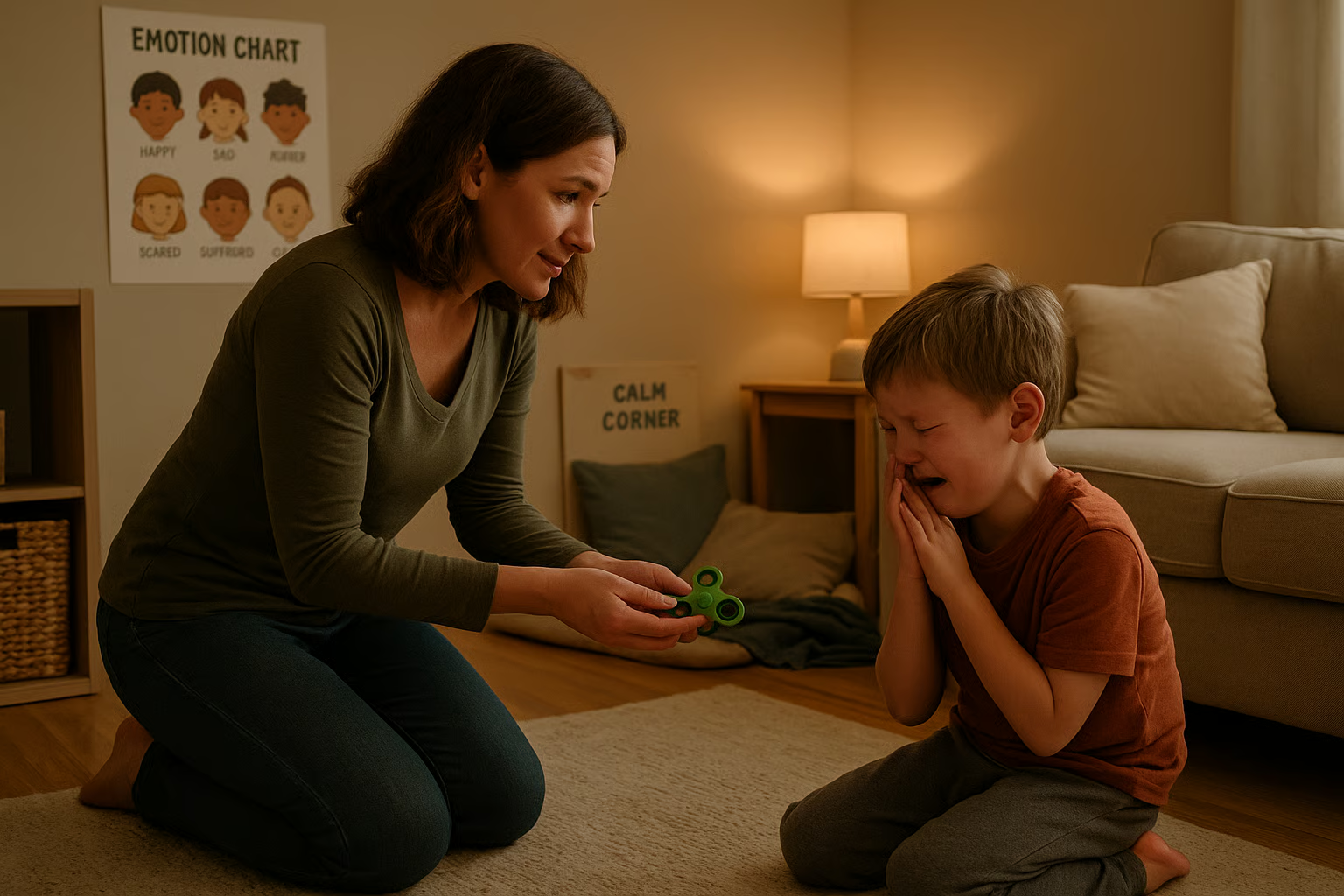
Calm in the chaos: Practical, hopeful strategies for managing emotional outbursts in neurodivergent children
Dive into a compassionate, action-packed guide for parents navigating emotional outbursts in neurodivergent children. Discover how to confidently distinguish meltdowns from tantrums, identify triggers, and apply neuroaffirming strategies that soothe big emotions. Through relatable stories and easy-to-use resources, this article empowers families to transform chaotic moments into opportunities for connection, resilience, and hope. It reminds you that calm is possible, and you’re never alone.
Read more