Pathological Demand Avoidance, usually shortened to PDA, is an anxiety-based need to be in control. It is not defiance. It is not a discipline problem.
Australia's national guideline on autism assessment takes the same view. It asks clinicians to consider whether extreme demand avoidance is driven by an anxiety-based need to be in control, rather than seeing the person as oppositional or defiant.
Source: Autism CRC, National Guideline for the Assessment and Diagnosis of Autism in Australia, Recommendation 45.8.
We use the words people search for, and then we write in our own.
Pathological Demand Avoidance is the term most clinical writing uses. It is also the term most people type into a search box, so we use it here. That way you can find this page.
We do not love the word pathological. There is nothing wrong with needing to feel in control of your own life.
In our own words we say PDA profile for the neurotype, and PDAer for the person. Many people in the community say Pervasive Drive for Autonomy instead, and so do we. Laetitia, our co-founder, is a PDAer and a PDA parent. This is her language too.
One more thing worth knowing. PDA is not a standalone diagnosis in the DSM-5, the manual clinicians use. That is a fact about the manual, not about you.
Reward charts, countdowns and firm boundaries are built for a child who is choosing not to. A PDAer is often not choosing.
Every one of those tools works by adding pressure. A nervous system that already reads a request as a threat gets more threat. So a strategy that worked last Tuesday can cause a shutdown today.
“One of the easiest ways to trigger PDA stress responses is pressure and expectation, and making assumptions. And so I think when we go the other way, which is to make space, to offer choice, to genuinely try and understand their internal experience.”
Sarah says it even more plainly: “Often it's not that they don't want to, it's that they can't.”
Read that way, the behaviour starts to make sense. A child who melts down at the word “now” is not testing you. Their body has decided the next minute is unsafe, and it has acted first.
Lower the demand, give back control, and stay curious about what the nervous system is protecting.
None of this is giving up. It is a different way to get to the same place, chosen because the usual way is not open right now.
Parents raising a neurodivergent child do a second job that almost nobody can see.
Australian families in our national study, Making the Invisible Visible.
Caregiving carried each week by a parent raising a neurodivergent child.
Of that, invisible work: emotional regulation, advocacy and admin.
Source: Understanding Zoe, Making the Invisible Visible, a 2025 national study of 1,091 Australian families, run with research partners Sunday Insights and PureSpectrum.
In the same study, 64 per cent of neurodivergent parents said they feel exhausted, compared with 42 per cent of neurotypical parents.
With a PDA profile in the house, the invisible hours climb. Every request has to be planned. Every change has to be softened. Every new professional has to be brought up to speed from the start.
You are not failing. This is one of the hardest parenting jobs there is, and most people do it with very little support.
We share more of what the study found on our page about the invisible work of caring.
Kate's son Theo is Autistic and ADHD, with a PDA profile. He was clipped by a car walking home. He said nothing about it, and asked for the iPad.
“I did what Pip suggested. And it worked really well. Theo actually did share, open up, respond. And I realised in that moment, if I had kept going in the way that I was socialised to do, I would have increased the stress. Theo probably would have had a meltdown. There would have been a big rupture between us. It resolved really healthily. It resulted in much more connection.”
Kate, parent. Names changed at her request. Read the full story: how Kate shares the load of raising a multiply neurodivergent child.
Supporting a PDAer: A Practical Guide for Families. The nervous system explanation, low-demand strategies, and school advocacy scripts you can use straight away.
A PDA profile is lifelong. Adults do not grow out of it. Many of us just get better at masking it.
For a lot of PDA adults it shows up as a job that becomes impossible for reasons nobody else can see. Or a to-do list where the easiest task is the one you cannot start. Masking that for years has a cost, and the cost often arrives as burnout.
Unmasking is not equally safe for everyone. It carries more risk for women, for LGBTQIA+ people, for people in Black, Brown, Indigenous or Asian communities, or for people who are more than one of these. Only you can judge what is safe where you are.
If you are recognising yourself here rather than your child, that is common. Our writing for adults is separate, and it never treats you as somebody's child.
You hold the whole picture in your head. Understanding Zoe holds it with you.
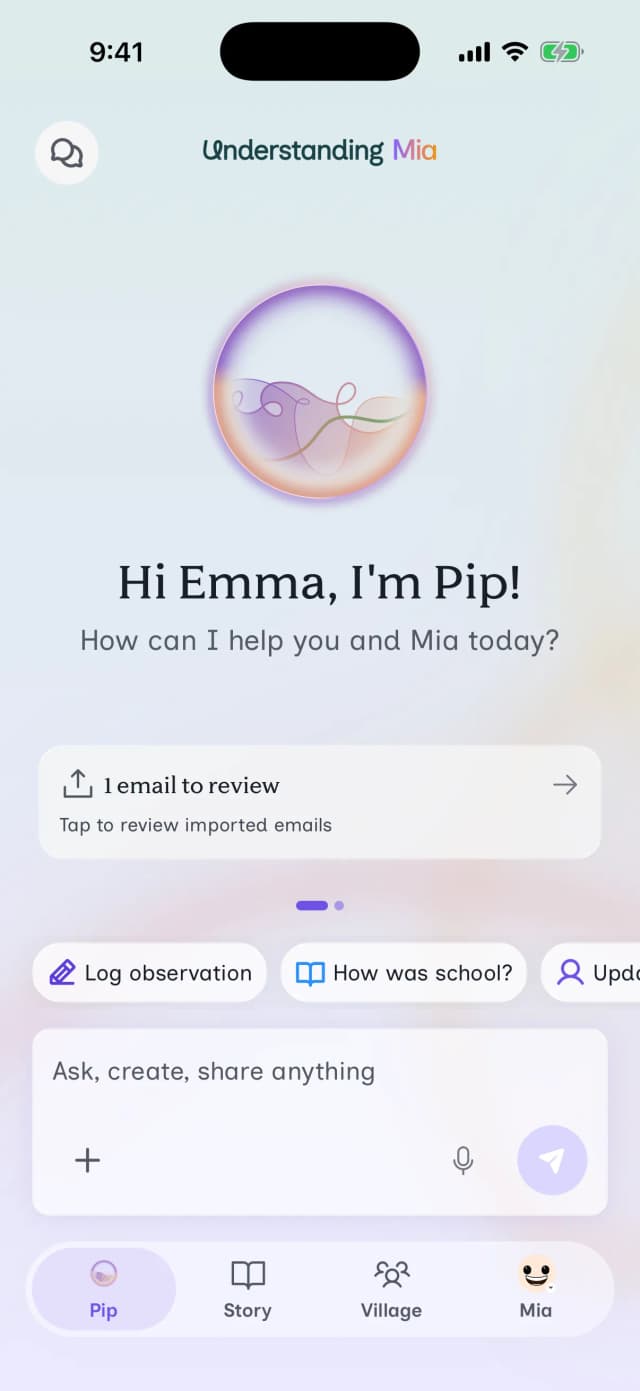
Pip* is your pocket coach. You talk to it by voice or text about what actually happened today. It writes the day down and gives you something to try straight away.
Over time it reads the days back to you as patterns you were too tired to notice. Observations, appointments, reports, medications and strategies all live in one profile.
The Care Village lets you invite family, teachers and therapists. You choose what each person sees, document by document. Supporters join free.
Pip is not a doctor and not a therapist. It helps you organise and prepare. It does not assess and it does not treat.
* Pip has nothing to do with the UK benefit called PIP, the Personal Independence Payment.
Real reviews from parents, neurodivergent adults, therapists and teachers. See the reviews.
“This is the only one that doesn't make my daughter sound like a problem to be managed. I jot down what's happening day to day and it quietly pulls out the patterns I'm too tired to notice myself.”
yoyo_e · Parent · App Store
“My child had a big meltdown this morning and I have been debriefing with Pip just now. It's been so incredibly helpful and specific in helping me get a handle on it.”
Katy S · Parent · App Store
“As a therapist, to be able to both recommend and utilise this app with families is incredible. Creating space to connect, grow and thrive.”
Kaya L · Therapist · Google Play
No. They can look similar from the outside, and they come from completely different places. Demand avoidance in a PDA profile is driven by anxiety. The nervous system reads a request as a threat to autonomy and protects against it.
Opposition, in the ODD sense, is understood as deliberate defiance. The difference matters, because the responses pull in opposite directions. Firmer boundaries are the standard advice for one, and the fastest route to shutdown for the other.
Yes. A PDA profile is lifelong, not a childhood phase. Many adults recognise it in themselves only after a child is assessed, or after a burnout that nothing else explains.
This is still an open question, in the community and in the research. PDA has usually been described as a profile within autism, and many PDAers are Autistic. Others describe demand avoidance alongside ADHD, or on its own. Your experience is real either way.
Start with information, not defence. Explain that demands are read as threat, and that the avoidance is anxiety rather than choice. Then name two or three things that work at home, so the conversation has somewhere practical to land.
A shared written profile helps more than a conversation nobody wrote down, because it survives the staff changing.
This is one of the hardest parts, and it deserves an honest answer. Siblings notice that the rules land differently, and they need words for it. Naming it plainly, in words their age can hold, works better than pretending the house runs the same way for everyone.
No. Understanding Zoe is not a clinical service, and Pip is not a doctor or a therapist. The app helps you record what is happening, see patterns over time, prepare for appointments, and share the right information with the right people.
Understanding Zoe is not a crisis service. In an emergency call 000. Lifeline is 13 11 14. Kids Helpline is 1800 55 1800. 13YARN is 13 92 76.
Nothing on this page is medical advice. It does not assess anyone, and it is not a substitute for care from a professional who knows you.