The hidden cost of AuDHD in academia
Neurodivergent students often perform well academically while experiencing severe burnout and exhaustion that parents rarely see. Jocelyn Green, an AuDHD student and advocate, explains why neurodivergent brains work twice as hard just to keep pace, why success stories can be harmful when they hide the cost, and what accommodations genuinely help. This episode challenges the myth that good grades equal wellbeing and invites parents to recognise the invisible toll of masking, the reality of autistic burnout, and the grace their child needs most.
In short
Autistic burnout at school does not always look like a child who is visibly struggling, and that is exactly what makes it so easy to miss. Jocelyn Green, an AuDHD student and advocate, explains that neurodivergent brains are essentially working twice as hard just to keep pace, meaning that when academic performance goes up, everything else, including rest, self-care, and food, often declines. AuDHD burnout is real, it is costly, and it is not a sign of low effort. As Jocelyn puts it: "I am doing my best with what I have, with how my brain is running, with how my brain is working. I am trying very hard, and it's costing me a lot." Understanding that cost, and extending grace rather than raising expectations, is one of the most important things a parent can do.
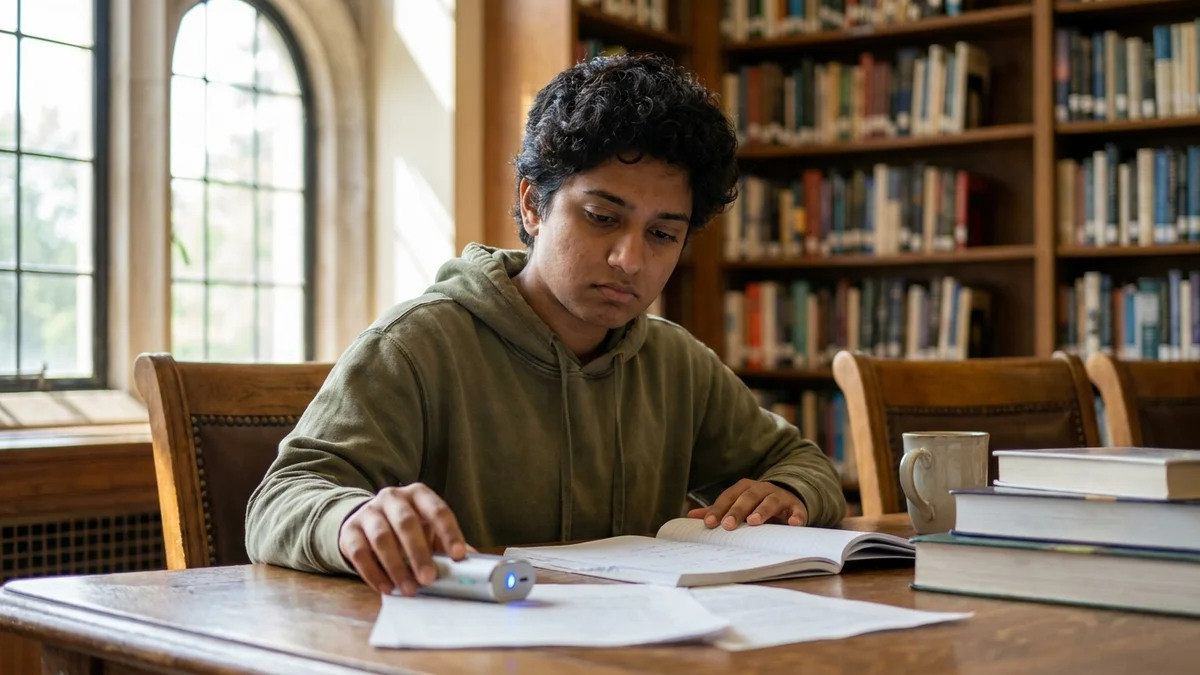
After finishing her first set of college exams, Jocelyn Green did not celebrate. She did not go out with friends or sleep in and feel relieved. The hardest thing, she says, was dragging herself out of bed to get food.
If you are a parent of a neurodivergent child, that image might stop you. Because it names something you may have sensed but struggled to put into words: that what your child produces at school and what it costs them to produce it are two very different things.
In Episode 36 of the Neurodivergent Pulse podcast, host Laetitia Andrac is joined by Jocelyn Green, an Autistic and ADHD student, advocate, and the creator behind @audhd_academic. Together they explore what it actually costs to be a neurodivergent student navigating academic institutions that were never designed for AuDHD brains. Their conversation moves through late identification, the invisible toll of masking and performing, what accommodations genuinely help, and what Jocelyn wishes every parent understood about their child's effort.
Why does my neurodivergent child fall apart after school?
What parents see and what neurodivergent students experience are often two completely different realities. Autistic burnout at school does not always look like a child who is visibly struggling. A good grade, a finished assignment, a semester survived: these look like success from the outside. But for many AuDHD students, they are the visible tip of something much larger and much more costly.
Jocelyn describes finishing her first college midterms and completely crashing. Not a tired-but-relieved crash. A crash where, as she put it, "the hardest thing after finishing that exams was dragging myself out of bed to get food." A student who has just performed academically and cannot now perform the most basic act of self-care is not a dramatic exception. For many neurodivergent students, it is the pattern.
This pattern shows up clearly in our research on neurodivergent families: 64% of parents raising neurodivergent children say they often feel exhausted, compared with 42% of parents raising neurotypical children. The cost of navigating systems not built for neurodivergent brains does not stay contained to the student. It ripples outward to everyone holding them up.
Understanding this gap, between what your child shows you and what they are carrying, is where real support begins. Developmental psychologist Sandhya Menon offers a powerful lens for understanding why school exhausts neurodivergent children far more than it appears, and how families can start tracking what charges and drains their child's nervous system.
Meet Jocelyn: the voice behind @audhd_academic
Jocelyn Green came to understanding her own neurodivergence the way many late-identified people do: through other people noticing first. Around the start of high school, her neurodivergent friends began suggesting that Jocelyn might have ADHD. Years of light research followed, then more serious investigation in her senior year as the academic pressure intensified, then a formal assessment in her second semester of college. The ADHD diagnosis came first. The autism diagnosis followed shortly after, prompted by a question during the ADHD assessment itself.
What did that identification change? Everything, and nothing, all at once. "It put my life into context," Jocelyn says. The scatteredness, the forgetfulness, the executive dysfunction her parents had always noticed. The feeling of being out of place, the flat facial expressions people had commented on since childhood. Suddenly there were words for all of it. Not a problem to fix, but a framework to finally understand.
Today, Jocelyn creates educational content through @audhd_academic, working to make accurate, accessible information about autism and ADHD available to more people and to challenge the harmful narratives that still circulate widely. She speaks from inside the system, not looking back at it from a comfortable distance. That is what makes her perspective so valuable.
Do neurodivergent students really work twice as hard?
Autism masking at school is exhausting in ways that rarely show up in a report card. Neurodivergent students are not working the same amount as their peers and getting less out of it. They are working significantly harder just to reach the same starting line. As Jocelyn explains, "when your brain works in a very different way than other people, you're essentially trying like twice as hard to like be in the same places or to do the same things."
And even that doubled effort does not always close the gap.
Even with the accommodations, even with me trying so hard, I'm behind. And I don't wanna be behind. I'm not like trying to be behind.
That sentence deserves to sit with you for a moment. This is not a student who is not trying. This is a student who is trying as hard as she possibly can, with supports in place, and still finding herself behind. The problem is not effort. The problem is a system that measures everyone by the same ruler.
When academic demands peak, something has to give. For neurodivergent students, it is rarely the schoolwork. It is everything else. Understanding this through an energy accounting framework can help parents see why the things that tend to decline under pressure include:
- Sleep and rest: the recovery time that neurodivergent brains need more of, not less
- Self-care routines: showering, getting dressed, the basics that require executive function to initiate
- Eating regularly: including, as Jocelyn described, the ability to get out of bed for food after exams
- Free time and decompression: the unstructured space that helps regulate an overloaded nervous system
- Focus on other responsibilities: anything outside the immediate academic demand becomes harder to hold
- Emotional regulation: with cognitive resources depleted, managing feelings becomes significantly harder
The scale of this invisible effort is significant. Research with Australian families found that parents of neurodivergent children spend an average of 33 hours per week on specific caregiving needs, with nearly 10 of those hours going to emotional regulation, advocacy, and administration alone. That figure reflects the load carried at home in direct response to what children absorb and expend at school.
When your child comes home from school and falls apart, this is likely what is happening. The performance happened. Now everything else is catching up.
Pip remembers the appointments, the notes and the small wins, so you don't have to.
7 days free on iPhone and Android.
Why success stories can be harmful for neurodivergent students
Holding up neurodivergent students who succeed academically as proof that anyone can do it with enough effort is not inspiring. It is harmful. Jocelyn speaks to this directly, and with the authority of someone who has been on the receiving end of exactly this kind of framing.
Earlier in the year, Jocelyn achieved straight As for a semester. Her family was proud. She was proud. But what followed was not celebration. It was a new expectation: why can't you do this consistently? Why haven't you always done this? The achievement, rather than being recognised for what it cost, became a new standard to be measured against.
This experience is far from isolated. In a national survey of Australian families, 39% of parents of neurodivergent children named better understanding of masking and burnout as one of their top priorities for the future. That is nearly 4 in 10 families explicitly asking the world to look past the visible result and reckon with what producing it actually costs.
"The standard for one person isn't automatically going to apply to other people," Jocelyn says plainly. Some neurodivergent people will achieve highly in academic settings. Others will struggle enormously, regardless of how hard they try. Both experiences are real. Both deserve to be honoured without being ranked.
The fix is not to stop sharing success stories. It is to tell them honestly. As Jocelyn puts it, "it's important that you do share success stories, but while also acknowledging that it wasn't easy to get here." When we show only the outcome and not the cost, we set an impossible standard for everyone who comes after.
Autistic student accommodations that actually help
The right accommodation is the one that fits the individual student, not the one that worked for someone else. Jocelyn is clear on this: reflecting on your own specific needs is more useful than copying what others have found helpful. That said, there are some starting points worth knowing about when exploring autistic student accommodations with your child's school.
Jocelyn's most significant accommodation is extra time. Not because they work slowly, but because processing takes longer when your brain is wired differently. "I need a lot more time to process. It takes me a lot more time to think and process and figure things out even with help, even with guidance." For many AuDHD students, extra time is foundational, not a bonus.
Jocelyn also points to the value of reflecting carefully on what you personally need: "It's just, like, really good to reflect on, like, what do you think you need? What can help you in that environment? So I know what's helpful for me isn't necessarily going to be helpful for everyone else."
Some accommodations worth exploring, keeping in mind that every student's needs are different:
- Extra time on assignments and exams, to allow for the additional processing time many AuDHD students need
- Sensory tools such as earplugs, noise-cancelling headphones, or stim toys to manage sensory input during work or assessment
- Body doubling: having someone present, even silently, even virtually, while working. As Jocelyn describes it, "body doubling has kinda helped for me. So like even just like somebody being there as like a silent support."
- Planned rest breaks built into the day, rather than pushing through until collapse
- Flexible deadlines where possible, to account for the uneven energy that comes with executive dysfunction
- A quiet or low-stimulation environment for exams or focused work, separate from the main classroom if needed
- Individual reflection on what specifically helps you, rather than assuming what works for one neurodivergent person will work for another
If you are a parent, these are starting points for conversations with your child's school. If you are a student, they are starting points for conversations with yourself.
It's the system, not the student
The exhaustion neurodivergent students carry is not a personal failing. It is the predictable result of a system that was built around one kind of brain and has not yet caught up with the reality of everyone else. Jocelyn names this without softening it.
A genuinely inclusive academic environment, in Jocelyn's vision, would have educators who already understand how neurodivergence affects learning and who are ready and willing to accommodate students without being asked to justify it. The key word is ready. Not reluctant. Not requiring students to fight for every adjustment. For a closer look at what a genuinely inclusive classroom looks like in practice, educator Millie Carr shares practical strategies that go beyond compliance into real belonging.
Instead, what many neurodivergent students experience is the opposite. As Jocelyn describes it: "I feel like there's some things, like, I feel like I shouldn't have to ask for, and then yet you find yourself having to just for, like, 'I need this.' You have to constantly, like, ask and ask and ask."
This sense of invisibility is not unique to students. According to Understanding Zoe's latest findings, 93% of parents of neurodivergent children say their experience feels misunderstood or invisible too. The pattern runs through the whole family: students fighting to be seen at school, parents fighting to be heard by the systems meant to help them.
Self-advocacy matters. But self-advocacy as the only mechanism for accessing basic support is exhausting, and it places the burden squarely on the people who are already carrying the most. Jocelyn's hope is that accommodation becomes the norm, not something students have to work and fight for. That is not an unreasonable hope. It is the minimum that genuine inclusion requires.
How to help an AuDHD child decompress after school
When Laetitia asked Jocelyn what she wished parents understood, the answer was immediate and direct. Not a list of strategies. Not a framework. Just this:
I am doing my best with what I have, with how my brain is running, with how my brain is working. I am trying very hard, and it's costing me a lot.
That is the message. Your child is trying. The cost is real. And the most valuable thing you can offer is not more pressure or higher expectations. It is grace. For many families, this is also where the path toward recovering from AuDHD burnout begins: not with a programme or a protocol, but with a shift in how effort is seen and honoured.
Practically, Jocelyn suggests that body doubling, simply being present alongside your child while they work, can make a meaningful difference for students who struggle to start or sustain tasks. You do not need to help with the work. You just need to be there. This sits at the heart of connection-based approaches that support neurodivergent young people, where the most powerful thing a parent can offer is often consistent, curious, non-demanding presence.
If you are looking for more ways to translate this understanding into practical support, Understanding Zoe is a neuroaffirming platform designed to help parents move from observation and overwhelm into clear, actionable next steps. Whether you are navigating school reports, meltdowns, or the daily puzzle of what your child needs, it is built to support you without adding pressure to yourself or your child. You can try it free for 7 days.
Jocelyn closes the episode with something that feels less like advice and more like a permission slip: "having that understanding is a sense of freedom, and I think being able to give yourself that grace is probably one of the most important things that you can do." That applies to your child. And it applies to you too.
Frequently asked questions
Why does my neurodivergent child fall apart after school?
Your child is likely experiencing what is sometimes called after-school restraint collapse: the release of enormous effort spent holding themselves together during the school day. Neurodivergent students, particularly those who are autistic or have ADHD, often spend the entire school day masking, managing sensory input, and meeting social and academic demands that require significantly more effort than they do for neurotypical peers. By the time they get home, there is nothing left. The falling apart is not bad behaviour. It is the cost of the performance.
Do neurodivergent kids get more tired than other children?
Yes, and the gap is significant. As Jocelyn Green explains, neurodivergent students are often working twice as hard just to reach the same starting line as their peers. Autistic burnout and AuDHD burnout are real, documented experiences, not excuses. When a neurodivergent child appears to be coping or even thriving academically, it is worth asking what that performance is costing them in sleep, self-care, and emotional regulation outside school hours.
What is after-school restraint collapse?
After-school restraint collapse is the term used to describe the emotional and behavioural release that many neurodivergent children experience when they get home after a school day. Having spent hours suppressing their needs, managing sensory overwhelm, and meeting external expectations, children release that built-up tension in a safe environment, usually at home with a trusted caregiver. It can look like meltdowns, tears, withdrawal, or complete shutdown. It is a sign that your child felt safe enough to let go, not that something has gone wrong.
How do I get accommodations for my autistic child at school?
Start by documenting what you observe at home: the post-school crash, the sleep disruption, the self-care difficulties. This gives you concrete evidence to bring to the school. Request a meeting with your child's teacher and any learning support staff, and come prepared with specific examples of what your child struggles with and what has helped. Autistic student accommodations such as extra time, sensory tools, and planned rest breaks are a useful starting point for that conversation. If you need support preparing, Understanding Zoe is designed to help parents move from observation into clear, confident advocacy.
Connect with Jocelyn
- Instagram and Threads: @audhd_academic
- Links and resources: linktr.ee/audhd_academic
Pip is not a doctor or therapist. It helps you organise and prepare, not diagnose or treat.
In a crisis call 000. Lifeline 13 11 14. Kids Helpline 1800 55 1800. 13YARN 13 92 76.

Ready to put it all in one calm place?
Tell Pip one thing today. It remembers the rest.
Stored in Australia, encrypted. Cancel before day 8 and you won't be charged.
Related articles

Is an ADHD assessment worth it at 40? An honest Australian answer
An adult ADHD assessment in Australia costs about $1,387 and takes about 10 weeks. Learn what a diagnosis gives you, what it does not, and when to wait.
Read more
Why so many Autistic women and gender diverse people are identified late
Autism tests were built around boys, girls needed more visible difficulty to be assessed, and masking worked. Australia's own evidence on late identification.
Read more
How to create neuroaffirming classrooms
What does it take for neurodivergent children to feel truly safe at school? Educator Millie Carr shares practical strategies for creating neuroaffirming classrooms on our podcast. From Universal Design for Learning to teaching equity over equality, discover how teachers and parents can work together to build inclusive spaces where every brain type belongs. With 96% of teachers feeling unprepared to support neurodivergent students, this conversation offers hope and a path forward.
Read more