Energy accounting: Finding balance for neurodivergent lives with Sandhya Menon
Hosted by
Laetitia Andrac
Host of The Neurodivergent Pulse, CEO and co-founder of Understanding Zoe, and a neurodivergent parent.
With
Sandhya Menon
The Neurodivergent Pulse is Understanding Zoe's podcast for families raising neurodivergent children in Australia. Hosted by Laetitia Andrac, each episode is an honest conversation about autism, ADHD and everyday family life. In this episode, "Energy accounting: Finding balance for neurodivergent lives with Sandhya Menon", you'll hear practical, neuroaffirming ideas you can use today.
Key takeaways
- How energy accounting works like a bank.
- Why not all “chargers” actually recharge
- How school takes more energy than we think
- Why predictability protects energy
Watch this episode
Prefer audio? Listen on Spotify
Loading the player...
Chapters
- Welcome and introducing Sandhya Menon
- Explaining energy accounting like a bank
- When a charger is really a drainer
- School takes more energy than it looks
- Planning ahead to avoid burnout
- Spotting low energy in the classroom
- Supporting different energy needs in a family
- Sandhya's daily ritual and finding her work
- Zoe's own energy check in
Show notes
How do you find balance as someone who is neurodivergent?
In this beautifully grounded episode, Laetitia is joined by Sandhya Menon, an AuDHD developmental psychologist, author, and creator of the beloved books The Brain Forest, The Rainbow Brain, and My Body’s Power Pack.
Together, they unpack energy accounting, a gentle, practical approach for understanding how your nervous system gains and loses energy throughout the day.
Whether you’re a parent, teacher or therapist, Sandhya offers powerful tools to help neurodivergent children (and ourselves!) stay in the black, not the red, when it comes to our daily energy needs. They explore how burnout builds invisibly, why rest is as important as activity, and how we can design systems and rhythms that honour every person’s power pack.
✨ Try Understanding Zoe free for 7 days – the neuroaffirming app turning every report, observation and meltdown into an actionable next step.
About the guest
Sandhya Menon is an AuDHD Developmental Psychologist and Author of the much-loved kids’ books The Brain Forest, The Rainbow Brain, and her latest creation, My Body’s Power Pack. She spends her days helping children and families build strong self-identities that celebrate and know their neurotype before the world tries to tell them otherwise.
Her work is a mash-up of sharp clinical knowledge, lived experience, and just enough whimsy to make even the trickiest concepts feel human (and yes, actually fun). She also draws from her collectivist family roots in Singapore and her neurodivergent self to call out Western and neuronorms that don’t serve our communities and make conversations truly inclusive and representative of our different realities.
💻 Website: www.onwardsandupwardspsychology.com.au
📸 Instagram: @onwardsandupwardpsych
📘 Facebook: @onanduppsych
About the host
Laetitia Andrac (Autistic & ADHDer) is an award-winning entrepreneur, international speaker, and podcast host.
She is the bestselling author of Light It: How to Trust Your Intuition and Build a Thriving Business. With over 15 years of experience in consulting, strategy, and innovation, Laetitia has worked with industry leaders like Deloitte and Telstra.
Inspired by my journey as a neurodivergent parent, she co-founded Understanding Zoe, an AI-driven solution dedicated to supporting caregivers of neurodivergent children.
Her passion is creating a more neuroinclusive world, where everyone can thrive—whether in their homes, communities, or workplaces.
Frequently asked questions
What is energy accounting for neurodivergent people?
Energy accounting means noticing what puts energy into your nervous system. It also notices what takes energy away. This is similar to tracking money coming in and going out. Sandhya Menon says the aim is to bring in more energy than you spend. Burnout happens when energy flows out faster than you can put it back. Often you do not realise this is happening.
Why does sitting in the sun sometimes drain your energy?
Sandhya Menon found that sitting in the sun watching her children play felt relaxing. But her watch showed a high stress rate. She realised her nervous system was picking up on her children's disagreements. It also picked up the temperature and other small stresses without her noticing. This hyper empathy meant an activity that looked calm was actually costing her energy. It was not recharging her at all.
How do you know when a child's energy is running low?
Some children show it clearly, slumping in, dropping their bag, or seeming grumpy. Others give quieter signs, like a straight face instead of a smile. They may also be less ready to join in. Sandhya Menon says these are each child's individual signs to watch for. Zoe, a young guest on the show, said she gets angry. She also gets a headache and stims more when her energy is low.
What can help a neurodivergent child recharge after school?
Sandhya Menon suggests offering simple, low pressure options. This could be a snack, some quiet time, or reading together. She says not to push a tired child to explain how they feel. This is because their energy needs to recover first. Planning ahead for a day off school also helps. This works better than waiting for a crisis. It stops a child's energy running out completely.
Transcript
Read the transcriptAbout 22 min read
Laetitia: Welcome to The Neurodivergent Pulse where we explore the often misunderstood world of neurodivergence with experts, parents, teachers, and therapists. Grounded in lived experience, each bite-sized episode gives you something practical to try. I am your host Laetitia Andrac, AI expert, neurodivergent mum and founder of Understanding Zoe. This podcast is recorded on Dharawal country. I acknowledge that sovereignty was never ceded. It always was and always will be Aboriginal land.
Laetitia: Hello Sandhya, thank you so much for being on The Neurodivergent Pulse podcast.
Sandhya: Hi Laetitia, thanks for having me.
Laetitia: We are going to talk today about energy accounting, and it's a concept that you're really leading the way with, My Body's Power Pack, which is your latest book. But before we start, and we talk a bit more about this, I would love for you to share a bit more about you with our listener, and how you came up with this idea of energy accounting.
Sandhya: Sure. So hi, I'm Sandhya. I am an ADHD psychologist. I started my journey through writing books, so my first book was The Brain Forest. And I suppose it was that start that led me to burnout, you know, being undiagnosed autistic. I didn't realise the impact of perception on my nervous system. And then I got into burnout, and I was surprised by how surprising burnout was for me.
Sandhya: I'd heard it as a concept, but experiencing just how much burnout can take away from you gave me a new lens. So I started to look at, how can we help? How do we support this nervous system that is honestly kind of hanging by a thread?
Laetitia: Yes.
Sandhya: You know, yeah, what does that look like? And we didn't have ideas, we didn't have answers. So, in the chronic illness community, there is spoon theory, from Christine Miserandino. Now, I didn't invent energy accounting, it was a concept that I saw around in the autistic community already, as just kind of the next step up from that. So, important to say that I didn't invent the concept.
Laetitia: Yes.
Laetitia: Yeah. So can you share a bit more, then? I love the origin story of how you came across writing and focusing on energy accounting. Can you explain a bit more for our listeners what this concept means, and how you've used it to recover from your burnout? You may know that I had a big burnout 11 years ago, and now I know it was an autistic burnout, even though at the time I didn't know, I just thought my body was telling me. So yeah, really interesting to learn a bit more about this concept and idea of energy accounting.
Sandhya: Yeah. So energy accounting, I think, is best understood first through the lens of accounting, right? What is your money in, what is your money out, what is your profit and loss statement, right? Ideally you want to stay in the black, I think is what it's called in accounting. And then we take that concept and apply it to energy. It's a bit more fluffy, but we start to think about what are the things that we do that help our nervous system feel good and recharge. And where does energy flow out? What are the things that we spend more energy on? And I guess where burnout happens is when you're in the red with that, right? When your energy is flowing out way more than you're putting in.
Sandhya: And if we apply a neurodivergent lens, often we don't know what those needs are, right? So energy is just kind of flowing out of our nervous system and we don't even realise it. Like going to a shopping mall, we think that's normal, but it's the lights, it's the sounds, it's the noise that's having this impact on our nervous system, and we're not cognitively aware of it.
Laetitia: So energy accounting starts to bring an awareness to where that energy is kind of...
Sandhya: Yes.
Laetitia: And I love the analogy you took with accounting itself, and being in the black rather than the red. And, of course, in a business lens you understand the money coming in, or in a family wise sense you understand where the money is coming in and you see where the money is going out. Whereas in our own self, I find, it took me a long time to really understand what was giving me energy and what was taking energy. And there are so many things that we do from a place of fawn response and people pleasing, which is my tendency, of trauma response, and really kind of, okay, I'm going to please everyone, and those are the neuronormative expectations of society, so I should be doing all of this. So, how is that looking like in day to day life? We have lots of parents listening to this podcast, we have therapists as well and teachers. So how can we, for oneself, or as a family, look at this in and out, in the day to day?
Sandhya: Yeah. So I think, with neuronormative expectations, for example, we're actually starting to question, is what's supposed to be a charger, like socialising, for example, actually a drainer for us?
Laetitia: Yes.
Sandhya: So one thing that surprised me. So I started this journey in 2023 doing bio tracking for myself, and I was surprised, because I was doing things that I thought was charging me, like sitting on the grass in the sun watching my children play. That sounds like a charger. But my watch was telling me, you've got a high stress rate, take a moment to breathe. And I went, wow. You know, it's just this hyper empathy of, when my children are having a little disagreement over there, that's impacting my nervous system. If it's a little bit too hot or a little bit too cold and I'm not regulating, that's impacting my nervous system. So, that's something that we're starting to do, is to accurately classify, and start to question, are my regulators regulators, right? And what are some of the things I can start to notice a little bit more about how my body responds. So, it's tuning into that body response.
Laetitia: It is so important what you just said, because there are so many things where I thought this would charge me, using your analogy of the charger, and actually, this was discharging the battery. Being like, oh my goodness, it's actually costing me way more energy. And socialising is a big one.
Sandhya: Like social settings.
Laetitia: Going for those catch ups with friends, which is supposed to fill up your cup, where actually exchanging a meme on social media, or sending a WhatsApp message, which is just a few words, is actually charging me more than hanging out with friends. So, yeah, if you're a friend and you want to hang out, and I'm not very available, and I send memes instead, that's what's charging me. But yeah.
Sandhya: Yeah.
Laetitia: Beautiful example. And, you just mentioned one around socialising and sitting in the grass and so on, what are other misconceptions that you came across when you're sharing with other people about finding what's charging them? What are those expectations that they've taken on from society, and then want to discover about their own needs, their own neurodivergence, and they work through their own internalised ableism potentially, or the neuronorm? What are the new things that they discover that are actually charging them? Just to give some inspiration for our listeners, because there are so many things that we don't think about that can be charging or discharging our batteries.
Sandhya: Yeah, I think one of the stories that we grow up with is that school is easy, because everybody does school, right? You go to school and you're supposed to have enough energy for after school activities.
Sandhya: And, sometimes we kind of push through when our child needs rest, we've still got this, like, well, school shouldn't have been that much of a drain on your nervous system, you should have more energy to do things. And we...
Laetitia: That is a good one.
Sandhya: Yeah.
Laetitia: That is such a good one, because I know that in our own family, and from our own lived experience, we have days where school is not even an option, because it's taking so much energy out, that a day off school, or multiple days off school, are needed, on top of the time after school. And so, yeah, it's a beautiful example. Beautiful, beautiful example. I just love the practicality that you always bring in everything you do, Sandhya. It's just an absolute joy.
Sandhya: Thank you. Yeah. So I think, like, growing up, or not growing up, growing through my parenting journey with energy accounting, we started prep with school can't, which is fun. But something that we've put in along the way is, you always can just call for a day off, because now I've readjusted my understanding of what school actually is on your nervous system, to go, okay, well, if you feel like you're getting a little bit too drained, if you feel like you're heading towards the red, tell me, right? Ideally, a couple of days in advance, I need a day off. Also available for emergency days off. Absolutely. But we try to start planning this, so we're staying in that black, right? We don't get to the red and then go, oh no, we should have done this earlier. I try really hard to keep our nervous systems in that black.
Laetitia: I love that. And so for a parent or a teacher or a therapist, or anyone who is surrounding a neurodivergent child, or are themselves identifying as neurodivergent, what tool or what approach would you give them to exactly bring that sense of awareness around, okay, my battery is starting to reduce, and I need, I need something, I need accommodation, I need a day off, I need something. Because we know, unfortunately, that very often in the neurodivergence space, brownout is ignored, and we go into burnout straight away. So, how can we, can we do that? Like, how do you do it with your own family, or how do you do it with yourself? Or do you have any approach or tools that could help us? Because I know I am one of those with pushing, pushing, pushing, pushing, pushing, until I end up under my weighted blanket, not able to use any words for a few days, and having to communicate in other ways, which is always a bit distressing for everyone who is used to hearing me speak. And I have those moments where I have a few days where I'm non speaking for a few days. So you'll have to read what I have to say, or my meme, or my movement. And so, how do we, how can we prevent that?
Sandhya: Yeah. So I guess, with that example where you go through a big drain and then you're under the blanket for a few days, I start to, I guess, question, do I know this? Do I know that this is going to happen? And, from past experience now, I do, I have the benefit of longitudinal data, where I start to say, you know what, I actually can't fly back the day of, like, if I've spoken, or even really the day after is a bit tricky. I need a few days. So I start to plan, so I'm not relying on last minute contingencies. If I need to go under a weighted blanket and not speak for a while, ideally I would have prepared my family.
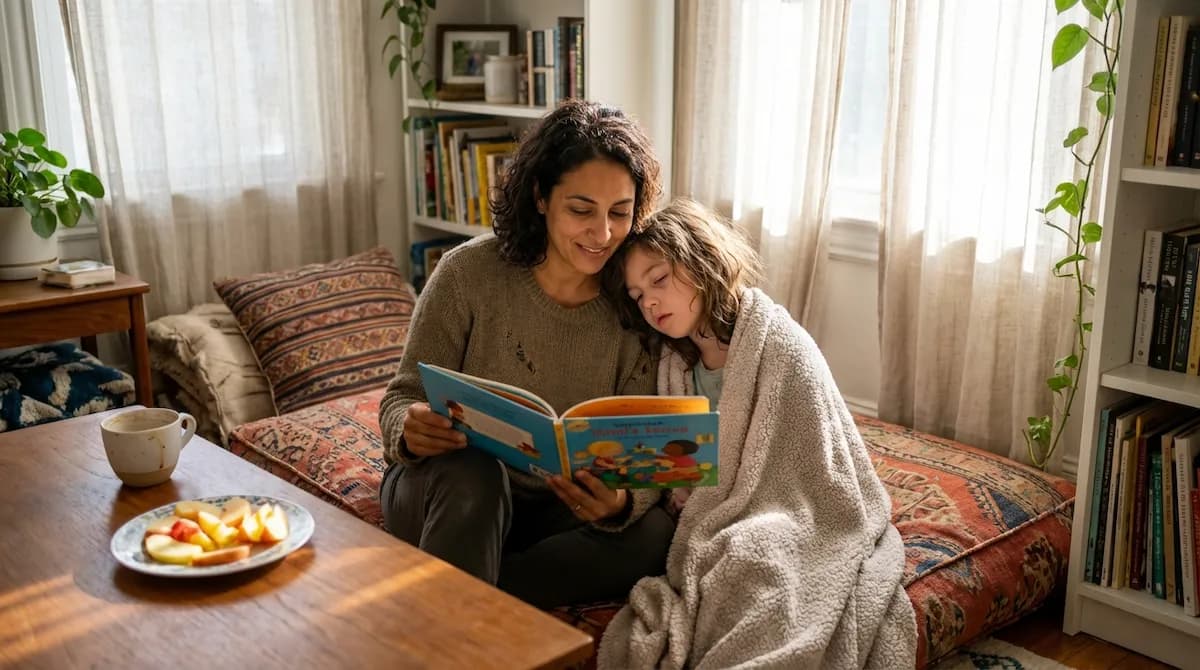
Sandhya: So, we're not, those things are still happening, but while I've had the language, I could prepare them for, this is what I need, mum needs some quiet while my own body is recharging. So those are the kinds of things that I would do, identify those big drains that might be something that's meaningful to you. Like, I know you speak at conferences too, and that's meaningful, to spread your awareness, and just to go, I understand this. But something concrete that people can do is start to notice when we're running low, right? So notice when we're charged up and happy. So, when they come back really tired, just go, "Ah, looks like your power pack has run low, here's a snack, right? Do you want some quiet, or read a book together?" Offering these really simple kind of recharging options that's not pushing them to tell you how they're feeling and why they're feeling that way. Their power pack's too low to do that. We have to recharge and bring them up to a more cognitive state first, before they can use any language to go through that.
Laetitia: I love that. I really love the simplicity of it, yet the power of it. And how many times do we just push through, rather than pausing and being like, okay, how is my power pack? And it's just this regular check in, right?
Sandhya: Yeah, that's it. Is building that into the everyday. So if you can, first of all, educate your child on, what are power packs, for example, and then start to model it, right? Going, my power pack's a bit low, but also my power pack's really high, let's do an activity together, right? So we're not just modelling that low slumpy period. It's, what's the middle ground of, I'm not quite sure, can we just go for like one hour rather than two hours, for example, you know? Like I don't think I can take two hours, because I'm in this orange zone, but I, we can do one hour, that'll be enough. And then when I'm really high, going like, yeah, let's go for a hike, you know. And so it's talking about your power pack at all the different levels.
Laetitia: I love this and I love that you mentioned, side note, because my brain wants to mention it. We went to Flip Out at the last school holidays. 10 minutes in, Lou broke one of her teeth. So I was like, "Oh my goodness, oh my goodness." So it's like, "Oh my god." But it's lovely how they can get their energy out in those beautiful trampolines. And when you go when there is no one around, it's okay for my power pack. But when it's crowded with kids and parents and noise, like, for sure, I need a full battery to go there.
Laetitia: So if we go and look at a classroom context, for instance, I really understand how, as a family, we can start using the power pack and start bringing awareness around energy accounting. How have you seen, because I know you're helping lots of schools and teachers and community, around applying those concepts, how, if any teacher is listening to this podcast, they could start applying energy accounting in a classroom?
Sandhya: Yeah. So in the book, My Body's Power Pack, there is a lovely image that I really recommend you look at, and it is children lining up outside of a classroom, and they all have different power packs. And that's the thing that I want teachers to know, is that not everyone is going to start the day on 100%. Some of them will start at 50, some of them start at 20, we all have different starting points. And if we normalise, first of all, if we know that we can normalise that, to go, it's okay to take it a little bit slower, I'm here for what you need, right? It's okay to check in with me if you're having a hard day, I can support you, I'm someone who you can come to. And if you're a teacher, getting to know your own students, I guess, ways of expressing that, there will be some students who you can observe that very easily. They're very expressive with their bodies, either coming in slumped and throwing the bag on the floor type thing, or coming in really grumpy. But then there are some kids who you can't tell on their face, right? It is actually a micro expression that we're looking for, of, rather than a smile, it's a straight line, for example, right? Rather than being ready to contribute and sitting up, they're just a bit more quiet. And that's that student's individual signs, and we've got to look out for that too.
Laetitia: Yes. Yes. Totally. And I love that, in the fact that every of your book, and if anyone hasn't read The Brain Forest or Power Pack, really kind of getting it. And also your first one, can you remind me, The Rainbow Brain?
Sandhya: So The Brain Forest was the first one, and then it was The Rainbow Brain.
Laetitia: Yeah, I came to you first with The Brain Forest, and then I read The Rainbow Brain.
Sandhya: I didn't know, oh okay.
Laetitia: And it's in that order, okay, great.
Laetitia: So yeah, any of your books, what I love, it's like there are exercises, and really good things. And I know The Brain Forest, we shared it with Zoe's class for them to do the exercise of the brain that you recommend in the book. Always thinking about getting those books to really help and apply those examples. Is there anything that you'd like to share with our listeners about energy accounting, before I go through, what is charging you?
Sandhya: Ah, good question. I think one of the things that I think about, as a parent, is to look at energy accounting in terms of a systems approach, right? So if you're working one on one with a child or an adult, even getting to know their own nervous systems, but the next step is really learning about how nervous systems interact, right? Because, for example, as a parent, I go, okay, well, we've gone to a birthday party, my power pack is low, I have child one whose power pack is low, but then I've got child two, who that birthday party was so energising that they've still got a high power pack, and they're going to need more stimulating activities, right? So, it's about how can we plan for a little system, whether it's a family or a classroom, for people to have different needs.
Laetitia: Yes. And how can we do that then? Because that's happened so many times in our family dynamic, but I also witness it in other contexts, how sometimes you have one person who is fully charged, and then another one who is really, really in the red, and one which is in between, and another, like, we all have, as you've said beautifully, different needs and different energy levels. What can we do in those contexts to acknowledge and accommodate for everyone's needs?
Sandhya: Yeah. So, in my household, we have a little jar of little energising activities, so you can pick from that. And I've learned how we can engage. So, for example, if I've got a low power pack, I'm going to sit out on the deck and I'm just going to rest. My other child, with a low power pack, he's going to read. My other child will be outside on the trampoline, right? So, we can all kind of share space, because these things are predictable, I know that that's what she's going to need, because that's what they're like. So I think, part of making space for this, is being able to plan and predict, so that you can have these activities going, I already know what's going to happen, right? It's not a surprise that people have different nervous systems.
Laetitia: Definitely. Yet, you know, it's not a surprise, yet most of our society is built for everyone to be on the same level for everything. It's insane. The more I dive deeper into this work, for myself, and for my family, and for Understanding Zoe, the more I discover how there are so many expectations that is just, oh, we're all, we're all, we're all the same, we're all equal. And you're like...
Sandhya: Nope.
Laetitia: Yeah.
Sandhya: Yeah. So, for example, in the classroom, if we were to plan for that, we'd go, okay, well, those who want to work quietly, grab your headphones and you can sit on this table. Those who want group discussions, you're on the other end. So, we can start planning for that. And that's really the push that we're moving towards. It's not, we're all doing the same, we're all learning, that's the same thing, but we're all learning in a way that works for us.
Laetitia: I love that.
Sandhya: Yeah.
Laetitia: So good. And we've stumbled across Montessori, and I'm not promoting Montessori whatsoever, but it's been a beautiful experience for us. And I know every Montessori school is different, but for us it's been a beautiful experience because there is actually this, led by the child and their own needs. So if one child wants to actually work under a table with their headphones in, kind of a more dark place, and read, they can. And if they want to do maths lying down on the floor, they can. And that's, I wish this would be possible in other schools, because this is something that we struggled with in our own family, is the expectation of sitting on a table and on a chair and just doing the same work as other people, which sometimes can be difficult for some of our kiddos, which then creates some school can't situations and things like that. So I wish that more people will listen to this, and try, start bringing within their school environment or their home environment, those different corners that we all need, and those different spaces.
Sandhya: Yeah, that's it. Plan for diversity is the message that we're going for.
Laetitia: Exactly, the universal design, I love it.
Laetitia: So what is, before I let you go, Sandhya, what is the one small ritual that is really charging you, whatever happens? It's like your go to. Just to inspire us.
Sandhya: Yeah, so I always start the morning with a cup of freshly brewed coffee, and I put it in my special whale cup, so I don't use any other cups, so I connect with the whales. And then I just sit outside and listen to the birds, and that's the five minutes that I have to just go, that's my time, that is my grounding, connecting to my body. I don't have to do anything aside from drink this cup. So yeah, that's a little thing that I do, that's sacred.
Laetitia: I love it. The importance of sacred ritual is really something that helps us, and this ritual, as you said, are predictable, and they're always the same, and there is an intention behind it. I love that. And I love your love for whales, it's just such a beautiful artistic joy and spirit to witness. I notice them everywhere around.
Sandhya: Yeah, yeah, that's it. So it's like being able to connect to it while I'm away from the ocean. And it's coffee, which is delightful. Now I made my own chai syrup, so it's like a dirty chai, and it's just so, ah, makes me happy.
Laetitia: Special, so special. So, for anyone who's listening to this, and that, okay, this time was not enough for me to dive deep enough in all of those topics, so any of you who is listening to this and you want to go for a deep dive, where can they connect with your work? Where can they get your books? How can they learn more from you? I know you have fantastic courses, which I'm guilty of having done many of those, and I highly recommend.
Sandhya: Cool. Yeah, so I'm probably most active on Instagram, at Onwards and Upwards Psych, or on Facebook, Onwards and Upwards Psychology. You can buy My Body's Power Pack really all over the world, wherever you get your books. But if you'd like the card deck, that's available on my website, so onwardsandupwardspsychology.com.au. I am going to be speaking more about energy accounting at the Neurodivergence conference in Adelaide, so that's coming up in February. But aside from that, I'll really respond to workshops that the community wants, so if that's something that people are interested in, feel free to connect with me on social media, say, "I've been looking for this," and then we can work something out.
Laetitia: Amazing. Thank you so much for your time today. It was really special to spend some time interviewing you on The Neurodivergent Pulse, and as always, you have pearls of wisdom that you spread around, and highly recommend for anyone listening to this to check your work. And thank you again for being such an amazing support to myself and my family, and everyone that is around us in the community. Thank you. Thank you.
Sandhya: That's right. It's so lovely to connect.
Laetitia: Quick pulse check about energy accounting. So, Zoe, how do you know when your energy tank is low?
Zoe: I get angry sometimes, I have a headache, and I would stim a lot.
Laetitia: Okay, thank you. And Zoe, how do you refill your tank of energy back up?
Zoe: By being underneath my weighted blanket, and sometimes having sensory toys, fidgeting, and again stimming.
Laetitia: Thank you for joining us for this quick pulse check, Zoe.
Laetitia: That's a wrap for The Neurodivergent Pulse. If this helped, follow the show and leave us a quick review on your favourite platform. You can even share this episode with someone who needs it. You can learn more about our platform at understandingzoe.com. Thanks for listening.
Subscribe to The Neurodivergent Pulse.
Follow the show so a new episode finds you. It's free.