In short

Signs of autism in girls are often quieter than the ones people expect. Many Autistic girls copy others and work hard to fit in. They hold it together at school. Then they fall apart at home.

A University College London review found signs of gender bias. Girls who meet the criteria are more likely to be missed.

Source: Loomes, Hull and Mandy, University College London, What is the male-to-female ratio in autism?, Journal of the American Academy of Child and Adolescent Psychiatry, 2017.

Because of that, autism in girls is often missed, or noticed years later. This page explains how it can look, why it is missed and what to do.

We also have a page on autism in women.

How autism can look different in girls and gender diverse kids

Every Autistic child is different. These patterns come up again and again for girls, and for many gender diverse kids.

Many Autistic girls learn early to watch, copy and blend in. So the signs are often quieter than people expect. They are easy to put down to shyness or sensitivity.

Many gender diverse children describe the same patterns. We look at this more closely in the section on autism in gender diverse kids, below.

Our autism signs checklist covers signs in all children. This page focuses on what tends to be missed in girls.

Why signs of autism in girls get missed

The picture most people learned was built around boys.

In 2017, a team at University College London pooled 54 studies. It was led by Rachel Loomes, Laura Hull and William Mandy. Autism is often said to be four times more common in boys. They found the true figure is closer to three to one.

They also found signs of a gender bias in who gets identified. Girls who meet the criteria are more likely to go without a clinical diagnosis.

Another study looked at how children play. Michelle Dean, Robin Harwood and Connie Kasari watched 96 children at break time. They worked at California State University Channel Islands and the University of California, Los Angeles.

Autistic boys tended to play alone, which made them easy to spot. Autistic girls stayed close to other children and wove in and out of activities. The researchers warned that looking for socially isolated children will keep missing these girls.

Source: Loomes, Hull and Mandy, University College London, What is the male-to-female ratio in autism?, Journal of the American Academy of Child and Adolescent Psychiatry, 2017. Dean, Harwood and Kasari, The art of camouflage, Autism, 2017.

Podcast

“Are we still there?”

“I hear so often paediatricians will come back to me and say, "Oh, but they made eye contact and they have friends." And I'm like, are we kidding? Are we still there?”

Brianna Thomas, AuDHD clinical psychologist, speaking on The Neurodivergent Pulse, episode 7, 28 October 2025.

Brianna explains that many Autistic children learn eye contact. They are taught it is expected. In her words, “It's not safe not to.”

Masking in Autistic girls and gender diverse kids

Masking means hiding or copying behaviour to fit in. It often starts as a way to stay safe.

A child who masks may rehearse conversations or copy a friend's laugh. She may hold in the movements her body needs, like stimming. It works, which is why adults miss it.

It also costs a lot of energy. That is often why the hardest moments happen after school. Home is where she feels safe enough to stop.

Masking is not something to force a child to drop. The pressure to mask can be greater for gender diverse children. It can also be greater for children in Black, Brown, Indigenous or Asian (BBIA) communities. Home can be the place where they get to stop.

Autism in gender diverse kids

Gender diverse children are part of this picture, not a footnote to it.

In 2020, Varun Warrier and colleagues studied 641,860 people. They work at the University of Cambridge Autism Research Centre. Transgender and gender diverse people had higher rates of autism than cisgender people.

If your child is gender diverse, the same patterns on this page may apply. They deserve the same careful look, and a clinician who respects who they are.

Source: Warrier and colleagues, University of Cambridge, Elevated rates of autism in transgender and gender-diverse individuals, Nature Communications, 2020.

What parents of neurodivergent children tell us

Families carry a lot, and they see their children's strengths clearly.

Our 2025 study included families of neurodivergent children of all genders.

1,091

Australian families took part in our 2025 national study.

9 in 10

Parents of neurodivergent children feel misunderstood or invisible.

3 in 5

Parents raising neurodivergent children are neurodivergent themselves.

Source: Understanding Zoe, Making the Invisible Visible, a 2025 national study of 1,091 Australian families, run with research partners Sunday Insights and PureSpectrum.

“Watching her unique perspective unfold. Her intense focus on passions. The joy in her authenticity.”
A mother, in our 2025 national study of 1,091 Australian families.
Read the key findings of Making the Invisible Visible.
A parent reading with two children on the sofa at home
Making the Invisible Visible, a 2025 national study of 1,091 Australian families.

Many parents recognise themselves as they learn about their child. If that is you, you are far from alone.

Our page on the invisible work of caring shares more of what parents told us.

What to do if you notice signs of autism in your daughter

You do not need to be sure before you act. Start by noticing, and writing it down.

Keep short notes on what you see at home and hear from school. Note what happens before and after the hard moments. Patterns are easier to show a professional than to describe from memory.

  • Start with your GP or family doctor. Bring your notes. Ask whether an autism assessment makes sense, and who could do it.
  • Talk to the school. Ask her teacher what they notice. Schools can often make adjustments before any assessment.
  • Look for a clinician who knows girls. Ask for someone with experience of how autism can look in girls.
  • Look for a gender affirming clinician. If your child is gender diverse, find someone who respects who they are.

Autism and ADHD often appear together. If attention is part of the picture too, see ADHD in girls. Our page on AuDHD explains being both.

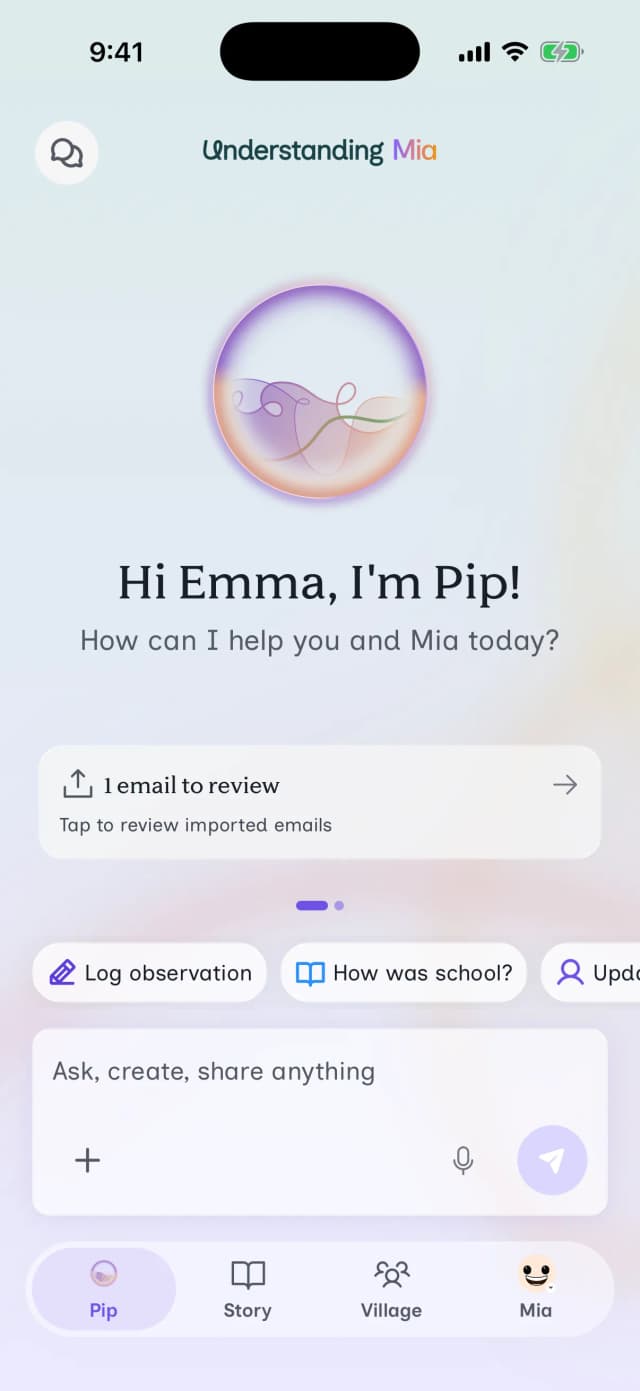
The Understanding Zoe app open on a phone, showing Pip's home screen

Where Understanding Zoe fits

Your notes become her story. Understanding Zoe keeps it all in one place for the people who help.

Pip* is your pocket coach inside the Understanding Zoe app. You talk to it by voice or text about what actually happened today. It writes the day down and gives you something to try straight away.

Over time it shows you patterns you were too tired to notice. Observations, appointments, reports and strategies all live in one profile.

The Care Village lets you invite family, teachers and therapists. You choose what each person sees, document by document. Supporters join free.

Pip is not a doctor and not a therapist. It helps you organise and prepare. It does not assess and it does not treat.

* Pip has nothing to do with the UK benefit called PIP, the Personal Independence Payment.

Their words, not ours

Rated 4.6 on the App Store

Real reviews from parents and therapists. See the reviews.

“This is the only one that doesn't make my daughter sound like a problem to be managed. I jot down what's happening day to day and it quietly pulls out the patterns I'm too tired to notice myself.”

yoyo_e · Parent · App Store

“My child had a big meltdown this morning and I have been debriefing with Pip just now. It's been so incredibly helpful and specific in helping me get a handle on it.”

Katy S · Parent · App Store

“As a therapist, to be able to both recommend and utilise this app with families is incredible. Creating space to connect, grow and thrive.”

Kaya L · Therapist · Google

As featured in

Startup Daily SmartCompany Channel 9 Mums and Co Women's Agenda Education Today ABC

Questions people ask us

Why is autism missed in girls?

The picture of autism most people learned was built around boys. Many girls adapt in ways that hide what they find hard. They are often quieter at school.

A 2017 review from University College London found signs of gender bias in identification. Girls who meet the criteria are more likely to be missed.

At what age are signs of autism in girls usually noticed?

Often later than in boys. Many families notice in primary school. Others notice when social life gets harder, before the teenage years.

Some girls are not identified until adulthood. It is never too late. It is also never too early to write down what you see.

Can a girl be Autistic if she makes eye contact and has friends?

Yes. Clinical psychologist Brianna Thomas hears this myth often. Many Autistic children learn to make eye contact because they are expected to.

Friendships can look different too. A child may have one intense friendship. Or she may stay close to a group without really joining in.

Is this page only for girls?

No. The search phrase is “signs of autism in girls”, so we use it. This page is for girls and gender diverse children throughout.

University of Cambridge research found higher rates of autism in transgender and gender diverse people. Their experiences are part of this picture.

What should I do if I think my daughter is Autistic?

Start writing down what you notice, at home and from school. Note what happens before and after hard moments.

Then talk to your GP or family doctor, and bring your notes. The school can also share what they see.

If today is a hard day

Understanding Zoe is not a crisis service. If you are in danger now, call your local emergency number. That is 000 in Australia, 999 in the UK and 911 in the US.

For support in Australia, call Lifeline on 13 11 14. In the UK, call Samaritans on 116 123. In the US, call or text 988.

Nothing on this page is medical advice. It does not assess anyone. It is not a substitute for care from a professional who knows you.

Keep reading