ADHD in girls often looks quieter than people expect. You may not see a child bouncing off the walls. You may see a girl who drifts off and loses track. She may work twice as hard to keep up.
Australia's 2022 ADHD guideline says girls may be under-recognised and less likely to be referred.
Source: Australian ADHD Professionals Association, Australian Evidence-Based Clinical Practice Guideline for ADHD, 2022.
The inattentive side of ADHD is the part most often missed. Many girls are not identified until high school, or until adulthood.
We also have a page on ADHD in women.
Every ADHDer is different. These patterns come up often for girls, and for many gender diverse kids.
ADHD in girls is often quieter than people expect. The busy part may be in her head, not her body. That is why these signs are easy to miss at school and at home.
If the big feelings sound familiar, our page on rejection sensitive dysphoria explains more. For starting and finishing tasks, see our page on executive function differences.
Inattentive ADHD is quiet, so it rarely gets a teacher's attention.
“They can be deeply insightful, introspective, thoughtful, and even have very calm bodies, because that inattentive side of things doesn't necessarily come with body restlessness. It can be a brain restlessness.”
Brianna Thomas, AuDHD clinical psychologist, speaking on The Neurodivergent Pulse, episode 7, 28 October 2025.
Brianna calls the idea that all ADHDers are hyperactive a myth. Many girls sit still and look fine. Inside, they are working hard just to follow along.
The research and Australia's own guideline point the same way.
In 2020, a group of UK experts published guidance on ADHD in girls and women. The group was led by psychologist Susan Young. They called for a move away from seeing ADHD only as a behaviour problem.
They described a subtler, more inward picture that is common in girls. They also noted that coping strategies can hide ADHD from teachers and parents.
Australia's 2022 clinical practice guideline for ADHD agrees. It says girls may be under-recognised and less likely to be referred. They are more likely to be told they have anxiety or depression instead.
The guideline also notes that inattentive ADHD may not be identified until secondary school. By then, many girls have spent years believing they are the problem.
Gender diverse kids can be missed for the same reasons. A 2020 University of Cambridge study found higher rates of ADHD in transgender and gender diverse people. Autism rates were higher too.
Source: Young and colleagues, Females with ADHD: an expert consensus statement, BMC Psychiatry, 2020. Australian ADHD Professionals Association, Australian Evidence-Based Clinical Practice Guideline for ADHD, 2022.
Families carry a heavy load, and they see their children's strengths clearly.
Our 2025 study included families of neurodivergent children of all genders.
Australian families took part in our 2025 national study.
Parents of neurodivergent children feel misunderstood or invisible.
Parents feel proud or grateful almost every day.
Source: Understanding Zoe, Making the Invisible Visible, a 2025 national study of 1,091 Australian families, run with research partners Sunday Insights and PureSpectrum.
“My ADHD kids see the world in different colours to me, they teach me things every day.”
More than three in five parents in the study are neurodivergent themselves. Many parents recognise their own story as their child's unfolds. If that is you, our page on ADHD in women may help.
Our page on the invisible work of caring shares more of what parents told us.
You do not need to be sure before you act. Start by writing down what you notice.
Keep short notes on what you see at home and hear from school. Include the good days too. Patterns are easier to show a professional than to describe from memory.
ADHD alone does not automatically make a child eligible for the NDIS. Eligibility depends on her support needs.
ADHD and autism often appear together. If you also see signs of autism, read signs of autism in girls.
How to Understand and Support Your ADHDer. It explains how ADHD works, without blame or shame. It includes home strategies and school scripts you can adapt.
Your notes become her story. Understanding Zoe keeps it all in one place for the people who help.
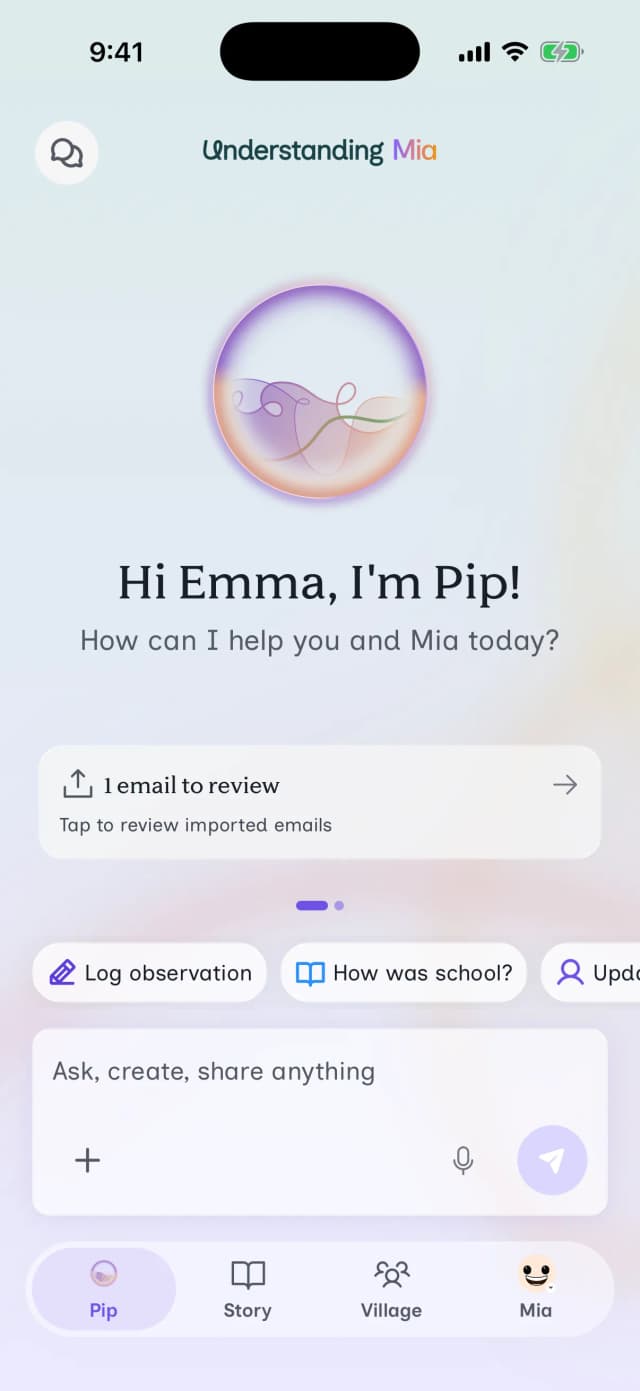
Pip* is your pocket coach. You talk to it by voice or text about what actually happened today. It writes the day down and gives you something to try straight away.
Over time it shows you patterns you were too tired to notice. Observations, appointments, reports and strategies all live in one profile.
The Care Village lets you invite family, teachers and therapists. You choose what each person sees, document by document. Supporters join free.
Pip is not a doctor and not a therapist. It helps you organise and prepare. It does not assess and it does not treat.
* Pip has nothing to do with the UK benefit called PIP, the Personal Independence Payment.
Real reviews from Australian parents. See the reviews.
“This is the only one that doesn't make my daughter sound like a problem to be managed. I jot down what's happening day to day and it quietly pulls out the patterns I'm too tired to notice myself.”
yoyo_e · Parent · App Store
“This app is a genuine must-have for ND families. Pip gives advice and direction in those tough moments, like meltdowns and Centrelink forms.”
Sian R · Parent · Google Play
“My child had a big meltdown this morning and I have been debriefing with Pip just now. It's been so incredibly helpful and specific in helping me get a handle on it.”
Katy S · Parent · App Store
The best-known picture of ADHD is a restless boy who cannot sit still. Many girls do not look like that. Their restlessness is often in their thinking, not their bodies.
Australia's 2022 ADHD guideline says girls may be under-recognised and less likely to be referred. They are more likely to be told they are anxious or depressed instead. A 2020 UK expert consensus adds that coping strategies can hide ADHD.
Inattentive ADHD is when attention differences stand out more than physical restlessness. Clinicians call it the predominantly inattentive presentation. It is one of three presentations, alongside hyperactive-impulsive and combined.
It can look like daydreaming, losing track of instructions, or being slow to start. She may know exactly what to do and still not begin. Because it is quiet, it rarely disrupts a class, so it is easy to miss.
Often later than in boys. Australia's ADHD guideline notes that inattentive ADHD may not be picked up until secondary school. Some girls are not identified until adulthood. Our page on ADHD in women covers what that can look like.
Secondary school brings more subjects, more homework and less structure. The coping strategies that worked in primary school can stop being enough. That is often when the gap between effort and results starts to show.
Yes. Some girls are physically restless. In others, restlessness shows as talking a lot, interrupting or fidgeting quietly. Some have a mind that never switches off.
Clinical psychologist Brianna Thomas describes this as “a brain restlessness”. It is just as real when her body is still. If you notice it, write down when it happens and what helps.
Not automatically. ADHD alone does not make a child eligible for the NDIS. Eligibility depends on her support needs and how they affect everyday life.
Your GP or paediatrician can talk you through other supports and referrals. Schools can put adjustments in place without a formal assessment. Examples include written instructions, movement breaks and extra time.
Understanding Zoe is not a crisis service. In an emergency call 000. Lifeline is 13 11 14. Kids Helpline is 1800 55 1800. 13YARN is 13 92 76.
Nothing on this page is medical advice. It does not assess anyone. It is not a substitute for care from a professional who knows you.