For autistic adults
Rebuilding after autistic burnout with skills regression
Jasmine is an autistic and ADHD adult in Australia who left a demanding career. A long autistic burnout with skills regression ended it in 2026. Being assessed as autistic named it for the first time. She now uses Understanding Zoe to process things in the moment. She also uses it to notice her own overload as it builds.
By Laetitia Andrac, co-founder of Understanding Zoe. Published 1 September 2026. About 7 minutes to read.
At a glance
- Who
- Jasmine, autistic and ADHD adult, Australia
- Assessed
- ADHD some years ago, autistic as an adult
- Household
- A partner
- Has told
- Her GP, her psychologist, and her parents
- Context
- Autistic burnout with skills regression, built over years. In 2026 it led her to leave a high-pressure profession
- Uses Understanding Zoe for
- Processing out loud in the moment, spotting patterns, and seeing overload as it builds
Before: autistic burnout she had been through before, without a name for it
Jasmine had been through autistic burnout more than once without knowing what it was. What made this time different was having a name for it.
Autistic burnout has a peer-reviewed definition, which came from autistic people’s own accounts. In 2020, Dora Raymaker and colleagues published the first study to define it. They describe it as “a syndrome conceptualized as resulting from chronic life stress and a mismatch of expectations and abilities without adequate supports”. Its signs are “pervasive, long-term (typically 3+ months) exhaustion, loss of function, and reduced tolerance to stimulus”. The word that matters is mismatch. It describes the fit between a person and what is being asked of them. It does not describe a fault in the person.
Before the assessment, the explanation was always her. Until her thirties she could not sustain full-time work. That read as a personal failing, not a mismatch with the rooms she worked in. Fluorescent light and overcast days made her physically unwell. Nobody had ever told her that this happens to people.
That is not a rare sequence. In 2019, Samuel Arnold and colleagues described the Australian Longitudinal Study of Adults with Autism. Of the autistic adults in it, 90% were assessed in adulthood. Their mean age at assessment was 35.3. An entire generation reached the explanation late. They spent the years before it blaming themselves for a mismatch.
What looked like coping was not capacity
The burnout that ended her career built over years. She worked full time, studied full time and went through a separation, all at once. It looked like coping. Jasmine says it was a survival strategy, not what she could sustain. Skills regression is the part of burnout that frightens people most.
“I have had massive burnout and skills regression. That’s been building over time, but culminated in me quitting my job...”
The turning point: the conversation she asked to bookmark
The clearest moment is small, which is why it is worth telling.
During a conversation with a family member, Jasmine recognised she was cognitively overloaded. She saw it before it turned into something else. What she had logged in Understanding Zoe made the overload visible to her in time. She did not push through and react badly. Instead she asked to bookmark the conversation and come back to it.
Nothing dramatic happened. That is the point. In the other version of that afternoon, nobody notices the overload in time. That version costs a relationship a little each time. It is also the one most people know better.
What Jasmine does now with Understanding Zoe
Processes out loud, in the moment
The need to debrief will not wait for someone to be free. She takes it somewhere that is always available.
Watches for her own overload
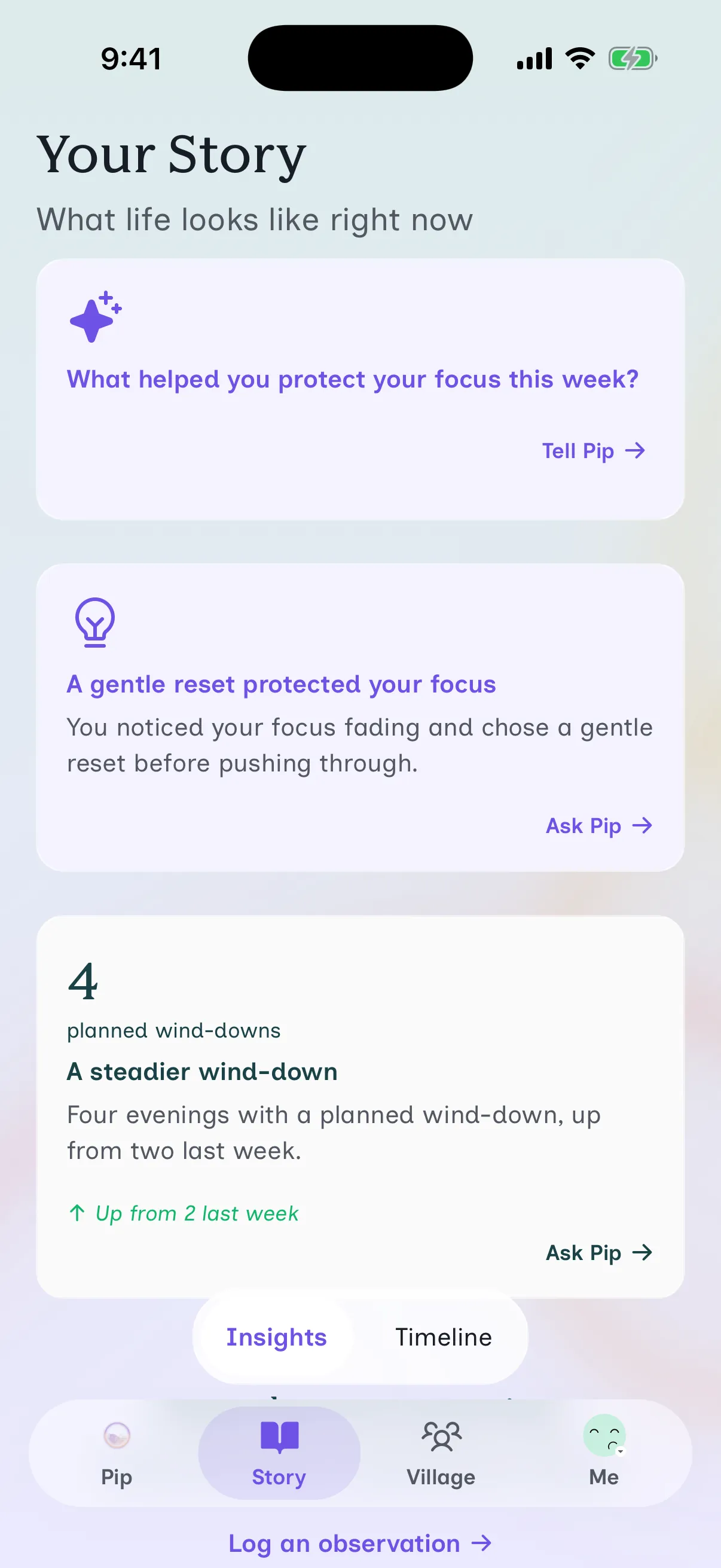
She logs what is happening, so she can see the build-up early enough to act. The bookmarked conversation was one of those times.
Has more than one place to talk
Her partner is no longer her only outlet. That is a change at home, not a change in an app.
Processing out loud as an autistic and ADHD adult
One of the things Understanding Zoe surfaced was how Jasmine regulates.
Anyone who processes out loud knows the problem. The need to talk does not wait until the other person is free. The loop of thoughts does not close on its own either. When her partner does not have the energy, Jasmine takes the debrief to Pip. Pip does not replace her partner. Her partner is no longer the only person available to her.
In Jasmine's words
“I think I actually hit autistic burnout before without recognising that it was autistic burnout... this time I had an autism diagnosis, so I was more aware of what was happening.”
On being assessed as an adult
“I often grieve what my life could have been like if I’d had [the assessment] earlier.”
On how she regulates
“I have worked out through Pip that [I] regulate through conversation. That’s something Pip identified for me. So instead of annoying my partner, not that I annoy [them], [they’re] fantastic, but sometimes [they don’t] have the energy to give me. And when I need to debrief, it needs to happen now while it’s in my head.”
On what happens when there is nowhere to put it
“If you don’t talk about it, then it’s just ruminating over in your head like this unsolved loop.”
If some of this sounds like you
You have been through burnout before, without a name for it.
For years, the explanation was always you.
You process out loud, and the need will not wait until someone is free.
You tend to notice your overload only after it has turned into something else.
Understanding Zoe is an Australian app for neurodivergent adults and caregivers of neurodivergent children. You tell Pip what happened. Pip helps you make sense of it and keeps what helps in one private place. You do not need a formal assessment to begin.
7 days free. Cancel before day 8 and you won’t be charged. After that it is A$14.99 a month or A$119.99 a year. Pip chats are private to you.
Questions autistic adults ask
What is autistic burnout with skills regression?
Skills regression means losing access to things you could previously do. Jasmine describes it building over years of working and studying full time. In 2020, Dora Raymaker and colleagues wrote the first peer-reviewed definition. They built it from autistic people's own accounts. It describes a mismatch between what is asked of someone and the support they have. It is not a failure in the person.
Why did nobody notice until I burned out?
Because functioning is not the same as capacity. Jasmine describes working full time, studying full time and going through a separation at once. She says what looked like coping was a survival strategy. It was not a sustainable reflection of what she could actually do.
Is it common to feel grief after a late autism assessment?
Yes, it is common rather than unusual. In 2019, Samuel Arnold and colleagues described a long-term Australian study of autistic adults. In it, 90% were assessed in adulthood, at an average age of 35. Jasmine's own words: "I often grieve what my life could have been like if I'd had [the assessment] earlier."
I regulate by talking, but my partner cannot always listen. What do I do?
This is what Jasmine uses Understanding Zoe for most. She describes needing to debrief in the moment, not in ten minutes. A partner who is fantastic still does not always have the energy. Processing somewhere else means her partner is not her only outlet.
How do I stop a conversation before I say something I regret?
Jasmine recognised she was cognitively overloaded. She asked to bookmark the conversation and come back to it. Seeing the build-up early made that possible, and that is what her logging is for. Naming the overload is easier than managing what happens after it.
Can an app help with autistic burnout?
No app treats burnout, and Understanding Zoe does not claim to. What Jasmine describes is narrower and more useful. She has somewhere to process in the moment. She also keeps a record that shows her own patterns, including overload as it builds.
About this case study
- Name
- Published under her own name, at her request.
- Source
- An interview on 24 August 2026. Quotes are lightly edited to remove spoken filler. Square brackets mark a word supplied for sense. Two quotes are shortened. One drops two clauses naming her profession and the month she left. The other keeps her partner ungendered. Jasmine approved both wordings on 31 August 2026.
- Written by
- Laetitia Andrac, Understanding Zoe
- Published
- 1 September 2026
- Last reviewed
- 1 September 2026
- Next review
- March 2027
- Consent
- Published with Jasmine’s written approval. She reviewed every quote in context.
References
- Raymaker DM, Teo AR, Steckler NA and others, “‘Having All of Your Internal Resources Exhausted Beyond Measure and Being Left with No Clean-Up Crew’: Defining Autistic Burnout”, Autism in Adulthood, 2020, 2(2), pages 132 to 143. The first peer-reviewed study to define autistic burnout, built from autistic people’s own accounts. Link checked 31 August 2026. pmc.ncbi.nlm.nih.gov/articles/PMC7313636
- Arnold SRC, Foley K-R, Hwang YIJ and others, “Cohort profile: the Australian Longitudinal Study of Adults with Autism (ALSAA)”, BMJ Open, 2019, 9(12), e030798. 90% of the cohort were assessed in adulthood, at a mean age of 35.3. Link checked 31 August 2026. pmc.ncbi.nlm.nih.gov/articles/PMC6924702
- Australian Government Department of Health, Disability and Ageing, National Autism Strategy 2025 to 2031, released 14 January 2025. Link checked 31 August 2026. health.gov.au/resources/publications/national-autism-strategy-2025-2031
Read next
- The rest of Jasmine's storyWhat she does each morning now. She plans around the energy she has, not the list she wishes she could do.
- Understanding Zoe for adultsA profile for yourself, not for a child. How the app works when you are the one who needs it.
- Autistic and raising autistic childrenMichael Coles keeps his family's reports, patterns and plans in one place. He has a profile for himself too.
- How Understanding Zoe worksWhat Pip does, what the village is, and what happens to what you write down.