For parents and carers
Thriving Kids: what it is and what it means for your family
What changed on 1 October 2026, who it is for, and what to do next. Written by people who live it.
7 days free, then A$14.99/mo.
Registered NDIS provider
By Laetitia Andrac. Published 8 October 2026. Last checked against government sources on 8 October 2026.
In short
Thriving Kids is a new Australian Government program. It supports children aged 8 and under with developmental delay or autism and low to moderate support needs. It started on 1 October 2026. Raising Children Network says your child does not need a diagnosis, and you do not need to apply.
Information, a nurse phone line and an autism helpline are open now. Allied health supports are expected during 2027.
Source: Raising Children Network, Thriving Kids: FAQs about support, eligibility and access (opens in new tab), 2026.
If your child is on the NDIS now, our guide NDIS and autism: what parents need to know explains how it works today.
What Thriving Kids is
A government program that sits alongside the NDIS.
Thriving Kids is funded by the Australian Government with the states and territories. It is for young children who need extra help with their development, and for their families.
The government says it aims to help families notice concerns early, and to connect them with support.
It works alongside the NDIS and does not replace it. It is the first part of a wider plan, called Foundational Supports, to offer more support outside the NDIS.
Source: Raising Children Network, Thriving Kids: FAQs about support, eligibility and access (opens in new tab), 2026. Department of Health, Disability and Ageing, About Thriving Kids (opens in new tab), 2026.
Who Thriving Kids is for
Children aged 8 and under, and the people who care for them.
8 and under
The age range Thriving Kids covers.
Source: Raising Children Network, Thriving Kids FAQs (opens in new tab), 2026.
- Aged 8 and under. From babies to the early school years.
- Developmental delay or autism. Either one is enough.
- Low to moderate support needs. Children with high support needs stay with the NDIS.
- Their families, carers and kin. Thriving Kids includes them too.
Source: Raising Children Network, Thriving Kids: FAQs about support, eligibility and access (opens in new tab), 2026.
Does my child need an assessment for Thriving Kids?
No. Support starts from what your child needs.
Raising Children Network says children can get support “without needing to get a diagnosis or apply to the NDIS”.
You can use the hub, the nurse line and the autism helpline without any assessment or referral. The government says states and territories will deliver “child health and development checks to identify when a child may need extra support”. It also plans a new Medicare Healthy Kids Check, where your GP looks at your child's health and development at age 3.
Source: Raising Children Network, Thriving Kids: FAQs about support, eligibility and access (opens in new tab), 2026. Department of Health, Disability and Ageing, Thriving Kids: state and territory governments (opens in new tab) and Supports being rolled out (opens in new tab), 2026.
Note: At Understanding Zoe we say assessment rather than diagnosis. An assessment describes what someone found. It does not decide that something is wrong.
What you can use right now
Three national supports opened on 1 October 2026.
- The Thriving Kids Information and Resources Hub. Run by the Raising Children Network, at raisingchildren.net.au/thrivingkids (opens in new tab). Information on child development, developmental delay and autism.
- The national nurse line. Child and family health nurses on 1800 882 436, or by video call. 7am to midnight (AET), seven days.
- The Thriving Kids Autism Helpline. Run by Amaze (opens in new tab), on 1300 654 789, 8am to 7pm, Monday to Friday. You can also email thrivingkids.autism@amaze.org.au or use the webchat on Amaze's website. It is free, and Amaze says you do not need “a diagnosis or referral” to get in touch. For an interpreter, call TIS National on 131 450 and ask for the helpline.
Other support will come through GPs, early childhood services and schools. Each state and territory has its own timeline. The Department of Health, Disability and Ageing lists what is happening where (opens in new tab).
What happens if my child is on the NDIS
NDIS access does not change before 1 January 2028.
1 January 2028
When every Thriving Kids support is due to be in place.
Source: Raising Children Network, Thriving Kids FAQs (opens in new tab), 2026.
Children aged 8 and under can keep applying to the NDIS until 1 January 2028.
Children who are on the NDIS before 1 January 2028 keep being reassessed under the current rules. When they turn 9, they are reassessed under the new rules.
From 1 January 2028, children aged 8 and under with developmental delay or autism and low to moderate support needs will no longer be able to join the NDIS. They will be supported through Thriving Kids and mainstream services.
Children with significant and permanent disabilities stay eligible for the NDIS. That includes Autistic children with high support needs.
Funding for some NDIS supports was reset from 1 October 2026. Your NDIS planner can explain what this means for your child's plan.
Source: Raising Children Network, Thriving Kids: FAQs about support, eligibility and access (opens in new tab), 2026. Department of Health, Disability and Ageing, About the changes to the NDIS (opens in new tab), 2026.
What is still being worked out
Thriving Kids is new, and some details are not settled yet.
2027
When allied health supports, like speech, OT and psychology, are expected.
Source: Raising Children Network, Thriving Kids FAQs (opens in new tab), 2026. Department of Health, Disability and Ageing, Supports being rolled out (opens in new tab), 2026.
- Allied health support. Speech pathology, occupational therapy and psychology are expected during 2027. They are not available through Thriving Kids yet.
- How it looks where you live. Most support will come through state and territory programs. Each one runs on its own timeline.
- Where you live. State pages are listed below. Queensland is not on RCN's list yet.
- Moving from the NDIS. Children already on the NDIS are reassessed under the new rules once they turn 9. Your NDIS planner can explain how this applies to your child.
RCN's own page says it plainly: “Thriving Kids is a new program, so some details are still being worked on.”
Source: Raising Children Network, Thriving Kids: FAQs about support, eligibility and access (opens in new tab), 2026. Department of Health, Disability and Ageing, Thriving Kids: state and territory governments (opens in new tab).
Thriving Kids where you live
Most supports come through your state or territory. These are the official pages.
- ACTThriving Kids and the ACT Government (opens in new tab)
- New South WalesNSW Government, Thriving Kids (opens in new tab)
- Northern TerritoryThriving Kids in the Northern Territory (opens in new tab)
- South AustraliaThriving Kids in South Australia (opens in new tab)
- TasmaniaTasmanian Government, Thriving Kids (opens in new tab)
- VictoriaThriving Kids Victoria (opens in new tab)
- Western AustraliaGovernment of Western Australia, Thriving Kids (opens in new tab)
- QueenslandNot on RCN's list yet. The national hub, nurse line and autism helpline are open to Queensland families.
Source: Raising Children Network, Thriving Kids FAQs (opens in new tab), state and territory list, read 2 October 2026. South Australia: Department of Health, Disability and Ageing, state and territory governments (opens in new tab), read 8 October 2026.
Before you call: get what you know in one place
Thriving Kids starts from your child's needs. Usually, you are the one who describes them.
You will tell your child's story many times: to the nurse line, the autism helpline, your GP, a child health check, an early learning centre or a school. Each of them sees one part of your child. You are the one who sees all of it.
Most parents already know their child well. That knowledge is just scattered. A note on your phone after a hard morning. A therapy report in your inbox. What the teacher said at pick-up. The thing that finally worked at bedtime. Bringing it together before you call makes it easier to say what you came to say. Amaze says you do not need documents ready to call the helpline. It also says details of your child's assessments, services or supports can be helpful to have nearby.
In 2025 we asked 1,091 Australian families about caregiving. Parents of neurodivergent children spend around 30 hours a week on it. Nearly ten of those hours are work nobody sees: emotional regulation, advocacy and admin.
Source: Understanding Zoe, Making the Invisible Visible, 2025.
“I had a care team where everyone was doing their own part, but I had no ways to bring it all together and guarantee for Zoe to feel safe, seen, heard, understood.”
 Laetitia Andrac, neurodivergent mum, co-founder and CEO of Understanding Zoe. Speaking on The Neurodivergent Pulse, episode 30, 30 April 2026.
Zoe's reports came from speech therapy, occupational therapy, psychology and school. Each held something important. They sat in different formats, in different places: on Laetitia's laptop and phone, in her email and her texts. Understanding Zoe started at the kitchen table, as a way to bring them together.
In the app: About Me
About Me is a one-page profile of your child, strengths first. Pip writes it from what you have logged, whenever you ask, and you can edit or refresh it any time. It covers your child's strengths, interests, support needs and the best way they learn. Everyone you invite into your village can read it, so a new teacher or therapist starts with the whole picture. Have it open when you call the nurse line or the helpline, and you are not starting from scratch.
7 days free, then A$14.99/mo.
What to do now
You do not need to be sure before you act. Start with what you notice.
Keep short notes on your child's days: what drained them, what helped and what changed. Include the good days too. A few weeks of notes help any conversation.
Put what you know on one page. Your child's strengths, interests, what helps and what makes days harder. In the Understanding Zoe app, Pip writes this for you as your child's About Me.
Call the nurse line with any questions. 1800 882 436, 7am to midnight (AET). For questions about autism, call the helpline on 1300 654 789. Have your notes nearby.
Talk to your GP or early learning centre. Ask what supports are available where you live.
Read the Thriving Kids hub. It is free, and it covers child development, developmental delay and autism.
If your child is on the NDIS, keep going. Who can join the NDIS does not change before 1 January 2028.
How Understanding Zoe can help
Your notes, reports and people, in one private place.
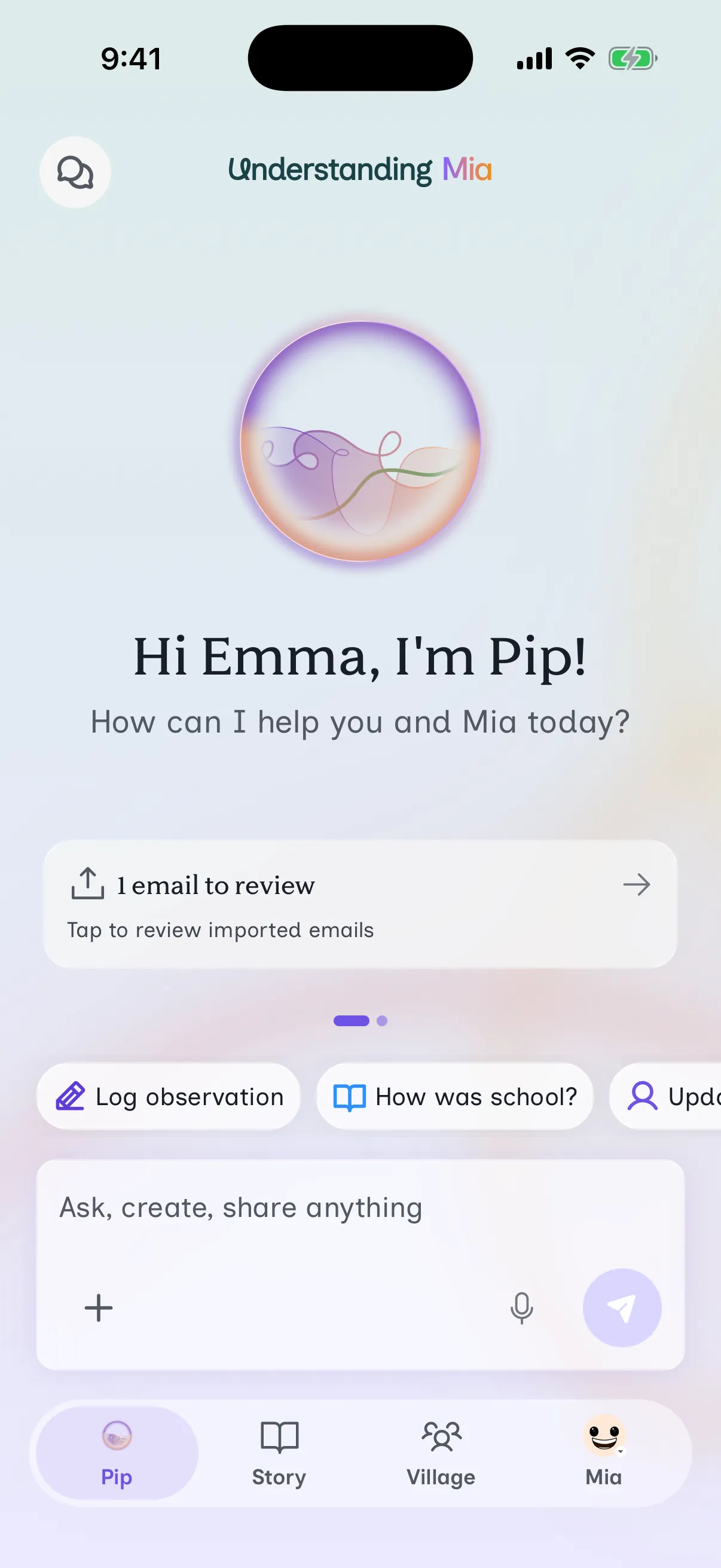
Pip* is your pocket coach inside the Understanding Zoe app. You tell it about your child's day, by voice or text. It writes the day down, and can suggest an everyday idea to try.
Pip draws on more than 1,200 parenting resources licensed from the Raising Children Network (opens in new tab).
Reports, letters and appointments live in one place. Pip reads each one and writes a short summary. It helps you draft a summary for the GP, a brief for a new teacher, or the questions you want to ask the nurse line or the helpline. You can edit every draft.
You can invite the people around your child: a grandparent, an educator, an OT. You choose what each person sees.
Understanding Zoe is not part of Thriving Kids. The hub is free, and you do not need our app to use it.
Pip is not a doctor and not a therapist. It helps you organise and prepare. It does not assess and it does not treat.
* Pip has nothing to do with the UK benefit called PIP, the Personal Independence Payment.
7 days free, then A$14.99/mo.
Their words, not ours
Rated 4.7 on the App Store
Real reviews from parents. See the reviews. (opens in new tab)
“My child had a big meltdown this morning and I have been debriefing with Pip just now. It's been so incredibly helpful and specific in helping me get a handle on it.”
Katy S · Parent · App Store “This app is a genuine must-have for ND families. Pip gives advice and direction in those tough moments, like meltdowns and Centrelink forms.”
Sian R · Parent · Google Play
As featured in






Questions people ask us
What is Thriving Kids?
Is Thriving Kids replacing the NDIS?
Do I need to apply for Thriving Kids?
Is Thriving Kids only for Autistic children?
When will speech, OT and psychology be available?
Can Understanding Zoe tell me if my child needs Thriving Kids support?
Is Understanding Zoe a Thriving Kids provider?
If today is a hard day
Understanding Zoe is not a crisis service. If you are in danger now, call your local emergency number. That is 000 in Australia, 999 in the UK and 911 in the US.
For support in Australia, call Lifeline on 13 11 14. In the UK, call Samaritans on 116 123. In the US, call or text 988.
Nothing on this page is medical advice. It does not assess anyone. It is not a substitute for care from a professional who knows you.
References
- Raising Children Network, Thriving Kids: FAQs about support, eligibility and access (opens in new tab), read 8 October 2026.
- Raising Children Network, Thriving Kids Information and Resources Hub (opens in new tab).
- Department of Health, Disability and Ageing, About Thriving Kids (opens in new tab), read 8 October 2026.
- Department of Health, Disability and Ageing, Thriving Kids: supports being rolled out (opens in new tab), read 8 October 2026.
- Department of Health, Disability and Ageing, Thriving Kids: state and territory governments (opens in new tab), read 8 October 2026.
- Department of Health, Disability and Ageing, About the changes to the NDIS (opens in new tab), read 8 October 2026.
- Amaze, Thriving Kids Autism Helpline (opens in new tab).
- Amaze, Here for families: Amaze to deliver the Thriving Kids Autism Helpline (opens in new tab), 6 October 2026.
- Understanding Zoe, Making the Invisible Visible, 2025, 1,091 families.