School readiness is usually described as a list of skills a child should have before starting school. For neurodivergent children, it helps to turn the question around. Is the school ready for your child? Readiness is about the fit between your child and the school. It is not a test your child has to pass.
Starting school goes best when the family, the preschool and the school plan it together. Your child does not need to arrive able to do everything. Teaching children to read and write is the school's job. So is adjusting for your child.
This guide is for families of Autistic, ADHD, AuDHD and otherwise neurodivergent children starting school in Australia. It covers what readiness really means, a plan for the year before, and what to share with the school. You will find more in our school and learning topic.
The first year of school has a different name in each state and territory. The Australian Curriculum calls it the Foundation year.
| Where you live | First year of school |
|---|---|
| New South Wales | Kindergarten |
| Australian Capital Territory | Kindergarten |
| Victoria | Prep (officially the Foundation year) |
| Queensland | Prep |
| Tasmania | Prep |
| South Australia | Reception |
| Western Australia | Pre-primary |
| Northern Territory | Transition |
Each state and territory also sets its own starting age and cut-off date. Check your state education department's website for the rules where you live.
Readiness is less about letters and numbers, and more about your child feeling safe, understood and able to ask for help.
Under the Disability Standards for Education 2005, schools must consult with families. They must make reasonable adjustments so students with disability can take part on the same basis as other students. The Australian Government's guide to the Standards says you do not need a diagnosis for them to apply.
Many neurodivergent families do not use the word disability, and that is your choice. The Standards are there if you need them.
Thriving Kids is a government starting point for families of children aged 8 and under with developmental delay or autism. You do not need a diagnosis to use it. The Thriving Kids website has information and a helpline.
If your child is Autistic, our guide to the NDIS and autism explains how the NDIS works, in plain language.
Raising Children Network suggests making a transition plan with the school: a set of activities and supports to help your child settle in. Here is how that can look across the year before.
Early in the year before school, ask the educators what they have noticed, what helps your child, and what they would pass on to a school.
Keep their notes and any reports together in Understanding Zoe, so nothing gets lost between preschool and school.
Ask how the school supports neurodivergent students, how it handles a quiet space or breaks, and who you would plan with. How a school answers tells you a lot.
Once you have enrolled, ask to meet the teacher and a school leader. Bring your child's profile and any reports, and invite allied health workers if you have them.
Pip, your pocket coach, can help you prepare what to raise from your notes. The Care Village lets you share chosen reports with the teacher before the meeting.
Go to orientation days, and take photos of the classroom, toilets and playground. A visual storybook with those photos helps your child know what to expect.
Try the uniform and shoes in short bursts, practise opening the lunchbox, and walk or drive the route to school a few times.
Agree how the school will check in with you. Plan quiet time after school, because the first weeks are tiring for every child.
A quick note each afternoon gives you and the teacher something to look back on together when you review the plan.
How pictures, schedules and visual storybooks help children know what is coming next. From episode 15 of The Neurodivergent Pulse.
Read the article
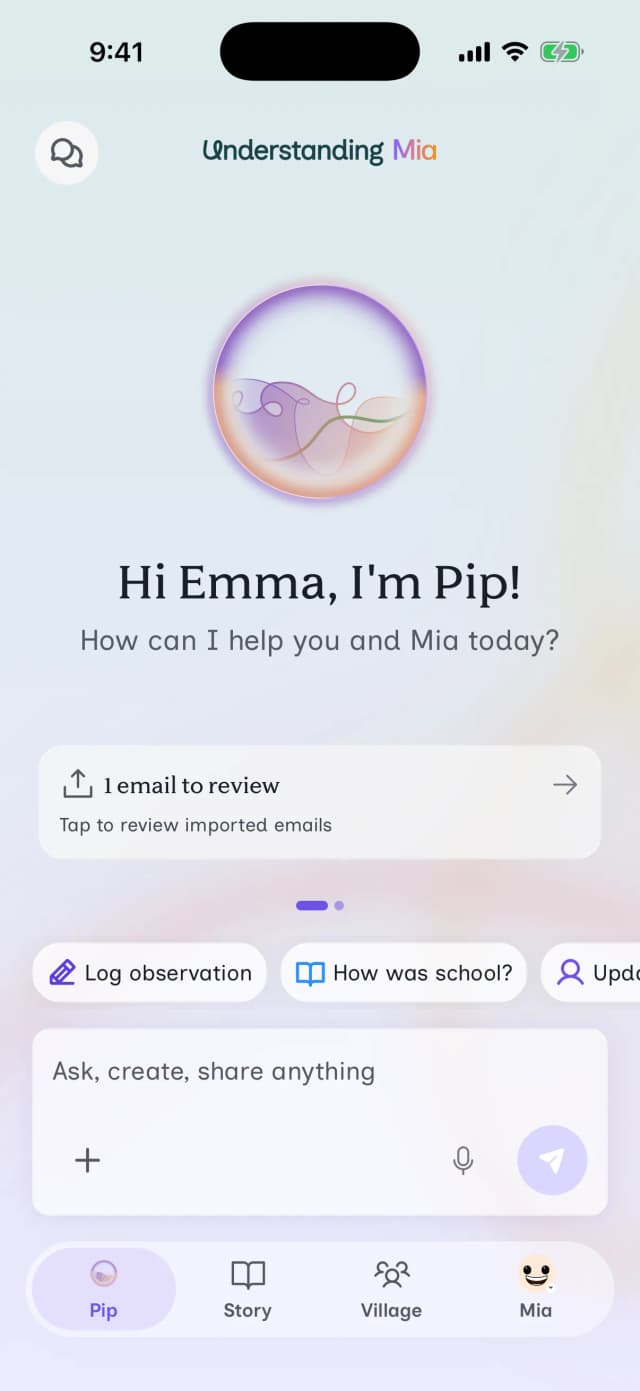
Starting school comes with a lot of paper. Reports, plans, school forms and your own notes arrive at different times, from different people.
Understanding Zoe keeps them in one place. Pip*, your pocket coach, keeps your notes by voice or text. You can look back and prepare what to raise at the transition meeting.
The Care Village lets you share chosen documents with your child's teacher. It keeps the people who help on the same page, and you decide who sees what.
What Understanding Zoe does not do. It does not assess and it does not treat. Pip is not a therapist, and it does not replace one.
* Pip is the pocket coach in the Understanding Zoe app. It has nothing to do with the UK benefit called PIP, the Personal Independence Payment.
Most children start school at around five years old. Each state and territory sets its own starting age and cut-off date. School becomes compulsory by about age six.
The first year also has a different name in each state, such as Kindergarten in New South Wales and Prep in Queensland. Check your state education department's website for the exact rules.
There is no single right answer. Some families find an extra year at preschool gives their child more time to grow in confidence. Others find school, with the right adjustments, is the better place to learn.
Talk with your child's preschool educators and any allied health workers who know your child. Ask what an extra year would offer, and what the school could put in place. Check the compulsory starting age in your state, too.
No. You do not need a diagnosis for the Disability Standards for Education to apply, according to the Australian Government's guide. Schools must consult with you and make reasonable adjustments based on your child's needs.
Reports from allied health or a doctor can still help a school understand what your child needs. Share what you have, and ask the school to explain what it will put in place.
It is a set of activities and supports that help your child get used to school. It can include school visits, a visual storybook, a one-page profile, and agreed supports for the first weeks.
It works best when the family, preschool and school make it together. Look at it again once your child has settled in.
Many children find the first weeks tiring, and neurodivergent children can find them overwhelming. Plan quiet time after school, keep evenings simple, and talk to the teacher early about what you are seeing.
If school starts to feel impossible for your child, some people call this school can't, alongside school refusal and school anxiety. You are not alone. Our podcast episode on school can't is a good place to start.
Understanding Zoe is not a crisis service. In an emergency call 000. Lifeline is 13 11 14. Kids Helpline is 1800 55 1800. 13YARN is 13 92 76.
Nothing on this page is medical advice. It does not assess anyone, and it is not a substitute for care from a professional who knows you. If something here sounds familiar, write it down and take it to your GP.