An IEP, or individualized education program, is a written plan for a child who receives special education in a US public school. It sets out what the child needs, the goals they are working toward and the services the school will provide. Parents are equal members of the team that writes it.
This page explains what goes into an IEP, who is on the team, how the process works and how to prepare for the IEP meeting. Many parents search for an "individual education plan". The legal name is individualized education program, and most people simply say IEP.
IEPs come from a federal law, the Individuals with Disabilities Education Act (IDEA).
IDEA gives eligible children with disabilities the right to a free appropriate public education. To qualify for an IEP, a child is evaluated by the school and found to have a disability under one of the law's categories, such as autism or other health impairment, and to need special education because of it. ADHD is often covered under other health impairment.
A child who has a disability but does not need special education may get a 504 plan instead. A 504 plan, under Section 504 of the Rehabilitation Act, sets out accommodations so a student can access learning, such as extra time or a quiet place for tests.
The law sets out what every IEP must include. Knowing the parts makes the document much easier to read.
IDEA names who must be part of the team. You can also bring others who know your child.
| Team member | What they bring |
|---|---|
| You, the parents | Knowledge of your child at home, their history and what works. |
| A general education teacher | What the regular classroom expects, if your child spends time there. |
| A special education teacher | How to adapt teaching to your child's needs. |
| A school district representative | Authority to commit the district's resources. |
| Someone who can explain evaluations | What test results mean for teaching. |
| Your child, when appropriate | Their own view. Students are invited once transition planning begins. |
Timelines vary by state, but the steps are the same everywhere.
You can request one in writing from your child's school. The school needs your consent before it evaluates.
Specialists look at how your child learns, communicates and manages the school day.
The team, including you, decides whether your child is eligible for special education.
The team writes the IEP together. You can ask questions, suggest changes and take time before you sign.
You can also bring a written parent input statement: your child's strengths, what works at home, and your priorities for the year. Pip, the pocket coach in the Understanding Zoe app, can help you draft it from the notes you have already kept.
The IEP is reviewed at least once a year, and your child is reevaluated at least every three years. You can ask for a meeting at any time.
A little preparation turns a long meeting into a real conversation.
Print it, or keep it on your phone.
IEPs come with a lot of paper. Evaluations, drafts, progress reports and emails pile up across a school year.
Pip* is your pocket coach. You tell it what you notice, by voice or text, and it keeps your notes. The Story tab lays your notes out over time, in plain language, so you can look back and prepare what to raise at the IEP meeting.
When it is time for the meeting, Pip can help you draft your parent input statement from your own notes and words. You walk in with your child's strengths and your priorities already written down.
Reports and letters can be kept with your child's records, and the Care Village lets you share chosen documents with teachers and therapists. You decide who sees what.
What Understanding Zoe does not do. It does not assess and it does not treat. Built with families, researchers and allied health.
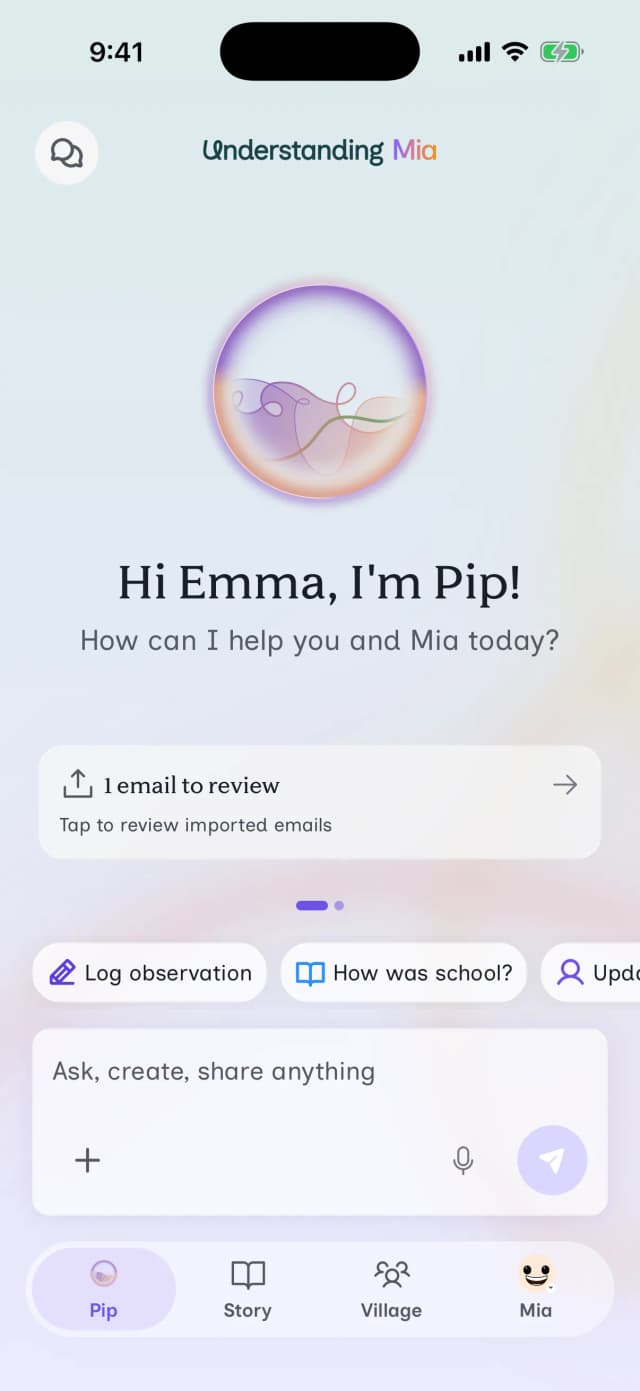
Understanding Zoe is for neurodivergent people and the people who love them, at every age and stage.
Family, teachers and your care team join free when you invite them.
* Pip is the pocket coach in the Understanding Zoe app. It has nothing to do with the UK benefit called PIP, the Personal Independence Payment.
An IEP is for a child who has a disability and needs special education. It includes goals, services and supports. A 504 plan is for a child with a disability who needs accommodations to access learning, but not specialized instruction.
Both are free in public schools. IEPs come from IDEA, and 504 plans come from Section 504 of the Rehabilitation Act.
Yes. The IEP must be reviewed at least once a year, but you can ask for a meeting whenever you have concerns. Put the request in writing so there is a record.
If something changes at home or school, such as a new evaluation or a hard term, that is a good reason to ask.
You do not have to sign on the spot. You can take the draft home, read it carefully and ask questions first. The school needs your consent before it starts special education services for the first time.
If you disagree with part of the IEP, say so in writing. Your school must give you a copy of your rights, called procedural safeguards.
Autism is one of IDEA's disability categories. ADHD is often covered under other health impairment. In both cases, the child must also need special education because of the disability.
If your child does not qualify for an IEP, ask whether a 504 plan would help.
Yes, when it makes sense for your child. Students must be invited once the team starts planning for life after school, by the IEP in effect when they turn 16, and many come earlier.
Hearing a child's own view of what helps can change a meeting. Some children join for part of it, or share their thoughts in writing beforehand.
Understanding Zoe is not a crisis service. In an emergency in the US, call 911. For mental health crisis support, call or text 988 to reach the 988 Suicide & Crisis Lifeline.
Nothing on this page is legal, medical or educational advice. Special education rules vary by state and district. For advice about your child, talk to your school district or your state's Parent Training and Information Center.