Twice exceptional, often shortened to 2e, describes a person who is both gifted and neurodivergent or disabled. A twice-exceptional child might read years ahead of their age and still find handwriting exhausting, or solve complex problems in their head and struggle to get through a school day.
This page explains what twice exceptional means, why these children are so often missed twice over, and how to support both sides of a 2e child.
A twice-exceptional child has two things going on at once: giftedness, and a disability or neurodivergence that affects learning.
Giftedness means ability well above what is typical for a child's age, in one area or several, such as reasoning, language, math, music or creativity. It is often misunderstood, and twice exceptionality even more so, which is why so many 2e children go unrecognized.
The US National Association for Gifted Children describes twice-exceptional students as gifted children with the potential for high achievement who also have one or more disabilities. Those can include ADHD, autism, specific learning disabilities such as dyslexia or dyscalculia, and speech and language differences.
Deep curiosity, big vocabularies, intense interests, creative problem solving, strong memory for things that matter to them, and a sharp sense of fairness.
Uneven skills, such as advanced reasoning with slow writing, frustration and big emotions, difficulty with organization, and exhaustion from school.
Each exceptionality can hide the other. A child can end up looking average, and get help for neither.
Girls, and children from groups who are already under-identified, are at extra risk of being missed. Our pages on ADHD in girls and signs of autism in girls explain why.
The most useful support feeds the strength and supports the challenge at the same time.
Concrete examples help a school see both sides of your child.
Print it, or keep it on your phone.
Supporting a 2e child means keeping track of two very different stories at once. School reports, assessments and teacher emails rarely sit together.
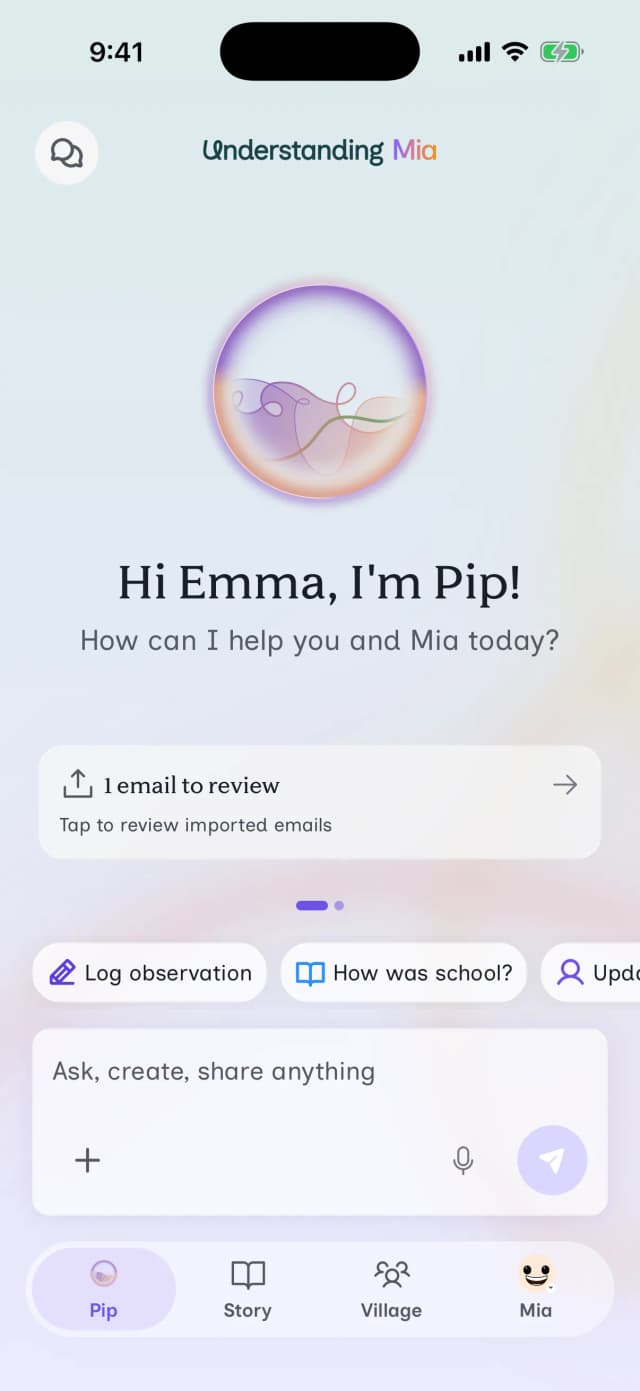
Pip* is your pocket coach. You tell it what you notice, by voice or text, and it keeps your notes. The Story tab lays your notes out over time, in plain language, so you can look back and prepare what to raise with school.
The Care Village lets you share chosen notes and documents with teachers and practitioners. You decide who sees what.
What Understanding Zoe does not do. It does not assess and it does not treat. Built with families, researchers and allied health.
Understanding Zoe is for neurodivergent people and the people who love them, at every age and stage.
Family, teachers and your care team join free when you invite them.
* Pip is the pocket coach in the Understanding Zoe app. It has nothing to do with the UK benefit called PIP, the Personal Independence Payment.
2e stands for twice exceptional. It describes a person who is both gifted and has a disability or neurodivergence, such as ADHD, autism or a specific learning disability.
The term is used most often for children at school, but many adults recognize themselves in it too.
Yes. ADHD and giftedness often occur together. A gifted ADHD child may be bored and restless in class, hyperfocus on interests, and struggle with organization and finishing work.
Because high ability can hide ADHD, these children are sometimes identified later than others.
Yes. Many Autistic children have areas of high ability, often linked to deep interests. They may also find social expectations, sensory environments and changes in routine hard at school.
A good assessment looks at strengths as well as challenges, so both are recognized.
There is no single test. Identification usually comes from a psychologist's assessment of thinking skills alongside assessment of the disability or neurodivergence. Uneven results, with big gaps between strengths and challenges, are common in 2e children.
Ask the assessor to report on both, so school can plan for both.
Often both. Twice-exceptional children tend to do best with extension in their areas of strength and adjustments for their areas of difficulty, at the same time.
If school can only offer one, share examples of both sides and ask how the two can work together.
Understanding Zoe is not a crisis service. In an emergency in the US, call 911. For mental health crisis support, call or text 988 to reach the 988 Suicide & Crisis Lifeline.
Nothing on this page is medical advice. It does not assess anyone, and it is not a substitute for care from a professional who knows you. If something here sounds familiar, write it down and take it to your doctor.