AI for therapists: protecting human connection in care
Speech pathologist and AI educator Shae Rodgers discusses how AI can reduce the invisible admin load that consumes 30-50% of clinicians' working week, freeing capacity for human connection. The article covers AI literacy foundations, ethical use in allied health, how AI is transforming AAC for neurodivergent communicators, and what questions families should ask when AI enters their child's care. The core message: technology works best when it supports the background, leaving clinicians fully present for the human parts of care that cannot be automated.
In short
AI for speech pathologists is not about replacing clinicians. It is about reducing the invisible admin load, including AI clinical notes and report writing, so therapists have more capacity for the human parts of care. Shae Rodgers, a neurodivergent speech pathologist with almost 20 years of experience, argues that AI literacy is the foundation for ethical use in allied health: understanding what a tool does, how data is stored and whether it is clinically appropriate before you adopt it. Families have the right to ask those same questions of their child's therapist. And when technology does its job in the background, the human connection at the heart of care gets to stay exactly where it belongs.
You trained for years to sit with a child who is finally ready to talk. To notice the shift in their body when something clicks. To build the kind of trust that takes months. And then you spend Tuesday afternoon writing a report that nobody will read until Thursday.
If 30 to 50% of your working week disappears into paperwork, this is a structural one. It is exactly the problem that speech pathologist and AI educator Shae Rodgers has spent the last few years trying to solve, not by replacing the human parts of care, but by protecting them.
In Episode 44 of the Neurodivergent Pulse podcast, host Laetitia Andrac is joined by Shae Rodgers, neurodivergent speech pathologist, AI educator and founder of Speech Pathology Resources, to talk about what responsible AI use can look like in allied health practice. They move through the hidden admin load clinicians carry, the foundations of AI literacy, the possibilities opening up in AAC, and the questions every family has the right to ask when AI enters their child's care. Underneath all of it is something both Shae and Laetitia are clear that technology cannot touch: human connection.
The admin load problem. What the numbers actually say
Clinicians spend 30 to 50% of their week on paperwork, and most of that work is invisible to the families they serve. Session notes, reports, therapy preparation, resource creation, research, follow-up emails: all of it happens outside the room, drawing on the same finite reserves of time and energy that clinical presence requires.
Shae is direct about what this means in practice. The administrative load does not just slow things down. It shrinks a clinician's capacity for the personalised, present, creative work that neuroaffirming care actually requires, including how speech pathologists support co-regulation in practice. "A lot of my AI education for supporting speech pathologists and clinicians is to try to bring AI into those different areas of practice," she explains, "so that you really can reduce the load, and you've got more capacity for that clinical work, that personable clinical work that is where you kind of shine in your uniqueness."
The stakes of that capacity are real. According to our research on neurodivergent families, parents of neurodivergent children devote close to 10 hours every week to emotional regulation, advocacy and administration alone, on top of around 30 hours of overall caregiving. When a clinician's admin load eats into time for personalised follow-up and family communication, the families already carrying the most are the ones who feel it first.
The tasks where AI clinical notes and admin support can genuinely help include:
Writing session notes and clinical reports
Creating personalised, interest-led resources for individual clients
Preparing for therapy sessions with research summaries
Generating accessible handouts tailored to a family's needs
Drafting follow-up emails with practical strategies families can use at home
Building visual supports adapted to a child's communication style
None of these tasks require clinical judgement in the moment, which is exactly why they are good candidates for AI support, freeing the clinician to bring their full attention to the parts that do.
Will AI replace speech pathologists?
No. AI tools for therapists and clinicians are not about replacing the people in the room. They are about creating more capacity for the human, clinical work that cannot be automated. The fear of replacement is real and understandable, and it often stops clinicians from engaging with tools that could genuinely serve their clients.
Shae describes a concrete shift in her own practice. "Now I can actually write the note and provide a personalised email to the family with an attached, like, handout or resource that they can practically use after the session as well." Before AI, the time ran out after the note. Now the note and the follow-up happen together, and the family leaves with something practical in hand.
The personalisation piece is where Shae sees AI make the biggest difference. Rather than generic handouts, clinicians can now create resources built around a specific child's interests, accessibility needs and communication style, quickly and without starting from scratch each time. The result reduces not just the clinician's load, but also the invisible load neurodivergent parents carry when they have to bridge the gap themselves. Research shows that 93% of parents of neurodivergent children say their experience feels misunderstood or invisible. A clinician who sends a thoughtful, personalised resource home after a session is pushing back against a very common pattern of invisibility.
One example from Shae's practice captures this well. She worked with a young man who had no communication system, and used AI tools to help develop something tailored specifically to him and the way he communicates. The outcome was not a sophisticated device. "It was this really interesting blend between like high tech and low tech, 'cause it ended up just being like a printed book, which is really old school, but the tools that you use to kind of put that together make it a little bit quicker in the background and make it so it's extremely personalised." High-tech tools, working in the background, to produce something simple and deeply personal.
AI literacy for allied health
AI literacy is the foundation for ethical use in allied health. Without it, clinicians are left choosing between two uncomfortable options: avoid AI entirely, or adopt it without knowing whether it is safe. Both leave clients worse off.
It really comes down to developing good AI literacy foundations and having a really good understanding of what AI is, how it can help you.
Shae draws a useful analogy. When the internet first arrived, the response was not to reject it wholesale or to use it without any understanding of the risks. It was to learn what it could do, what to be careful about, and how to use it well. AI in speech language pathology is no different. The goal is not to become an AI expert. It is to build enough foundational understanding to evaluate a tool confidently and use it ethically.
To help clinicians do exactly that, Shae built a free AI Ethics Evaluator GPT, available through her tool library, that walks through the same questions she asks when reviewing any new tool. The speech-pathology.ai library curates and compliance-checks tools specifically for speech pathologists, removing the need for each clinician to wade through privacy policy pages alone.
When evaluating any AI tool for clinical use, Shae recommends asking:
What is this tool actually designed to do, and does it fit my clinical use case?
Where is data stored, and is it stored in Australia or overseas?
Does the tool train on my inputs, and if so, how is that managed?
Is it compliant with relevant privacy standards for health information?
What is the developer's background, and are they engaging with allied health clinicians?
Is this tool appropriate for use with identifiable client information, or only with de-identified content?
"If you have a strong foundation," Shae explains, "then it gives you some confidence going forward so you can know, like, if you're evaluating a tool, like is this safe to use clinically or is this something that I just use for a resource creation with de-identified information?" That distinction, clinical use versus de-identified resource creation, is one of the most practical frameworks a clinician can carry.
Pip remembers the appointments, the notes and the small wins, so you don't have to.
7 days free on iPhone and Android.
How AI is changing AAC for neurodivergent communicators
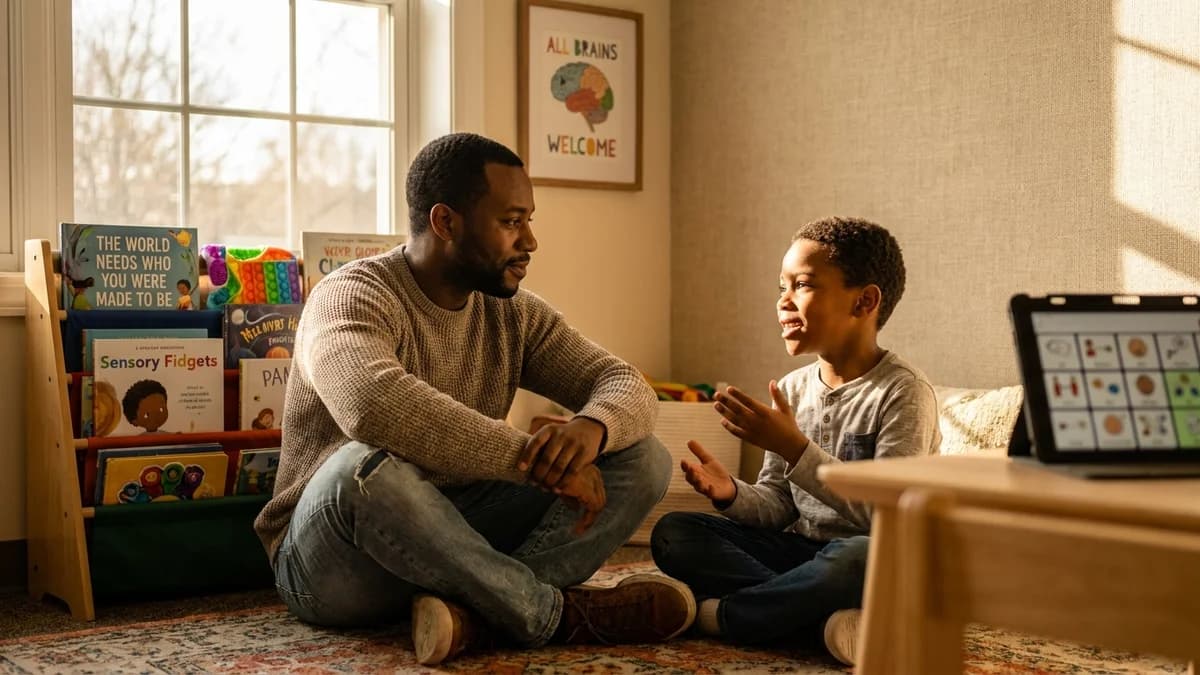
For AAC users, AI speech therapy features are creating possibilities that were not available even a few years ago. Traditional AAC has often been slow and effortful, with users spending significant time and energy constructing messages that neurotypical speakers produce in seconds. AI features like predictive text and context awareness are beginning to change that.
Shae has worked in AAC for over a decade and describes the shift with real excitement. Many AAC apps are now integrating AI features, from smarter prediction to easier programming, that allow users to communicate more efficiently without sacrificing their authentic voice. The goal is not to put words in someone's mouth. It is to reduce the friction between what they want to say and how quickly they can say it, a principle at the heart of honouring all types of communication for neurodivergent people. This connects to broader conversations about rethinking communication goals for neurodivergent kids, where the focus moves from compliance to authentic connection.
Shae is careful about the ethical dimensions. "You still need to have the consent of the user and for them to understand that, and just to monitor if it's benefiting them." An AI prediction that is accurate and helpful is a genuine gain. One that offers limited options misaligned with what the person actually wanted to say is a problem, and clinicians need to stay close to that distinction.
The young man with the printed photo book is the clearest illustration of what this can look like in practice. "The difference that it's made for him to be able to communicate and understand what's happening in his day and have that like social joy of sharing photos with the people around him, that's been really rewarding." The technology was a means. The social joy was the point.
What questions should parents ask if their child's therapist uses AI?
Families whose child's therapist is using AI have every right to ask about it, and clinicians should welcome those conversations. Transparency is good ethics, and it builds the kind of trust that makes therapy work.
It's important to remember that you have rights. You have rights to say, to ask questions and find out about what the program is and ask questions about what type of health information is gonna be put into the tool.
Shae notes that AI-assisted note-taking is already becoming commonplace in medical settings, with patients routinely asked to consent to its use. Allied health is moving in the same direction. Families who understand what is happening with their child's information are better placed to give meaningful consent, and clinicians who explain it clearly are modelling the transparency the profession needs to build trust in AI more broadly.
The conversation does not have to be one-directional. Many families are already using AI at home. A therapist who understands AI can help them do so safely and in ways that support therapy goals rather than cut across them. That is a real clinical opportunity. Research shows that 64% of parents of neurodivergent children often feel exhausted and 64% feel overwhelmed, figures that are significantly higher than for parents of neurotypical children. Meeting families with practical, accessible support is not optional for many of them. It is the difference between strategies that get used and strategies that get lost in the pile.
If you are a parent or carer whose child is receiving allied health support, here are questions worth raising with their therapist:
Which AI tools, if any, are you using in my child's care?
Where is my child's information stored, and who has access to it?
Is the tool compliant with Australian privacy standards for health information?
Does the tool train on client data, and how is that managed?
How does AI support your clinical work rather than replace your judgement?
Can I read more about the tool you are using?
A clinician who cannot answer these questions clearly is not necessarily doing something wrong. But asking them holds practice to account, and it gives clinicians a reason to build their own AI literacy if they have not already.
Technology that supports human connection
The best technology in care is the kind you barely notice. It holds the background so the humans in the room can be fully present with each other. That is the standard Shae applies when she evaluates tools and when she uses them in her own practice.
Shae uses Understanding Zoe personally and professionally, describing it as "a very smart diary" that helps her track what is happening with her son, prepare for appointments and work through parenting challenges with the support of the platform's AI coaching. She featured Understanding Zoe on the homepage of speech-pathology.ai at launch, and she is partnering with the team as a clinical advisor, a relationship that began when she reached out to evaluate the tool for her library. For more on why the platform was built, read the story behind Understanding Zoe.
That detail matters. Shae did not endorse Understanding Zoe because it was handed to her. She found it through the same rigorous process she applies to every tool: meeting the developers, understanding the use case, testing it in her own life. It passed.
The broader principle she returns to runs through the whole conversation.
Human connection, right? Like, that's, you know, underneath everything, and AI can help with a lot. But yeah, it can never replace that.
For clinicians, that is both a reassurance and a responsibility. AI for speech pathologists can take the report off your plate. It cannot sit with a child in the moment something shifts. It can help you prepare for an appointment. It cannot build the trust that makes that appointment matter. Used well, with literacy, consent and transparency, it gives you more room to do the parts that only you can do.
If you want to see what neuroaffirming AI can look like in your own life, try Understanding Zoe free for 7 days. And if you are a clinician building your AI literacy, Shae's resources are a practical, ethics-first place to start.
Frequently asked questions
Can AI write speech therapy session notes?
Yes, and this is one of the most practical applications of AI clinical notes for speech pathologists. AI can draft session notes, clinical reports and follow-up emails, freeing clinicians from the administrative tasks that consume 30 to 50% of their working week. The clinician still reviews, edits and takes professional responsibility for every note. AI handles the first draft; clinical judgement handles everything else.
Is it ethical to use AI in speech pathology?
Ethical AI use in speech pathology is possible, but it depends on AI literacy, informed consent and transparency with families. The key questions are whether client data is stored securely, whether the tool is compliant with Australian privacy standards, and whether families understand how AI is being used in their child's care. It sits alongside the broader question of what genuinely neuroaffirming clinical support looks like, and why the two conversations belong together. AI ethics in speech pathology is not a reason to avoid the tools. It is a reason to learn how to use them well.
How do I evaluate an AI tool for clinical use in Australia?
Start by asking where data is stored, whether the tool trains on your inputs, and whether it meets Australian privacy standards for health information. Shae Rodgers built a free AI Ethics Evaluator GPT specifically for allied health clinicians in Australia, walking through the same compliance questions she applies to every tool in her curated library. It is a practical starting point for any clinician building their AI literacy.
How can AI support AAC users?
AI speech therapy features, including smarter predictive text and context-aware suggestions, are being integrated into AAC apps to reduce the effort required to construct messages. The goal is not to put words in someone's mouth but to reduce the friction between what an AAC user wants to say and how quickly they can say it. Clinicians still need to monitor whether AI predictions genuinely reflect the user's intent and obtain informed consent before enabling these features.
Meet Shae Rodgers
Shae Rodgers is a neurodivergent speech pathologist whose clinical work has always been driven by a clear purpose. "My mission and drive is to sort of help children make sure they have a voice," she says, "and that kind of stems from my own background and upbringing." She has been a speech pathologist for almost 20 years, working in private paediatric practice with a particular focus on neurodivergent children, teens and young adults, and specialising in AAC and communication technology alongside strengths-based, neuroaffirming practice. That focus reflects the families she serves: according to Understanding Zoe's research findings, over three in five parents raising neurodivergent children also identify as neurodivergent themselves, bringing both a caregiving and a lived-experience perspective to every interaction.
When AI became widely accessible, Shae's response was characteristic. Her neurodivergent brain, as she puts it, "was very excited by all the innovation and tech and possibilities." She dove in immediately, problem-solving and figuring out how it could help in her clinical work and family life. That curiosity became a second professional focus: teaching AI literacy to speech pathologists and allied health clinicians across Australia.
In July 2026, Shae launched speech-pathology.ai, Australia's first AI tool library for speech pathologists, where tools are curated, reviewed and compliance-checked by a practising clinician. Her motto, which runs through everything she builds at Speech Pathology Resources, is simple: saving you time with every resource.
Connect with Shae Rodgers
Website: speechpathologyresources.com.au
AI tool library: speech-pathology.ai (free to browse; pro version waitlist available)
Free AI Ethics Evaluator GPT: Available at speech-pathology.ai
Free weekly newsletter: AI tips for speech pathologists, join at speechpathologyresources.com.au
Instagram: @aispeechpathologyresources
Pip is not a doctor or therapist. It helps you organise and prepare, not diagnose or treat.
In a crisis call 000. Lifeline 13 11 14. Kids Helpline 1800 55 1800. 13YARN 13 92 76.

Ready to put it all in one calm place?
Tell Pip one thing today. It remembers the rest.
Stored in Australia, encrypted. Cancel before day 8 and you won't be charged.
Related articles

What does a social worker do? An Australian answer
A social worker helps with your life and the systems around it. Many also provide therapy. What an AMHSW is, Medicare and NDIS funding, and how to find one.
Read more
Where is the village? Building neurodivergent community
Neurodivergent families experience isolation at twice the rate of neurotypical families, not because they can't cope, but because most spaces were never designed for them. In this episode, Laetitia Andrac (co-founder of Understanding Zoe) explores what real community looks like for neurodivergent people and families. She shares practical strategies for creating sensory-friendly, inclusive gatherings where everyone genuinely feels welcome, and explains how to build your village deliberately, right where you are.
Read more
Neuroaffirming practice: Beyond training to real support
Psychologist Adelle Sushames shares what truly neuroaffirming support means beyond training certificates and theoretical frameworks. This episode explores how to shift from deficit-based to strength-based approaches, understand autism as a dynamic spectrum wheel rather than a linear line, recognise who gets missed in diagnosis (particularly girls and women), and use practical communication tools like card decks to help neurodivergent people understand and express their needs.
Read more