Autism and Homeschooling
Is homeschooling right for an autistic or neurodivergent child? In this episode of the Neurodivergent Pulse podcast, AuDHD occupational therapist Selah Dimech shares her experience of being homeschooled from Grade 7 to Grade 10, before she knew she was neurodivergent. She explains why the answer depends on the individual child, how homeschooling can build self-management skills for university, where it can fall short in areas like timed exams and maths support, and how to approach socialisation through interests and meaningful experiences. The article also explores the difference between autonomy and independence, and offers practical guidance for parents at the start of this decision.
In short
Autism and homeschooling is not a simple yes or no. Selah Dimech, an AuDHD OT who was homeschooled before she knew she was neurodivergent, says the answer is always "it depends" on the child. Homeschooling can build real self-management strengths. Stay open to adjusting, and treat every choice as an experiment rather than a permanent decision.
You have been turning it over for weeks. Your child is not coping at school. You keep coming back to the same question: would homeschooling help? Then the next question arrives right behind it. What about university? What about friends? What about the gaps you might accidentally leave?
It is a lot to carry. That exhaustion is real. Our research on neurodivergent families found that 64% of parents raising neurodivergent children often feel exhausted. For parents raising neurotypical children, that figure is 42%. Most of what you find online about autism and homeschooling comes from parents in the middle of it. Not from someone who has lived it and come out the other side. Selah Dimech has. She was homeschooled from Grade 7 to Grade 10. She went on to university, built a career, and now runs her own occupational therapy practice. Her answer to the question you are asking is honest. It might also surprise you. If you are exploring neurodivergent homeschooling for the first time, this conversation is worth your time. You might also find our piece on unschooling for neurodivergent kids useful.
In Episode 55 of the Neurodivergent Pulse podcast, host Laetitia Andrac speaks with Selah Dimech. Selah is an AuDHD occupational therapist. She founded Neuraffirm, a practice of lived experience clinicians supporting neurodivergent adults. She was homeschooled from Grade 7 to Grade 10, long before she knew she was neurodivergent. The conversation draws on her personal story and her clinical work. Together they explore what homeschooling can offer, where it can fall short, and how to stay responsive to what your child actually needs.
Is homeschooling a good option for autistic children?
When parents ask Selah whether she recommends homeschooling for neurodivergent children, she does not give a yes or a no. "I'm going to give like a classic OT answer, and I'm so sorry, but the answer is it depends," she says. The answer depends on the individual child: what they need from a learning environment, how much structure helps them, and what kind of social world suits them.
Laetitia shared her own experience of this during the episode. She enrolled her second daughter in the same independent school that worked well for her first. It seemed practical. Then her daughter asked to move in the middle of the year. The school's open, self-directed approach was too much for her. She wanted structure. She wanted a uniform. She knew what she needed before anyone else did.
If you have ever felt guilty because a choice that worked for one child did not work for another, that guilt is worth setting down. There is a lot to be said for trusting your instincts as an autism parent, even when the path looks different from what you expected. The right fit depends on this child, right now. It is not a reflection of how well you know them or how hard you are trying.
What Selah's homeschooling days actually looked like
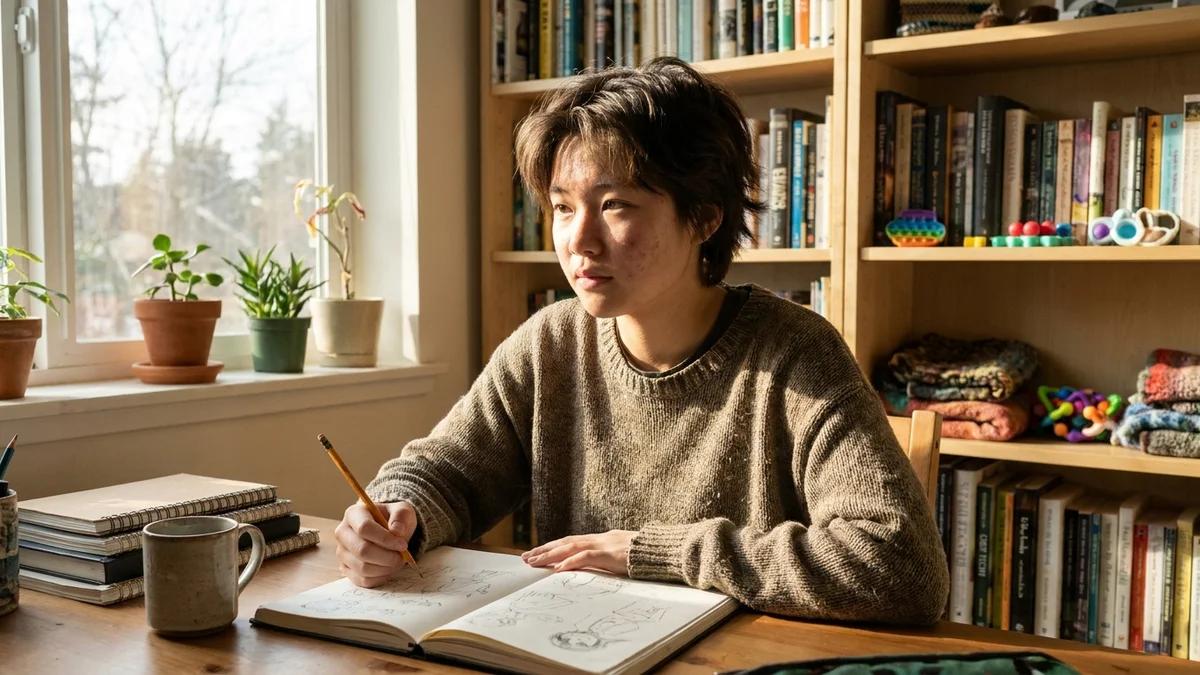
Homeschooling does not have to look like a classroom at home. Selah's weekdays as a self-directed 13 and 14-year-old were shaped by her own interests and energy, not a rigid timetable.
Her mum noted that Selah would study from around 8am to midday. The rest of the day opened up from there. Piano practice took one to two hours most days, with Thursdays blocked for her lesson. She started working at a cafe at 13 and began teaching piano at 14. The household was low-technology, so time outside and creative activity filled the gaps.
A typical weekday might have looked something like this:
A self-directed study block in the morning, roughly 8am to midday, covering the topics she chose that day
One to two hours of piano practice, sometimes in the morning and sometimes in the afternoon
Creative or craft activity, often something she had chosen herself
Time outdoors or around the home
Paid work at a cafe, or later, piano teaching
This is not a template. Selah was self-motivated and studious, and she says that helped. Her siblings' days looked different. The point is that a homeschooling day can be built around your child's actual rhythms, not a school bell.
How to spot when the schooling format is the problem, not your child
If your child was managing a subject at mainstream school and is now struggling at home, the problem may not be the subject. It may be the format, the timing, or the level of support available.
Selah was a year or two ahead in English during her homeschooling years. But maths became a slow drift away from engagement. Her mum was stretched supporting younger siblings, and one-to-one help was limited. Selah was handed a workbook and left to figure it out. Because maths was not her favourite subject, she gradually stopped trying.
That kind of stretch is not a personal failing. When capacity runs thin, something has to give. It is rarely the child's fault.
I think it's, like, just being reactive and responsive. Like, if something's not working, like, just trying to change it up, whether that's, like, one-to-one support, whether that's just changing the curriculum.
She contrasted her own experience with her partner's. He was also struggling with maths, but at a mainstream school. His dad started doing maths problems with him during the car ride to school. That small, warm, low-pressure moment of support shifted everything. He went on to top the subject and study pure maths at university.
The lesson Selah draws from both stories is about timing. Pushing when your child has no capacity rarely helps. Finding the moment when they are relaxed and connected, and meeting them there, can change the whole trajectory. This is why mindset matters more than method in neurodivergent parenting, a theme that runs through so much of this work.
If you are trying to work out what your child needs next, Understanding Zoe can help you turn each report, observation and moment into a clear next step. You do not have to figure it all out on your own. There is a free 7-day trial if you want to see how it works.
Pip remembers the appointments, the notes and the small wins, so you don't have to.
7 days free.
Will homeschooling limit my child's university options?
Homeschooling for autism can prepare children well for university. That is Selah's experience.
When she got to university, she noticed that many of her peers were struggling with something she had already built: the ability to manage their own time without anyone watching. University does not take a roll call. There is no one checking whether you show up. Students who had always been told when to be somewhere were suddenly adrift. Selah was not. "Homeschooling really helps to develop those self-management skills that you really need at uni," she says.
It is worth reading about the hidden cost of AuDHD in academia to understand what neurodivergent students are navigating once they arrive.
The gap she identified was time pressure. "My mum didn't really care whether we took, you know, 30 minutes or the whole day to do an exam. It didn't really matter." Timed exams were a different skill, and one she had not practised. Her ADHD also made memory-heavy, time-limited tasks harder.
Her suggestion is practical. Build small, low-stakes experiences with time boundaries into your child's homeschooling years. Not to replicate school. Just to give them some familiarity with working within a limit before they meet it in a high-stakes setting. Understanding energy accounting to prevent neurodivergent burnout can help you plan these experiences at the right moments, rather than when your child is already depleted. "I think giving your child as much opportunity to develop those skills where they can, when they're young is a good thing."
What about socialisation when homeschooling an autistic child?
Social connection is one of the biggest concerns parents raise about autism and homeschooling. Selah's experience shows that it can develop. It grows through interests and meaningful experiences, not through forced or frequent exposure.
When she was homeschooled, her social world came from family friends. She describes herself as "an incredibly shy kid. Like, I would not talk to people. I was a bookworm... you know, classic autistic child, I suppose." When she got to university, she realised she needed to approach connection differently. She watched a colleague who had strong social skills and quietly mirrored how she greeted students and parents. She joined a band. She said yes to opportunities that came up.
That instinct toward quality over quantity is backed by data. Understanding Zoe's latest findings show that nearly half of parents (46%) say their greatest priority is for their child to feel safe and accepted as they are. And 44% hope for real friendships built on genuine connection rather than frequent contact. Volume was never the point.
"I would surround myself with people that had good energy. I feel like I can, you know, feed off other people's energy and, and that brings out like the best version of myself."
She is also clear that this does not need to happen constantly. "Just as long as you're maybe encouraging your child to expose themselves to something a little bit different every now and then, it does not have to be all the time." For more on building authentic connection with neurodivergent young people, the PACE framework offers a practical starting point.
Some gentle ways to broaden your child's social world without turning it into another demand:
Interest-led groups, where the activity is the focus and conversation happens naturally alongside it
One-off experiences rather than ongoing commitments, so there is less pressure to sustain something
Time with trusted family friends, where the social environment already feels safe
Watching and learning from people they admire, which Selah describes as a kind of natural scripting
Saying yes to one new thing at a time, at a pace that feels feasible
A few meaningful experiences across a year can build real confidence. Consistency is not the only measure of progress.
Autonomy vs independence: why the difference matters
One of the most useful reframes in this episode is about what we are aiming for when we support a neurodivergent child. Most people assume the goal is independence. Selah says a good OT is aiming for something different.
This reframe lands differently when you consider something else from our research. Over three in five parents raising neurodivergent children also identify as neurodivergent themselves. Many are navigating their own relationship with autonomy and support at the same time as they are trying to build it in their child.
A good OT will try and foster autonomy more than anything because, you know, autonomy can also mean, like, being supported to do things. That's fine as long as, you know, you, you have that choice.
Autonomy means making your own choices, in your own way, with whatever support you need. It is not the same as doing everything alone. A child who needs help to complete a task but chooses how and when to do it is exercising autonomy. An adult who uses support to manage their workload and still directs their own career is doing the same. If this framing resonates, it connects to a broader understanding of autonomy as a nervous system need, which shapes how many neurodivergent children experience demands and choice.
Selah sees this play out in her clinical work. When a client finds a slightly different way to do something and it works, then applies that thinking to other parts of their life, that is autonomy building. "You don't have to do things in the normal, quote unquote, way," she says. That freedom, to find your own approach and trust it, is something homeschooling gave her early. It shaped the OT she became and the practice she built.
What Selah would say to a parent at the start of this road
Selah's advice to families at the start of this decision is warm and practical. It does not tell you which path to choose. It tells you how to hold whichever path you are on.
Tailor everything to this specific child. What worked for one child in your family, or for you when you were young, may not fit the child in front of you now. "Be open to, I think, experimentation. I encourage my clients to do that a lot because sometimes you don't know until you try."
Give your child time to explore who they are. Their interests, their identity, the things that light them up. Support them to say yes to opportunities that feel feasible, without turning every new experience into a requirement. When they do say yes, help them be set up to succeed.
"I think it's through saying yes to things that it's given me so much confidence in doing things in a slightly different way but in a way that feels really good to me."
Confidence grows through doing. Not through pressure, and not through getting it right every time. One question worth asking this week: what does my child need from their learning environment right now, and am I open to adjusting if the answer has changed?
Frequently asked questions
Is homeschooling a better option for autistic children?
There is no single answer that fits every child. Homeschooling for autism can help when the school environment is causing harm. It can also help when a child needs more flexibility in pacing and sensory load, or when their interests can drive their learning. But it is not automatically better. The right fit depends on this specific child, their needs right now, and what support the family can realistically provide.
What are the pros and cons of homeschooling for a child with autism?
The strengths include flexible pacing, reduced sensory overwhelm, interest-led learning, and the chance to build real self-management skills. The challenges include limited access to specialist support, the risk of academic drift in hard subjects, and social planning that falls entirely to the family. Neither list is fixed. Both shift depending on the child, the family's capacity, and how responsive the approach stays over time.
What about socialisation if I homeschool my autistic child?
Socialisation when homeschooling an autistic child does not have to look like school-based peer contact. Meaningful connection grows through shared interests, trusted family friends, and low-pressure one-off experiences. Frequent forced exposure is not the goal. A few genuine social experiences across a year can build real confidence. Quality and safety matter more than volume.
Will homeschooling affect my child's ability to get into university?
Not necessarily. Selah Dimech was homeschooled and went on to complete a university degree and build a professional career. The self-management skills that homeschooling can build, such as directing your own time and sustaining focus without external structure, are exactly what university demands. The one area worth preparing for is timed exams. Building small, low-stakes experiences with time limits during the homeschooling years helps close that gap before it matters.
Connect with Selah
Website: neuraffirm.com.au
Instagram: @neuraffirm
TikTok: @selahdimech
Pip is not a doctor or therapist. It helps you organise and prepare, not diagnose or treat.
In a crisis call 000. Lifeline 13 11 14. Kids Helpline 1800 55 1800. 13YARN 13 92 76.

Ready to put it all in one calm place?
Tell Pip one thing today. It remembers the rest.
Stored in Australia, encrypted. Cancel before day 8 and you won't be charged.
Related articles

Autistic burnout recovery: small steps that add up
Jasmine Lares, a late-identified autistic adult, shares her experience of severe burnout, skill loss, and the slow process of rebuilding. She describes losing abilities like writing, planning, and self-care, experiencing depression and physical breakdown, and grieving the loss of her legal career and athletic identity. Her recovery began with one small anchor: a morning check-in with an AI tool. From there, small habits grew into a sustainable rhythm. The article explores what autistic burnout actually feels like, why the boom-and-bust cycle happens, how to interrupt it, and why late identification offers permission to stop forcing yourself into unsustainable patterns. Recovery is not a return to who you were. It is building something different, at your own pace.
Read more
What does a social worker do? An Australian answer
A social worker helps with your life and the systems around it. Many also provide therapy. What an AMHSW is, Medicare and NDIS funding, and how to find one.
Read more
Where is the village? Building neurodivergent community
Neurodivergent families experience isolation at twice the rate of neurotypical families, not because they can't cope, but because most spaces were never designed for them. In this episode, Laetitia Andrac (co-founder of Understanding Zoe) explores what real community looks like for neurodivergent people and families. She shares practical strategies for creating sensory-friendly, inclusive gatherings where everyone genuinely feels welcome, and explains how to build your village deliberately, right where you are.
Read more